Custom PET/PE and VMPET/PE Laminates: Structure Selection, Applications and OEM Options
SEO Title: Custom PET/PE & VMPET/PE Laminates | OEM Flexible Films | OPERFECT
Meta Description: Explore PET/PE and VMPET/PE laminate structures, material selection, custom thickness, printing, roll specifications and OEM supply solutions from OPERFECT.
Suggested URL: /custom-pet-pe-vmpet-pe-laminates/
Understanding PET/PE and VMPET/PE Laminated Films
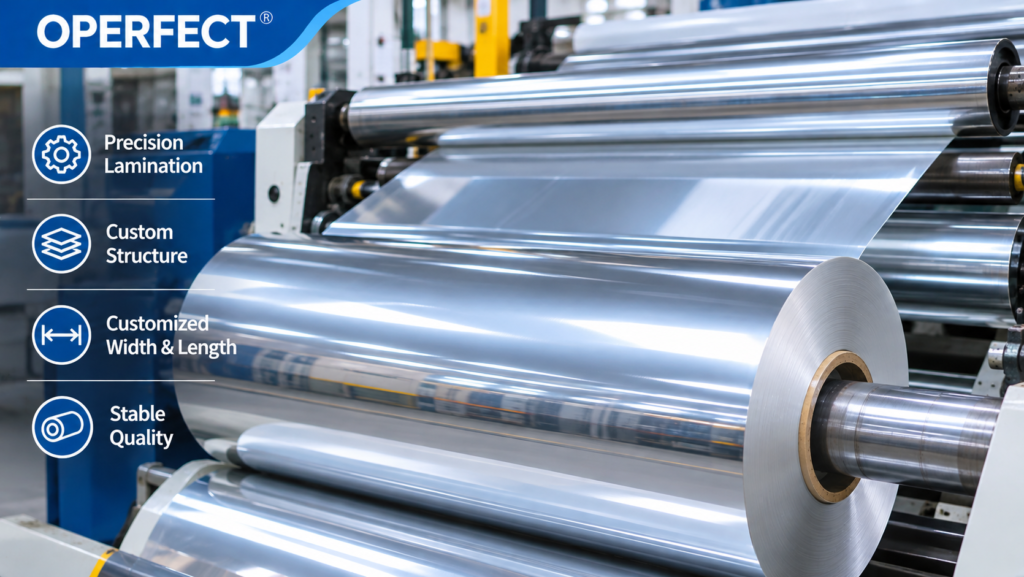
PET/PE and VMPET/PE are widely used flexible laminate structures combining different polymer films to achieve specific mechanical, sealing, appearance and barrier requirements.
PET/PE typically combines a polyethylene terephthalate (PET) film with a polyethylene (PE) layer. PET contributes dimensional stability, tensile strength and printability, while PE can provide heat-sealing functionality, flexibility and moisture resistance.
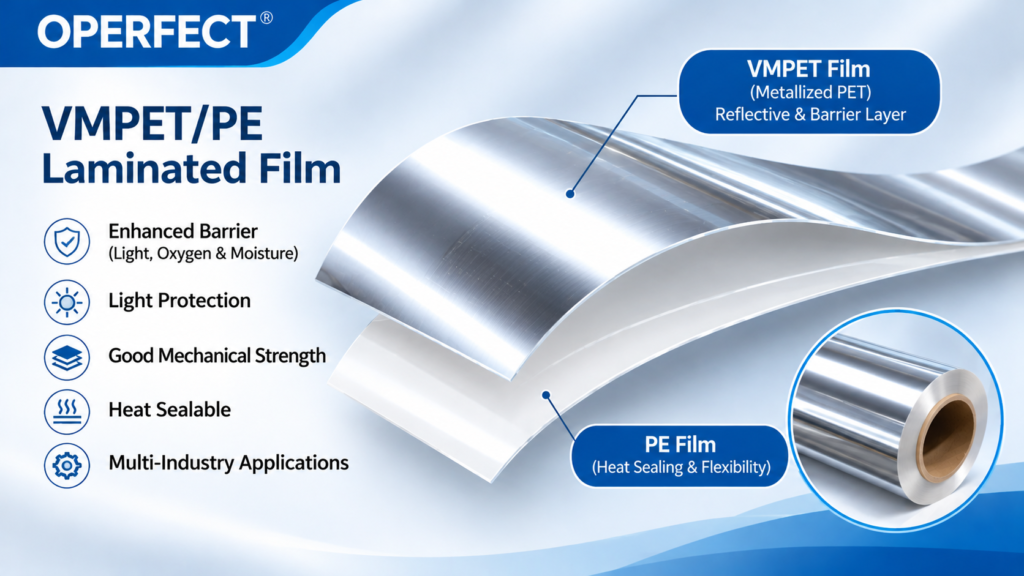
VMPET/PE combines vacuum-metallized PET film with PE. The thin deposited metal layer gives the material a metallic appearance and can improve light, oxygen and moisture barrier performance compared with an otherwise comparable non-metallized structure. Actual barrier properties depend on metallization quality, film thickness, lamination conditions and subsequent handling.
Neither structure should be selected by appearance alone. Industrial buyers need to consider the final application, converting process, required performance and material compatibility.
At OPERFECT, we support customers in identifying suitable flexible laminate structures and coordinating customized production according to their technical requirements.
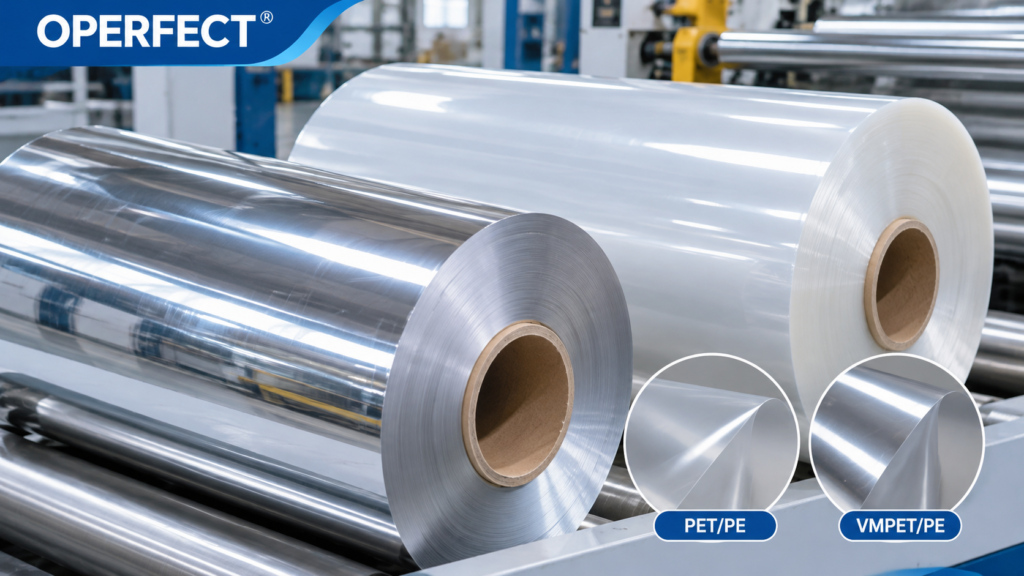
PET/PE vs. VMPET/PE: What Is the Difference?
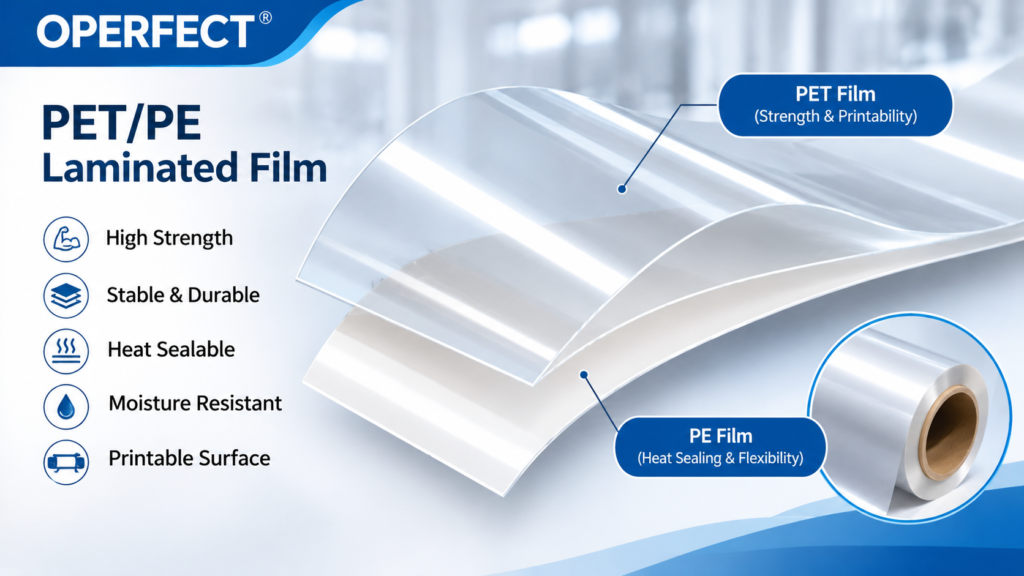
| Property | PET/PE | VMPET/PE |
|---|---|---|
| Typical construction | PET + PE | Metallized PET + PE |
| Appearance | Often transparent, translucent or printed | Typically metallic silver or printed |
| PET function | Strength, stability and printable surface | Strength and substrate for metallization |
| PE function | Sealing layer and flexibility | Sealing layer and flexibility |
| Barrier considerations | Depends on film grades and construction | Metallization may improve light and gas barrier |
| Customization | Thickness, width, printing, winding and roll size | Metallization grade, thickness, printing, winding and roll size |
These are general material characteristics rather than guaranteed specifications. A finished laminate must be evaluated against the customer’s actual performance requirements.
How to Choose the Right Laminate Structure
1. Identify the Required Function
Before choosing PET/PE or VMPET/PE, determine the material’s primary purpose.
Does the application require a printable surface, heat sealing, mechanical strength, light protection or improved moisture and oxygen barrier?
For applications requiring mainly structural stability and heat sealing, PET/PE may be a suitable starting point.
Where metallic appearance or additional barrier performance is important, VMPET/PE may be considered.
However, a metallized film is not automatically a substitute for aluminum foil. Applications requiring particularly high barrier performance should be assessed using appropriate test data and an application-specific material comparison.
2. Confirm the Thickness of Each Layer
Overall laminate thickness alone does not provide enough information.
Two materials with similar total thickness may behave differently because of their individual PET and PE layer thicknesses.
For example, increasing the PE thickness may affect sealing behavior and flexibility, while changing the PET thickness may affect stiffness and handling.
OPERFECT can review customer-provided structures, drawings or physical samples to help identify practical production options.
3. Consider Printing and Surface Appearance
A finished laminate may appear transparent, metallic silver, white or another specified color depending on its structure and surface treatment.
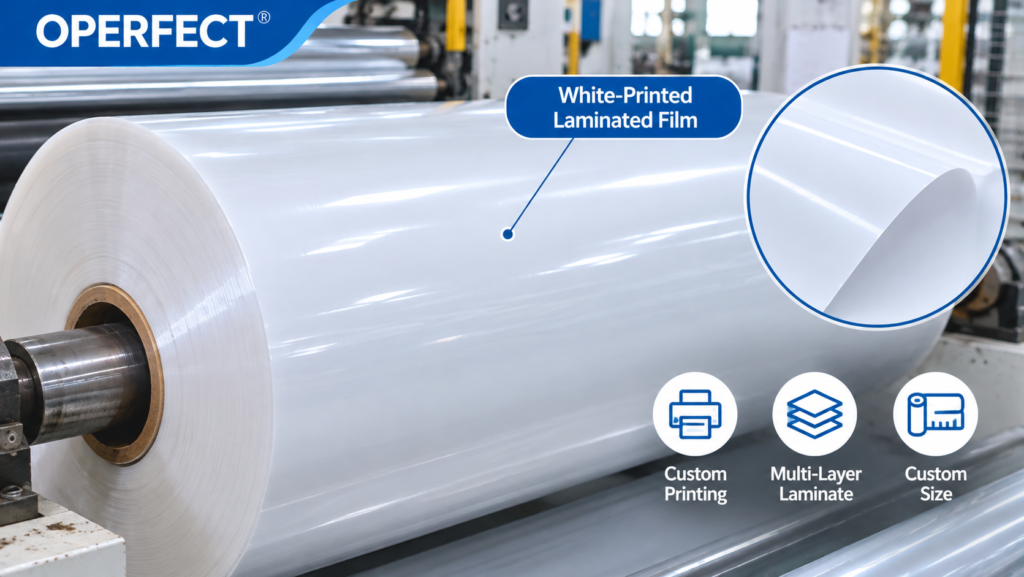
White appearance, for example, may result from printing rather than a white base film.
Buyers should clarify:
- Whether printing is required
- The intended printing surface
- Color and artwork requirements
- Whether printing will be protected within the laminate
- Surface treatment and adhesion requirements
For OEM projects, appearance should be evaluated together with technical performance.
4. Verify Heat-Sealing Requirements
PE is commonly used as a sealing layer, but sealing performance is not determined by the word “PE” alone.
Important considerations include PE grade, sealing temperature range, dwell time, pressure and compatibility with the customer’s sealing equipment.
Where heat sealing is critical, buyers should request representative samples and conduct trials under their actual production conditions.
5. Define Roll Specifications and Winding Direction
Roll configuration can be just as important as the laminate structure.
Common customization parameters include roll width, roll length, core diameter, maximum roll diameter, winding tension, printing orientation and inside/outside winding direction.
Incorrect winding orientation can create unnecessary handling problems or make a roll unsuitable for the customer’s converting equipment.
OPERFECT works with customers to confirm these details before production.
Typical Industrial and Converting Applications
Depending on the final structure and verified performance, PET/PE and VMPET/PE laminates may be evaluated for:
- Flexible packaging conversion
- Printed laminated films
- Industrial protective wrapping
- Heat-sealable film constructions
- Specialty flexible composite materials
- Customer-specific multilayer film development
These are potential application categories, not claims that every OPERFECT laminate has been tested or approved for each use.
Food-contact applications, regulated packaging and other specialized uses require appropriate material selection and supporting compliance documentation.
OEM and Custom Laminate Options
OPERFECT supports project-based customization, including:
Material structures: PET/PE, VMPET/PE and other technically feasible polymer combinations.
Layer thickness: Selected according to customer requirements and manufacturing feasibility.
Appearance: Transparent, metallic, white-printed or other agreed finishes.
Printing: Customer-specific artwork and printing arrangements, subject to production review.
Roll configuration: Customized widths, lengths, core sizes and winding direction.
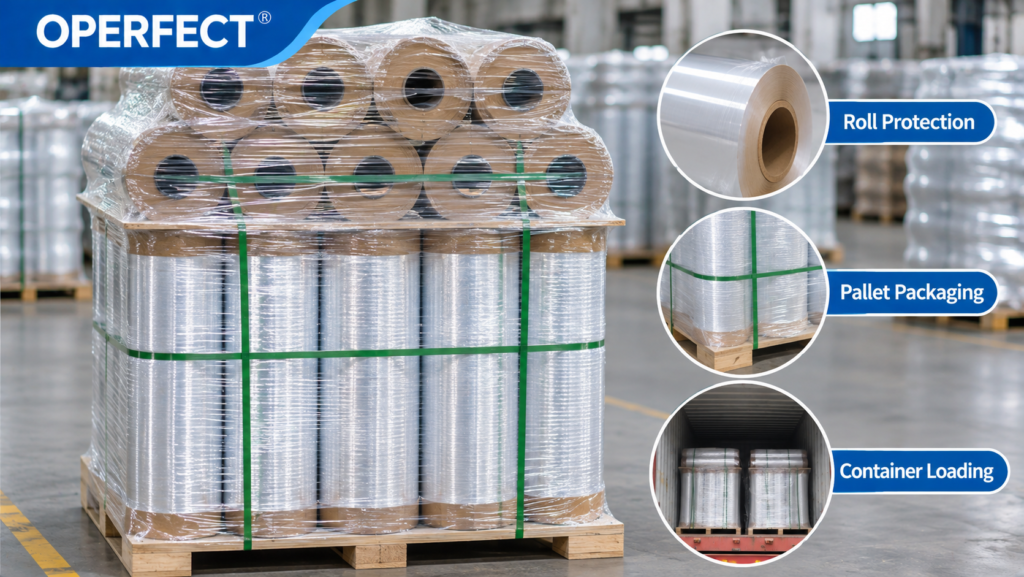
Export packaging: Roll protection, palletizing and shipment arrangements suitable for the agreed delivery conditions.
Not every combination is available in every thickness or width. Feasibility, minimum order quantities and production tolerances should be confirmed for each project.
Developing a Custom Laminate from an Existing Sample
Some industrial buyers do not have a complete technical datasheet. Instead, they have an existing film sample that performs well in their equipment.
OPERFECT can begin with that sample.
Our typical project workflow is:
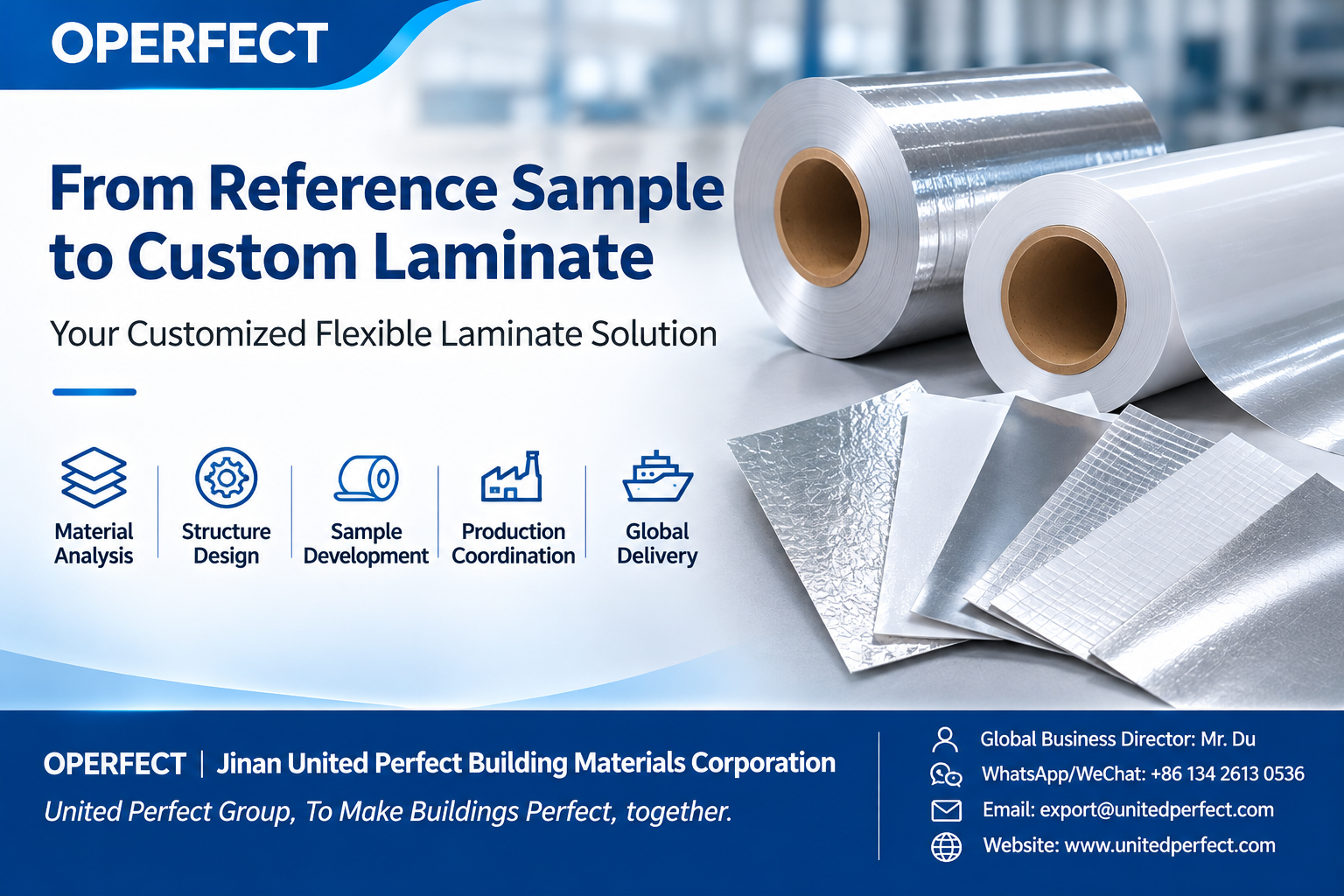
Reference sample or technical requirements → Material structure review → Production feasibility assessment → Suitable manufacturing partner selection → Sample development → Customer evaluation → Order production and export delivery.
This approach is particularly useful when a standard catalog material does not meet a customer’s dimensional, surface, processing or construction requirements.
Rather than assuming that one factory or one standard structure can solve every problem, OPERFECT evaluates available production resources against the customer’s actual requirements.
Why Work with OPERFECT?
Selecting a flexible laminate supplier involves more than comparing a price per kilogram.
Industrial buyers also need clear technical communication, reliable sample coordination, consistent roll specifications and practical export support.
OPERFECT combines experience in aluminum foil composites, flexible film structures and international sourcing to help customers develop workable material solutions.
Our value lies in understanding material requirements, coordinating suitable manufacturing resources and managing international order execution.
We support both established laminate structures and customized projects requiring additional technical evaluation.
Frequently Asked Questions
Can PET/PE laminate be customized in thickness and width?
Yes. Thickness and width can be customized within the capabilities and tolerances of the selected production process.
Is VMPET/PE the same as aluminum foil/PE?
No. VMPET uses a very thin deposited metallic layer on PET film, while aluminum foil/PE contains a separate aluminum foil layer. Their barrier characteristics, flexibility and converting behavior can differ substantially.
Can a white surface be produced on a laminate?
Yes. Depending on the construction, white appearance may be achieved through printing or other specified material choices.
Can OPERFECT develop a laminate from my existing sample?
Yes. Customers can provide physical samples or technical information for structure analysis and production feasibility evaluation.
Can you guarantee specific oxygen or moisture barrier values?
Specific barrier values must be established for the proposed material through relevant testing. They should not be assumed from the laminate name alone.
What information should I send for a quotation?
Please provide the intended structure or reference sample, layer thicknesses if known, roll width, quantity, surface requirements, winding direction and destination.
Request a Custom Laminate Quotation
Have a PET/PE, VMPET/PE or other flexible laminate requirement?
Send OPERFECT your material structure, technical drawing or existing sample. Our team can help evaluate production feasibility, customization options and export supply arrangements.
OPERFECT | Jinan United Perfect Building Materials Corporation
United Perfect Group — To Make Buildings Perfect, together.
Contact Our Global Team
Global Business Director: Mr. Du
WhatsApp/WeChat: +86 134 2613 0536
电子邮件: export@unitedperfect.com
Official Website: www.unitedperfect.com