Discover how fiberglass, polyester and other scrim reinforcements improve the strength, tear resistance and stability of aluminum foil laminates.
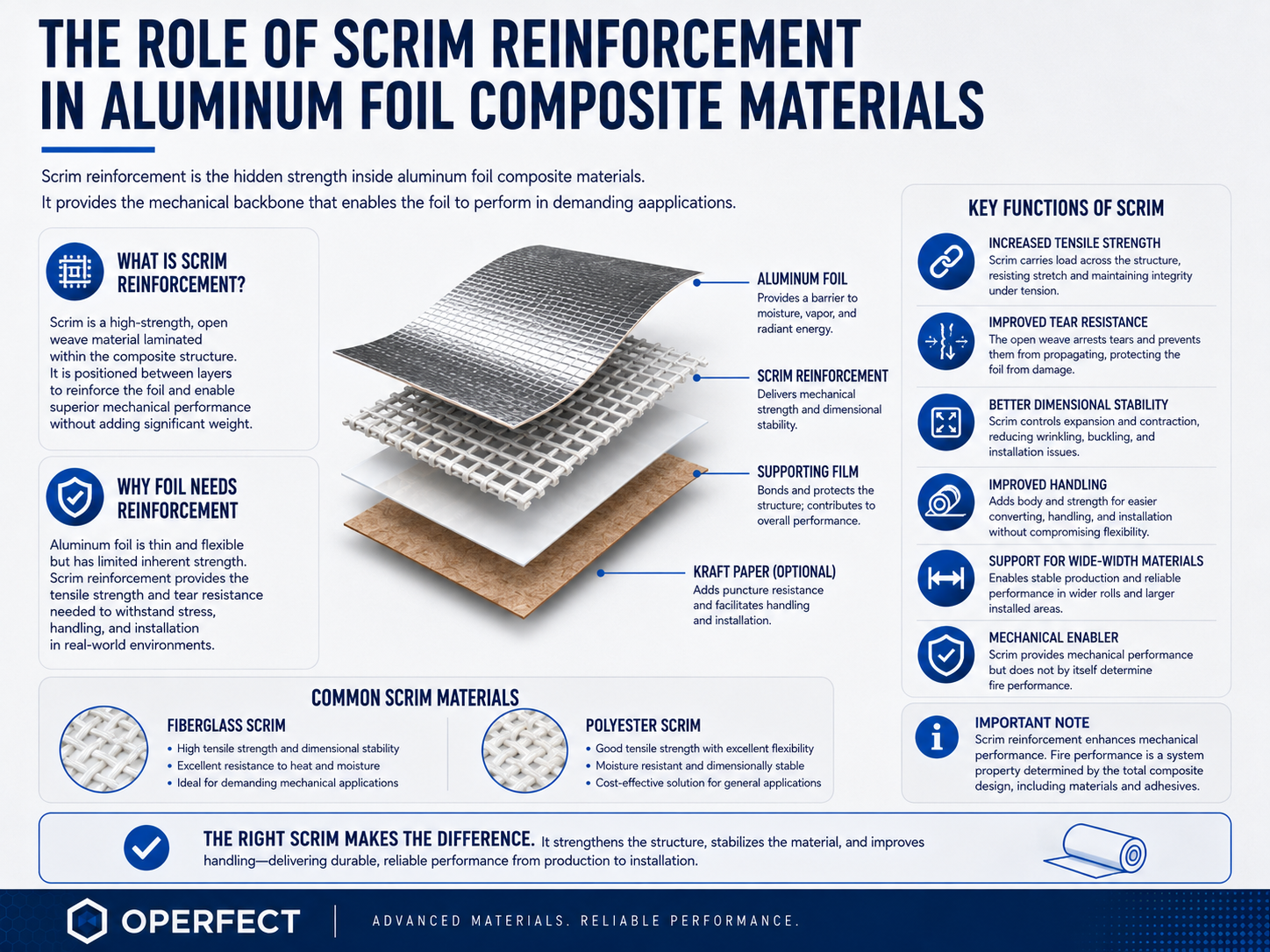
Scrim reinforcement is an important component in many aluminum foil composite materials.
A scrim is a lightweight open-grid structure placed between layers of foil, paper, film or other substrates. It is not normally used as the exposed surface. Instead, it acts as an internal reinforcement that improves the mechanical stability of the complete laminate.
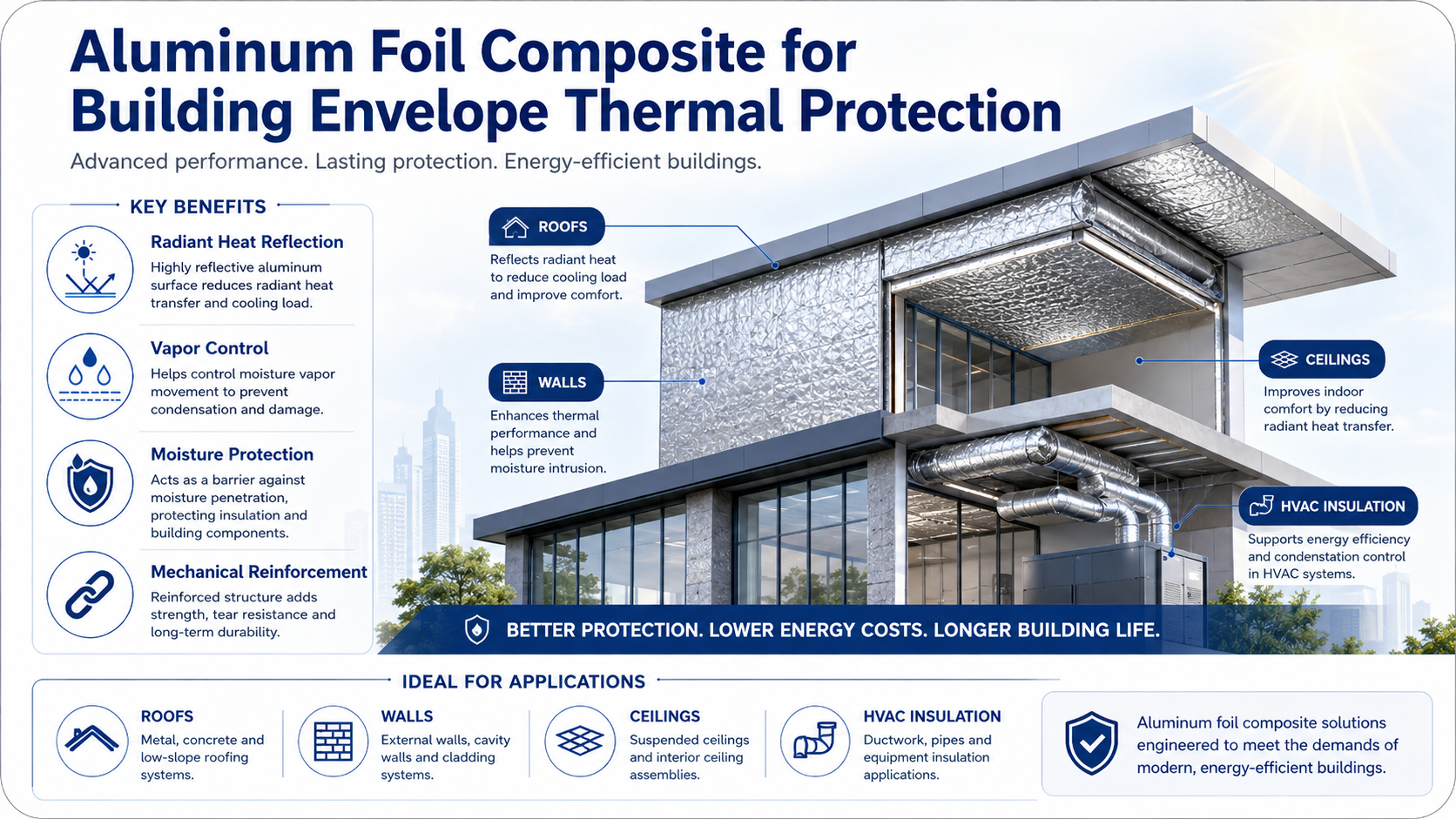
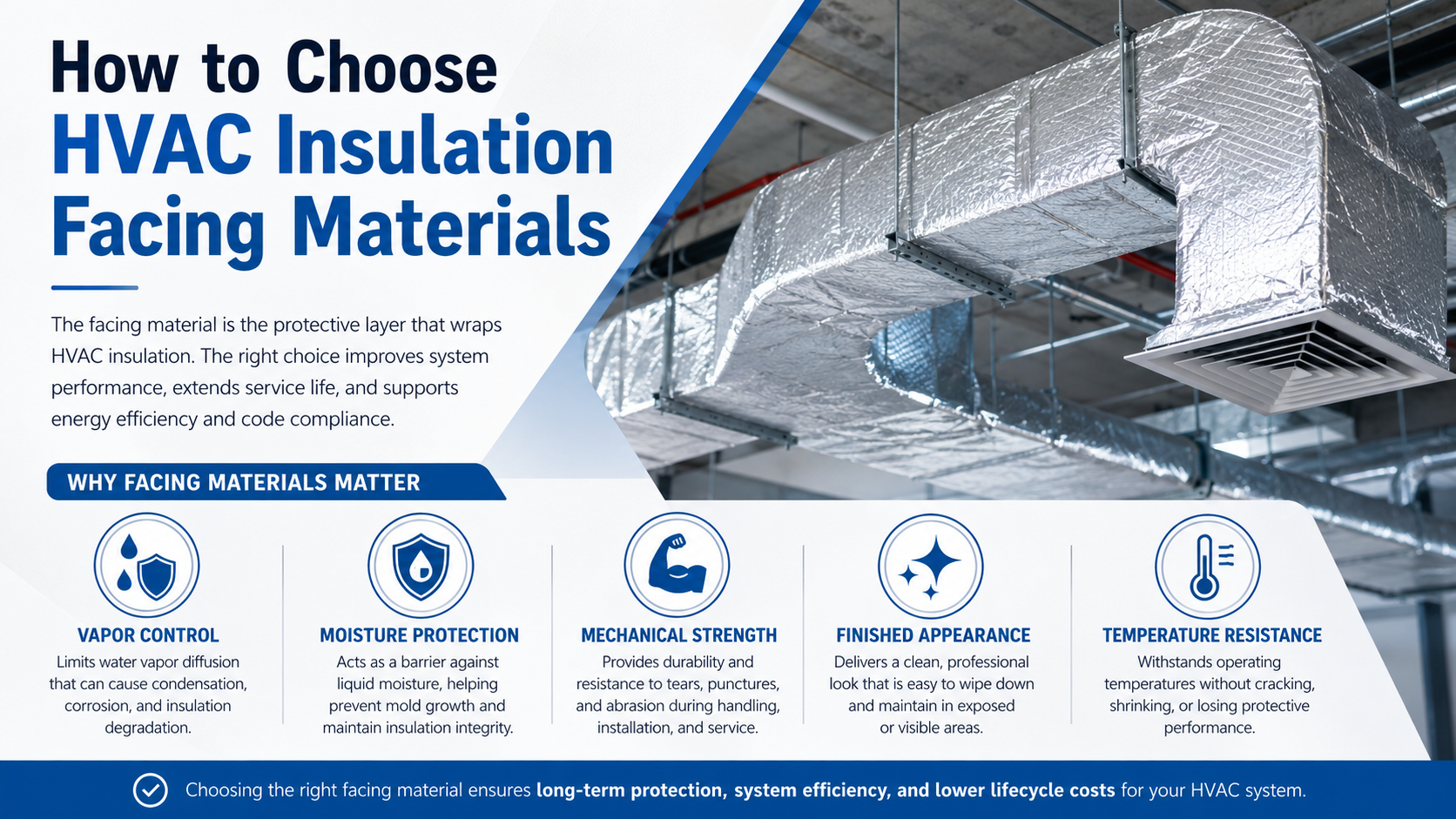
Scrim is commonly found in FSK facings, foil-scrim vapor barriers, HVAC facings, reinforced insulation laminates and industrial thermal-protection materials.
Why Aluminum Foil Needs Reinforcement
Aluminum foil provides excellent reflective and barrier properties, but thin foil has limited resistance to tearing, puncturing and repeated handling.
During production and installation, foil facing may be exposed to:
- Web tension
- Rewinding
- Slitting
- Folding
- Creasing
- Stapling
- Cutting
- Fastening
- Transportation
- On-site handling
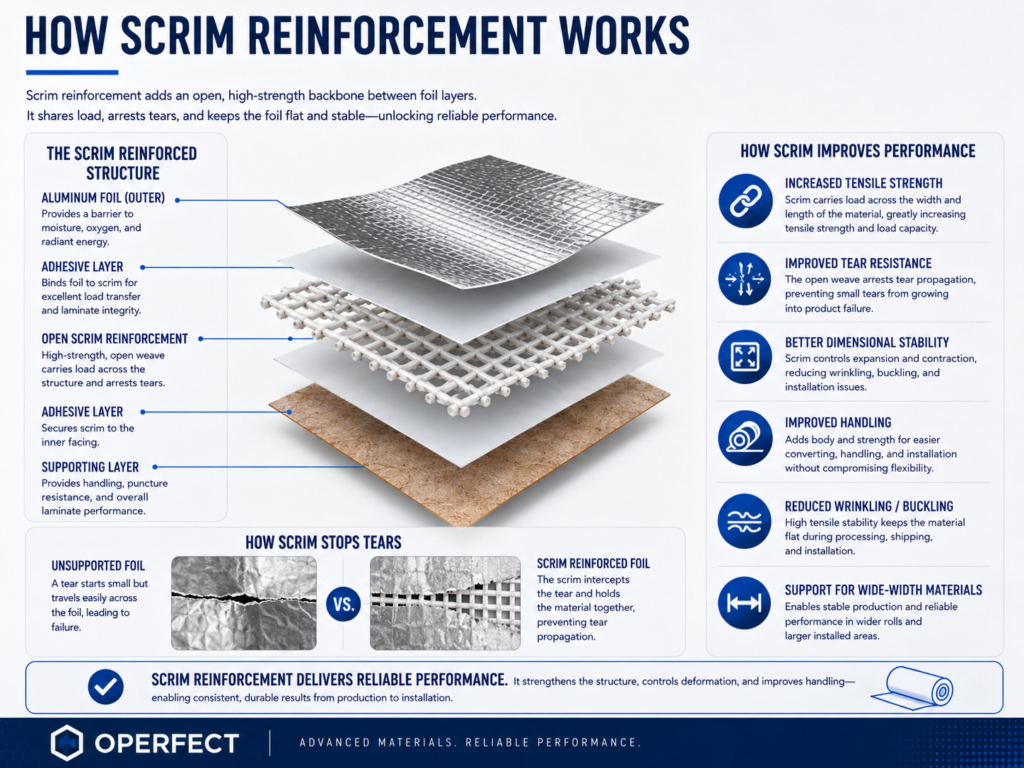
A small cut in unsupported foil may easily spread into a longer tear.
Scrim helps distribute stress over a wider area and limits the propagation of damage.
What Is Scrim?
Scrim is an open mesh made from intersecting yarns.
Depending on the required performance, the yarn may be made from:
- 玻璃纤维
- Polyester
- Polyethylene
- Polypropylene
- Other synthetic fibers
The yarns may be bonded at their intersections using adhesive or another binding method.
Because the structure is open, scrim can add strength without creating a heavy or rigid layer.
Main Functions of Scrim Reinforcement
Increased Tensile Strength
Tensile strength refers to the resistance of a material to being pulled apart.
The reinforcing yarns carry part of the load applied to the composite and help the material withstand tension during converting and installation.
Improved Tear Resistance
Scrim helps prevent a cut or puncture from spreading across the entire facing.
When a tear reaches a reinforcing yarn, the yarn can slow or redirect the tear.
Better Dimensional Stability
Scrim helps the laminate maintain its shape under tension, temperature changes and handling.
This is useful during high-speed lamination, slitting and rewinding.
Improved Handling
Reinforced foil facing is generally easier to handle than unsupported foil.
It can be lifted, positioned, folded and installed with a lower risk of immediate damage.
Support for Wide-Width Materials
Wide rolls place greater demands on web stability and tension control.
Scrim reinforcement can support more stable processing and reduce distortion across the roll width.
Fiberglass Scrim
Fiberglass scrim is commonly used in insulation facings.
Advantages may include:
- Good tensile strength
- Dimensional stability
- Low elongation
- Heat resistance
- Compatibility with foil and kraft structures
- Suitability for industrial insulation applications
Fiberglass yarn does not stretch as much as many polymer yarns, which can help maintain dimensional stability.
However, scrim performance depends on yarn quality, grid design and bonding consistency.
Polyester Scrim
Polyester scrim offers good flexibility and tensile strength.
Compared with fiberglass, it may provide:
- Greater flexibility
- Different elongation behavior
- Good resistance to repeated bending
- Compatibility with polymer-film laminates
The choice between fiberglass and polyester should depend on the required balance of rigidity, flexibility, temperature resistance and processing behavior.
Scrim Pattern and Grid Size
Not all scrims use the same pattern.
Important variables include:
- Yarn count
- Yarn thickness
- Grid spacing
- Machine-direction reinforcement
- Cross-direction reinforcement
- Diagonal reinforcement
- Adhesive pickup
- Intersection bonding
A tighter grid generally provides more reinforcement points but may increase weight and cost.
A wider grid may be sufficient for lightweight facings where only moderate tear resistance is required.
Some scrims contain yarns in two directions, while others include diagonal reinforcement to improve multidirectional stability.
Machine Direction and Cross Direction
Rolled materials behave differently in the machine direction and cross direction.
The machine direction follows the length of the roll. The cross direction runs across the roll width.
A laminate may have high strength in one direction but lower strength in the other. Scrim design should therefore be matched to:
- Production tension
- Roll width
- Installation method
- Fastener direction
- Expected mechanical load
Balanced reinforcement is important when the material may be pulled or stressed from multiple directions.
Scrim in FSK Facing
FSK is commonly understood as foil-scrim-kraft facing.
Each layer performs a different function:
- Foil provides reflection and vapor resistance.
- Scrim provides reinforcement.
- Kraft paper provides backing, stiffness and support.
Without scrim, a foil-kraft laminate may still be usable, but it will normally have lower tear and tensile performance.
Scrim is therefore particularly valuable for large insulation blankets, duct wrap, metal-building insulation and materials that require stronger handling performance.
Scrim in Foil-PE Laminates
Scrim can also be laminated between aluminum foil and polyethylene film.
This type of structure may provide:
- Moisture resistance
- Flexibility
- Reinforcement
- Vapor-control performance
- Heat-sealing capability, depending on the film
It is useful when paper is not preferred because of humidity, moisture exposure or production requirements.
Scrim Does Not Automatically Determine Fire Performance
A reinforced laminate is not necessarily a fire-resistant laminate.
Fire performance depends on the complete product, including:
- Foil
- Yarn
- Paper
- Film
- Adhesive
- Coating
- Total material weight
If fire performance is required, the full composite should be tested according to the relevant standard.
Changing the scrim, adhesive or backing may affect the test result.
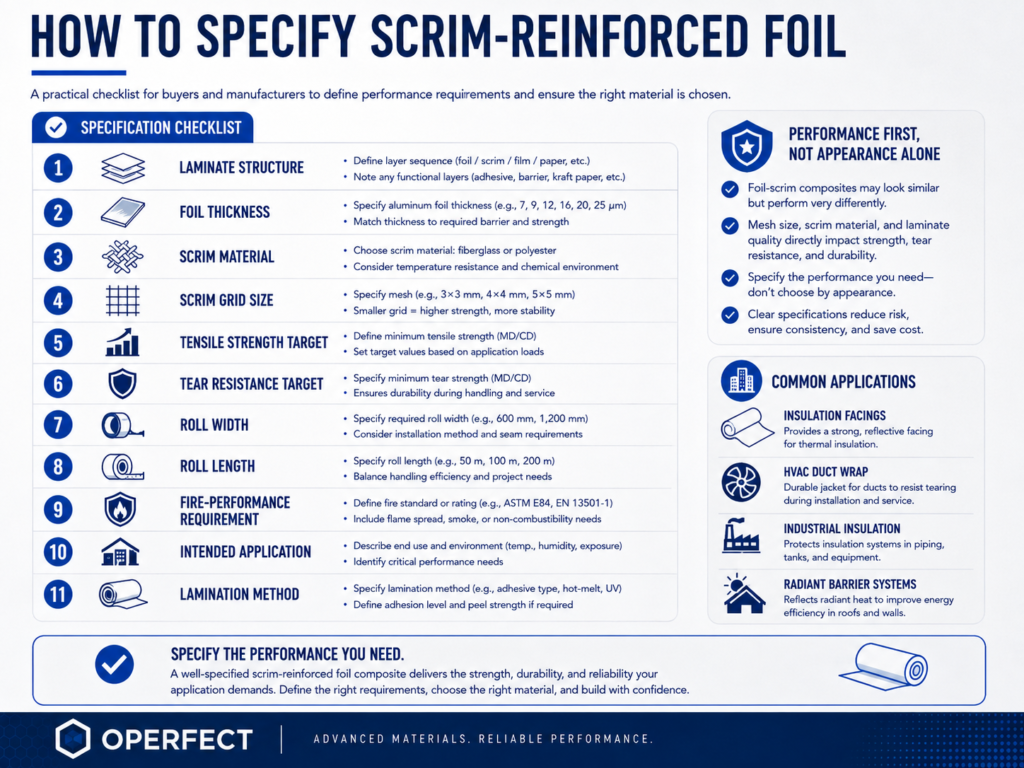
How to Specify Scrim-Reinforced Foil
When requesting a reinforced foil composite, buyers should provide:
- Required laminate structure
- Total basis weight
- Foil thickness
- Scrim material
- Scrim grid size
- Required tensile strength
- Required tear strength
- Roll width and length
- Fire-performance requirements
- Intended application
- Lamination method
It is better to specify the required performance than to select a scrim only by visual appearance.
Conclusion
Scrim reinforcement improves the mechanical reliability of aluminum foil composite materials.
It supports tensile strength, tear resistance, dimensional stability and handling performance while adding relatively little thickness.
The correct scrim should be selected according to the laminate structure, roll width, production process and installation conditions.
OPERFECT® offers aluminum foil laminates reinforced with fiberglass scrim, woven reinforcement and other supporting materials for insulation, HVAC and industrial thermal-protection applications.