Best House Wrap for Cold Climates
A Complete Buyer’s Guide for Builders, Contractors & Building Material Distributors
Category: Buyer’s Guide
Focus Keyword: Best House Wrap for Cold Climates
URL Slug: /buyers-guide/best-house-wrap-for-cold-climates
Meta Title
Best House Wrap for Cold Climates | Complete Buyer’s Guide | OPERFECT
Meta Description
Discover how to choose the best house wrap for cold climates. Learn which WRB performs best in snow, freezing temperatures, and high-moisture environments while improving energy efficiency and long-term building durability.
Best House Wrap for Cold Climates
Quick Answer
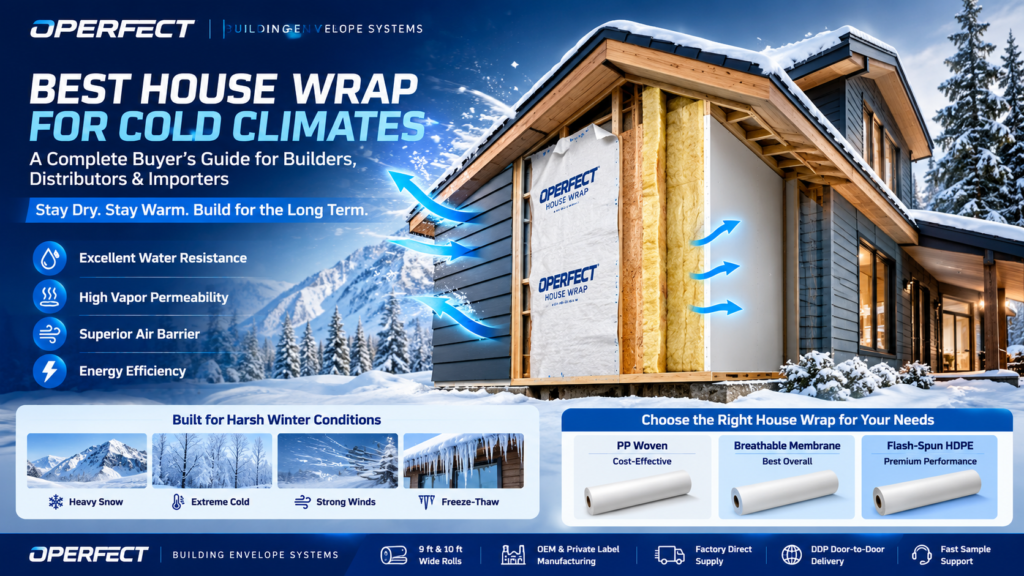
The best House Wrap for cold climates should provide excellent water resistance, high vapor permeability, superior air barrier performance, and long-term durability. In regions such as Canada, the northern United States, and Northern Europe, a breathable Weather-Resistive Barrier (WRB) helps walls stay dry while reducing condensation and improving energy efficiency.
Selecting the right House Wrap is not simply about stopping rain—it’s about effectively managing moisture throughout the entire building envelope.
Key Takeaways
- Cold climates require House Wraps that resist water while allowing walls to dry.
- Breathability is essential for reducing condensation inside wall assemblies.
- Air leakage significantly impacts energy efficiency in cold regions.
- High-performance WRBs help extend building life and reduce maintenance costs.
- Climate, building design, and local codes should all influence product selection.
Why Cold Climates Require Special House Wraps
Cold-weather buildings face challenges that are rarely encountered in warm climates.
Typical conditions include:
- Snow accumulation
- Ice dams
- Freeze-thaw cycles
- Wind-driven rain
- Large indoor-outdoor temperature differences
- Long heating seasons
These conditions increase the risk of condensation inside wall assemblies.
If moisture becomes trapped, it may lead to mold growth, wood decay, insulation failure, and higher energy consumption.
What Makes a Good House Wrap for Cold Climates?
A high-performance House Wrap should provide four key functions.
1. Excellent Water Resistance
Rain and melting snow must remain outside the wall assembly.
An effective WRB prevents liquid water from reaching structural components while maintaining long-term durability.
2. High Vapor Permeability
Walls must be able to dry naturally.
Breathable House Wrap allows moisture vapor to escape while preventing water intrusion.
This balance is critical for reducing condensation in cold climates.
3. Effective Air Barrier Performance
Cold air infiltration increases heating costs.
When properly installed and sealed, House Wrap helps reduce uncontrolled air leakage, improving indoor comfort and building efficiency.
4. Long-Term Durability
Cold climates expose buildings to UV exposure during construction, temperature fluctuations, wind, and snow loads.
Choose products tested for long-term weather resistance and dimensional stability.
Which House Wrap Performs Best?
Different projects require different levels of performance.
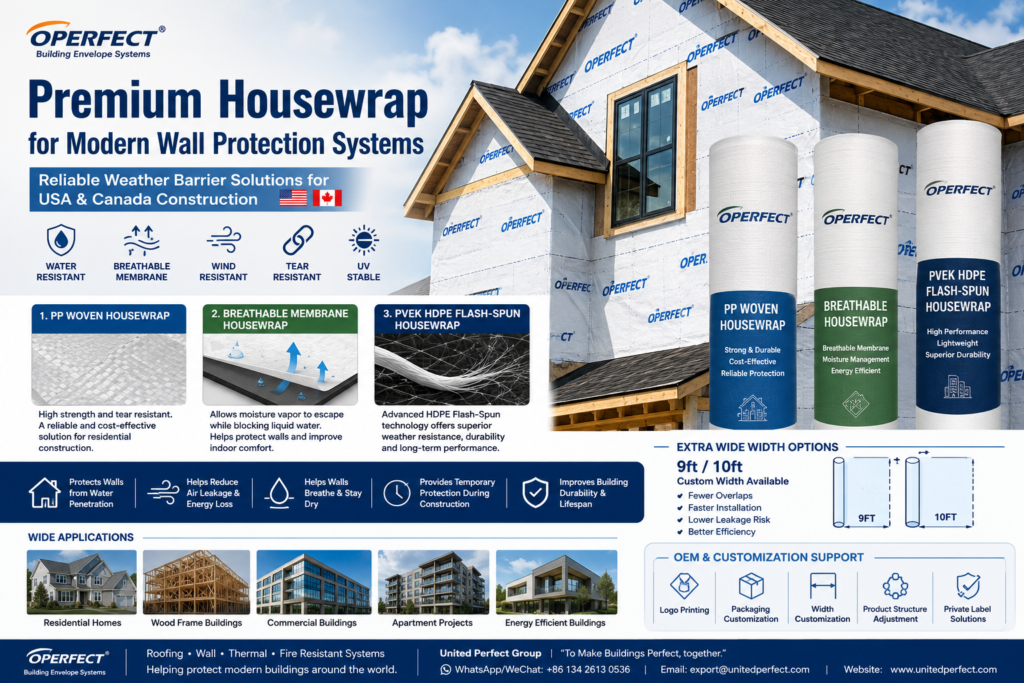
| Product Type | Recommended Application | Performance |
|---|---|---|
| PP Woven House Wrap | Budget residential projects | ★★★☆☆ |
| Breathable Membrane House Wrap | Most residential and commercial buildings | ★★★★★ |
| Flash-Spun HDPE House Wrap | Premium energy-efficient construction | ★★★★★ |
For high-performance buildings, breathable membrane and Flash-Spun HDPE products generally provide better moisture management and durability.
Common Mistakes When Choosing House Wrap
Many buyers focus only on price.
However, selecting the wrong product can lead to higher long-term costs.
Common mistakes include:
- Choosing non-breathable materials
- Ignoring local climate conditions
- Focusing only on water resistance
- Overlooking air leakage performance
- Selecting products without technical testing or certification
A lower purchase price may result in significantly higher maintenance costs over the building’s lifetime.
Recommended Applications
High-performance House Wrap is widely used in:
- Residential homes
- Timber frame construction
- Light commercial buildings
- Multi-family housing
- Passive House projects
- Energy-efficient buildings
These projects benefit from improved moisture management and reduced energy consumption.
Buyer Checklist
Before purchasing House Wrap for cold climates, ask:
✔ Does the product combine water resistance with high vapor permeability?
✔ Is it suitable for cold-weather construction?
✔ Has it been tested for long-term durability?
✔ Does it comply with local building requirements?
✔ Can the supplier provide technical documentation?
✔ Is OEM or private-label production available?
Why Choose OPERFECT?
OPERFECT provides complete Building Envelope Protection Systems designed for modern construction.
Our House Wrap solutions include:
- PP Woven House Wrap
- Breathable Membrane House Wrap
- Flash-Spun HDPE House Wrap
Why global buyers choose OPERFECT:
- 9 ft & 10 ft wide rolls available
- OEM & Private Label Manufacturing
- Factory Direct Supply
- DDP Door-to-Door Shipping
- Fast Sample Support
- Professional Export Experience
Whether you are supplying residential builders, distributors, or private-label brands, OPERFECT offers reliable solutions tailored to different climate zones and project requirements.
Frequently Asked Questions
Why is breathable House Wrap important in cold climates?
Because moisture trapped inside wall assemblies can condense when warm indoor air meets cold exterior surfaces. A breathable WRB allows moisture vapor to escape while preventing liquid water intrusion.
Can House Wrap improve energy efficiency?
Yes. When properly installed, House Wrap helps reduce uncontrolled air leakage, improving insulation performance and lowering heating costs.
Is Flash-Spun HDPE better than PP Woven House Wrap?
Flash-Spun HDPE generally offers higher durability, better weather resistance, and superior long-term performance, making it ideal for premium building envelope systems.
Does House Wrap replace insulation?
No. House Wrap is designed to manage water and air. It complements insulation but does not replace it.
How wide should House Wrap rolls be?
Wider rolls, such as 9 ft and 10 ft, reduce seams, improve installation efficiency, and minimize potential leakage points.
How do I choose the right House Wrap?
Consider climate, building type, vapor permeability, water resistance, installation efficiency, and supplier reliability—not just price.
Related Articles
- What Is a Building Envelope?
- Why Moisture Management Matters
- WRB vs. Vapor Barrier: What’s the Difference?
- How to Choose the Right House Wrap for Your Project
- Best House Wrap for Canada
Contact OPERFECT
United Perfect Group,To Make Buildings Perfect, together.
Global Business Director: Mr. Du
WhatsApp / WeChat: +86 134 2613 0536
电子邮件: export@unitedperfect.com
Products:House wrap – Manufacturer of foil lamination, Roofing & walling, Insulation & acoustic, Fiberglass .