Understand the layers used in aluminum foil laminates, including foil, scrim, kraft paper, PE and PET, and learn how each layer affects performance.
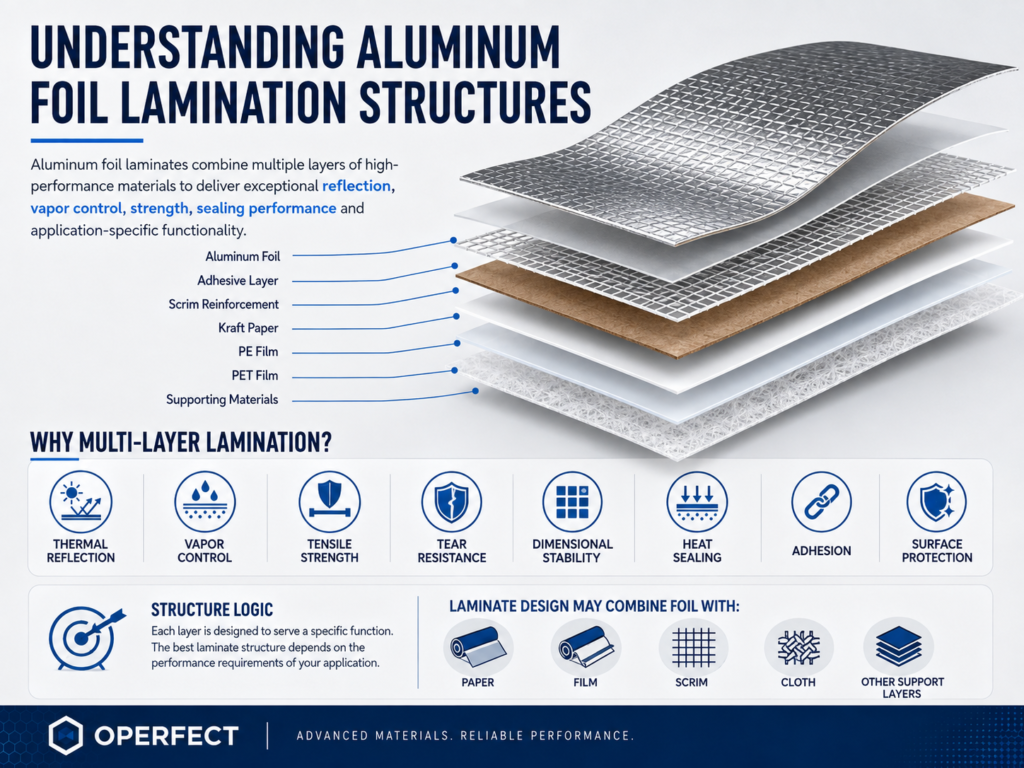
Aluminum foil lamination structures are designed by combining multiple materials into one functional composite. Each layer has a specific role, such as thermal reflection, vapor control, mechanical reinforcement, adhesion, heat sealing or surface protection.
Two aluminum foil laminates may look similar from the outside but perform very differently because of their internal structures. Understanding the function of each layer is therefore important when selecting insulation facing materials.
The Logic Behind Multi-Layer Lamination
A single material rarely provides every property required by an insulation system.
Aluminum foil offers good reflective and vapor-barrier properties, but thin foil has limited mechanical strength. Kraft paper provides stiffness but is sensitive to moisture. Polyethylene offers moisture resistance and sealing performance but does not provide the same thermal reflection as aluminum.
By laminating these materials together, manufacturers can combine their advantages.
A laminate may be designed to provide:
- Reflective thermal performance
- Moisture-vapor resistance
- Tensile strength
- Tear resistance
- Puncture resistance
- Dimensional stability
- Heat-sealing capability
- Adhesion to insulation
- Fire-performance support
- Printable surface appearance
The number of layers is less important than the function of each layer.
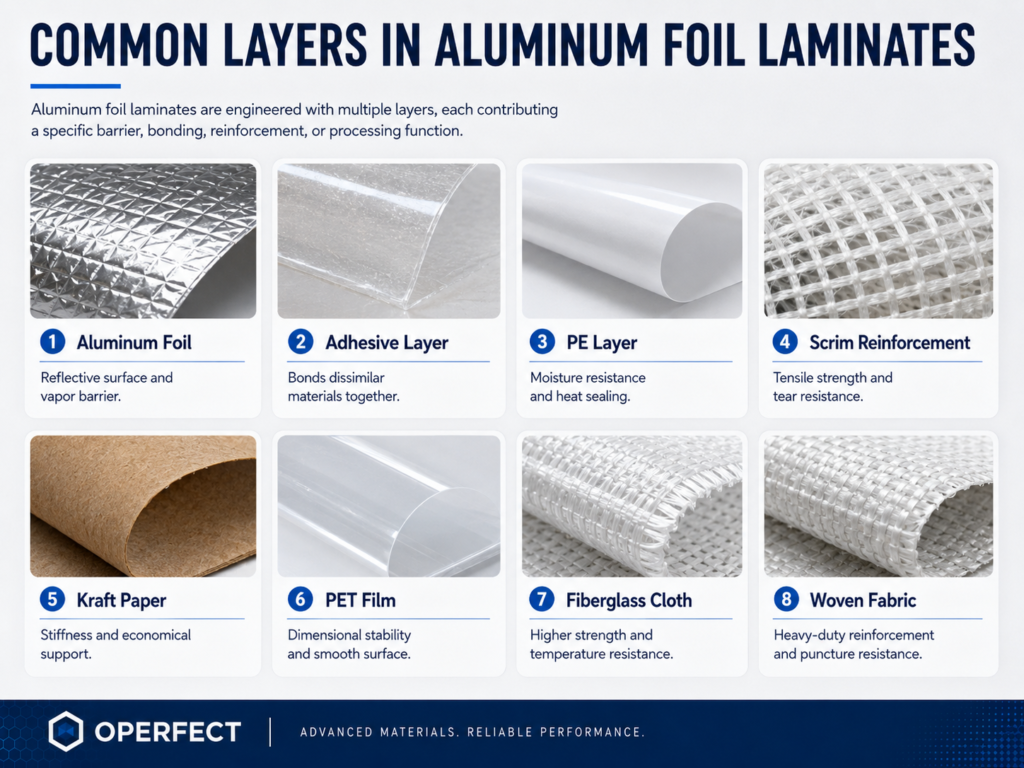
Common Layers in Aluminum Foil Laminates
1. Aluminum Foil
Aluminum foil is generally used as the outer functional layer.
Its main functions include:
- Reflecting radiant heat
- Reducing water-vapor transmission
- Providing a clean metallic surface
- Protecting underlying materials
- Supporting printing or embossing
Foil thickness should be selected according to the required durability and processing conditions.
A heavier foil is usually stronger and more resistant to pinholes, but it also increases material cost.
2. Adhesive Layer
Adhesive is used to bond aluminum foil to paper, film, cloth or scrim.
The adhesive system affects:
- Bond strength
- Temperature resistance
- Aging performance
- Flexibility
- Moisture resistance
- Fire behavior
- Resistance to delamination
Adhesive selection must match both the substrate and the intended operating environment.
3. Polyethylene Layer
Polyethylene may be used as:
- A bonding layer
- A moisture-resistant layer
- A heat-sealing layer
- A flexible film backing
- A protective coating
PE extrusion lamination can bond several materials while creating a continuous polymer layer. PE may also help reduce water-vapor transmission through paper-based structures.
4. Reinforcing Scrim
Scrim is an open-grid reinforcement inserted between other layers.
Common scrim materials include:
- Fiberglass yarn
- Polyester yarn
- Polyethylene yarn
- Woven reinforcement
Scrim improves tensile strength and helps prevent a small tear from spreading across the facing.
Scrim pattern, yarn type and grid spacing affect the final strength and appearance.
5. Kraft Paper
Kraft paper is commonly used as a backing layer in insulation facings.
It provides:
- Stiffness
- Dimensional support
- Economical reinforcement
- Good converting performance
- A suitable surface for adhesive application
Because paper can absorb moisture, it is often protected by aluminum foil, PE or another barrier layer.
6. PET Film
PET film provides:
- Smooth surface quality
- Good dimensional stability
- Higher temperature resistance than many PE films
- Good tensile performance
- Compatibility with metallization and printing
It is often used in technical composites that require a stable, thin polymer layer.
7. Fiberglass Cloth or Woven Fabric
Fiberglass cloth and woven fabrics are used when higher mechanical strength is required.
These reinforcements can improve:
- Tear resistance
- Puncture resistance
- Handling strength
- Long-term dimensional stability
- Performance in industrial environments
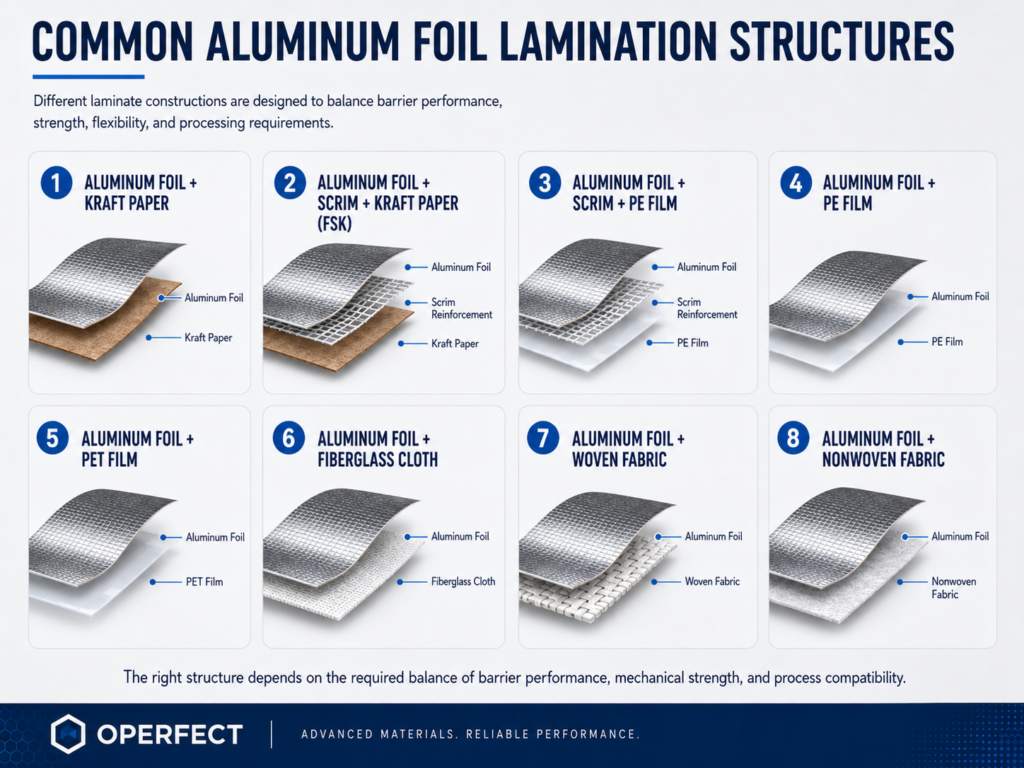
Common Aluminum Foil Lamination Structures
Foil + Kraft Paper
This is a relatively simple and economical structure.
It is suitable for applications where moderate strength and vapor protection are required.
Foil + Scrim + Kraft Paper
This structure is commonly known as FSK facing.
The foil provides reflection and vapor resistance, the scrim provides reinforcement, and the kraft paper provides stiffness and support.
Foil + Scrim + PE Film
This structure replaces paper with a polymer backing.
It is suitable where better moisture resistance, flexibility or heat-sealing performance is required.
Foil + Fiberglass Cloth
This structure offers higher strength and temperature resistance.
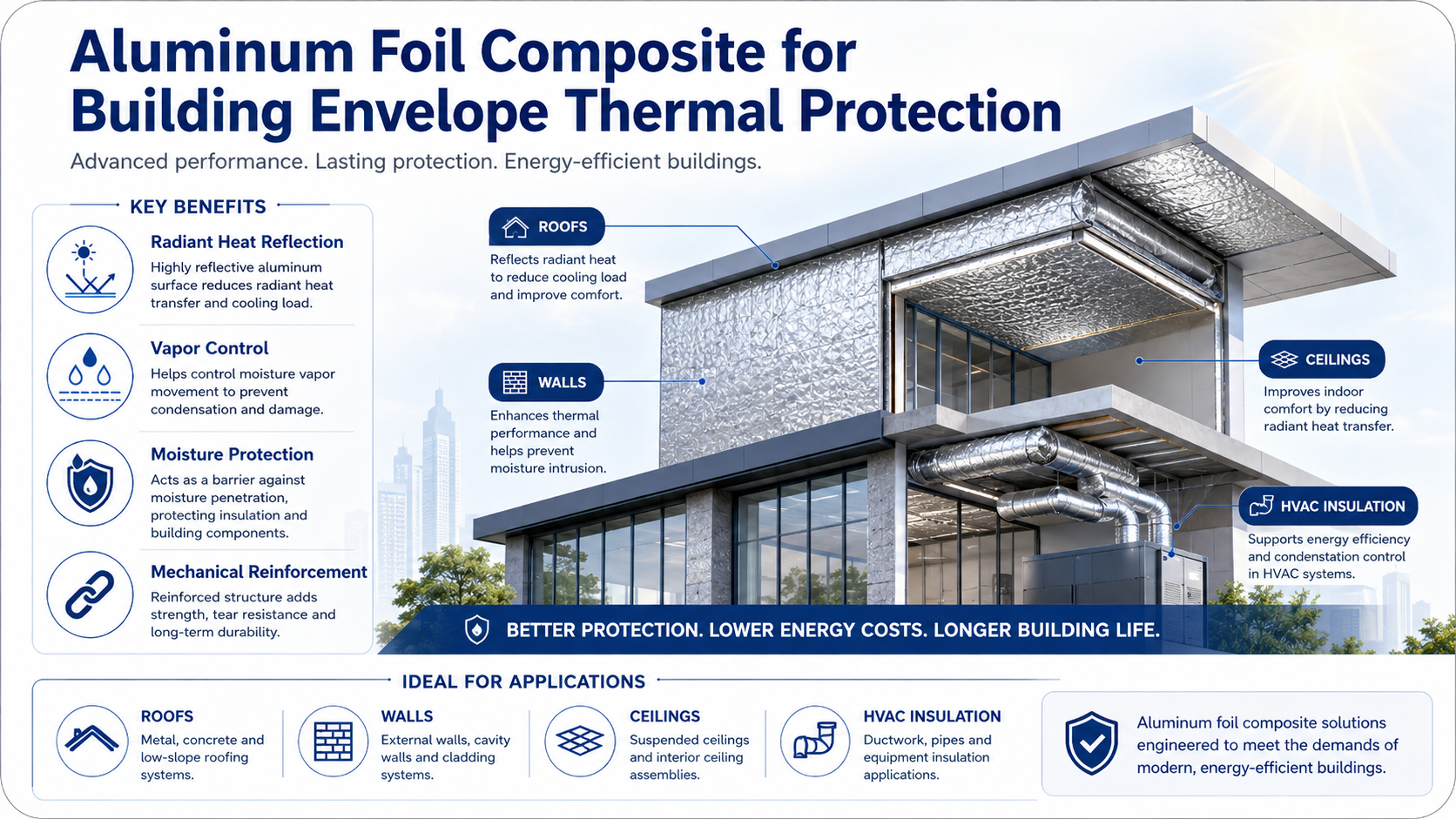
It is commonly used in HVAC, industrial insulation and demanding thermal applications.
Foil + Woven Fabric
Woven-backed foil laminates are designed for heavy-duty handling, roofing or industrial protection.
Foil + PET Film
This structure provides a smooth, dimensionally stable composite suitable for technical insulation or vapor-control applications.
Foil + Nonwoven Fabric
Nonwoven-backed foil may be selected for flexibility, surface protection, bonding compatibility or specific installation requirements.
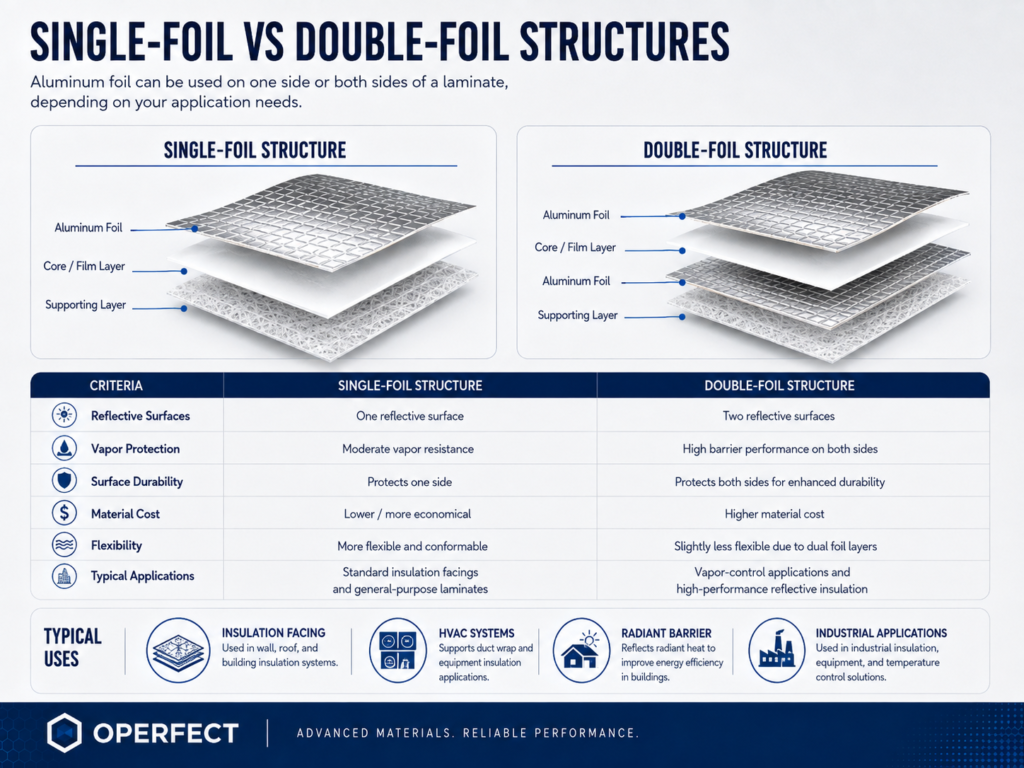
Single-Foil and Double-Foil Structures
A single-foil structure has aluminum foil on one side.
It is suitable when only one exposed reflective or vapor-control surface is needed.
A double-foil structure contains aluminum foil on both sides of the reinforcement or core material.
Potential advantages include:
- Two reflective surfaces
- Improved surface protection
- Better moisture resistance from both directions
- Greater durability in some applications
However, double foil is not automatically necessary for every project. The correct choice depends on installation method, exposure and cost requirements.
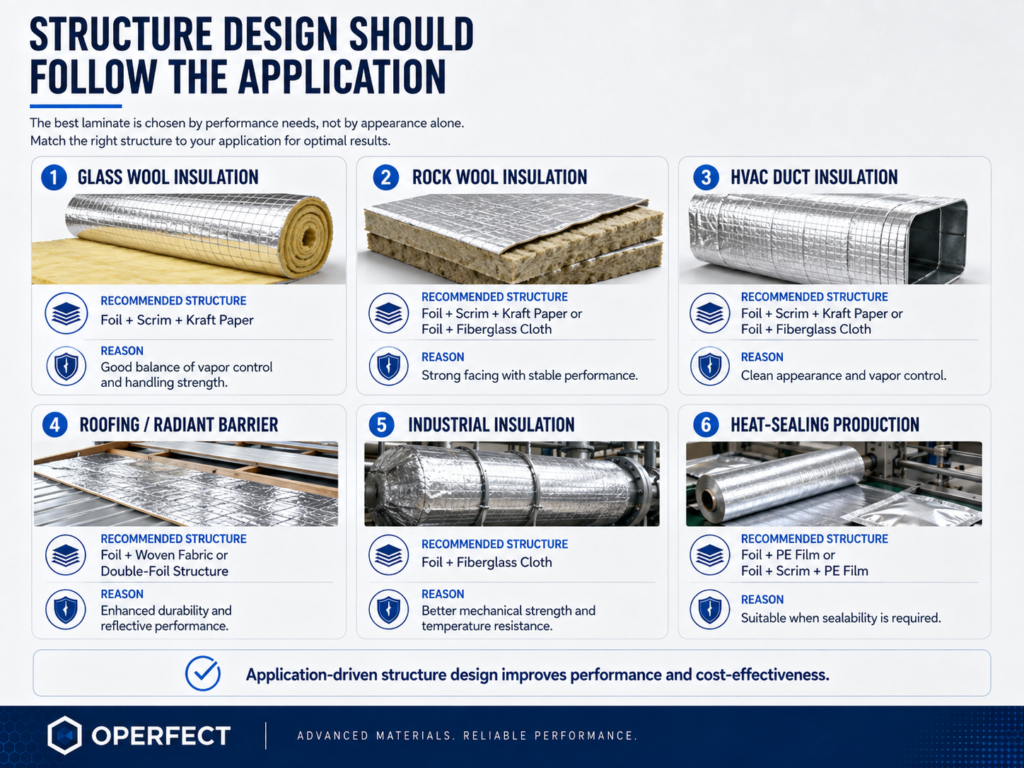
Structure Design Should Follow the Application
The best laminate should be designed around the actual application.
For example:
- Glass wool manufacturers may require good bonding and roll-processing performance.
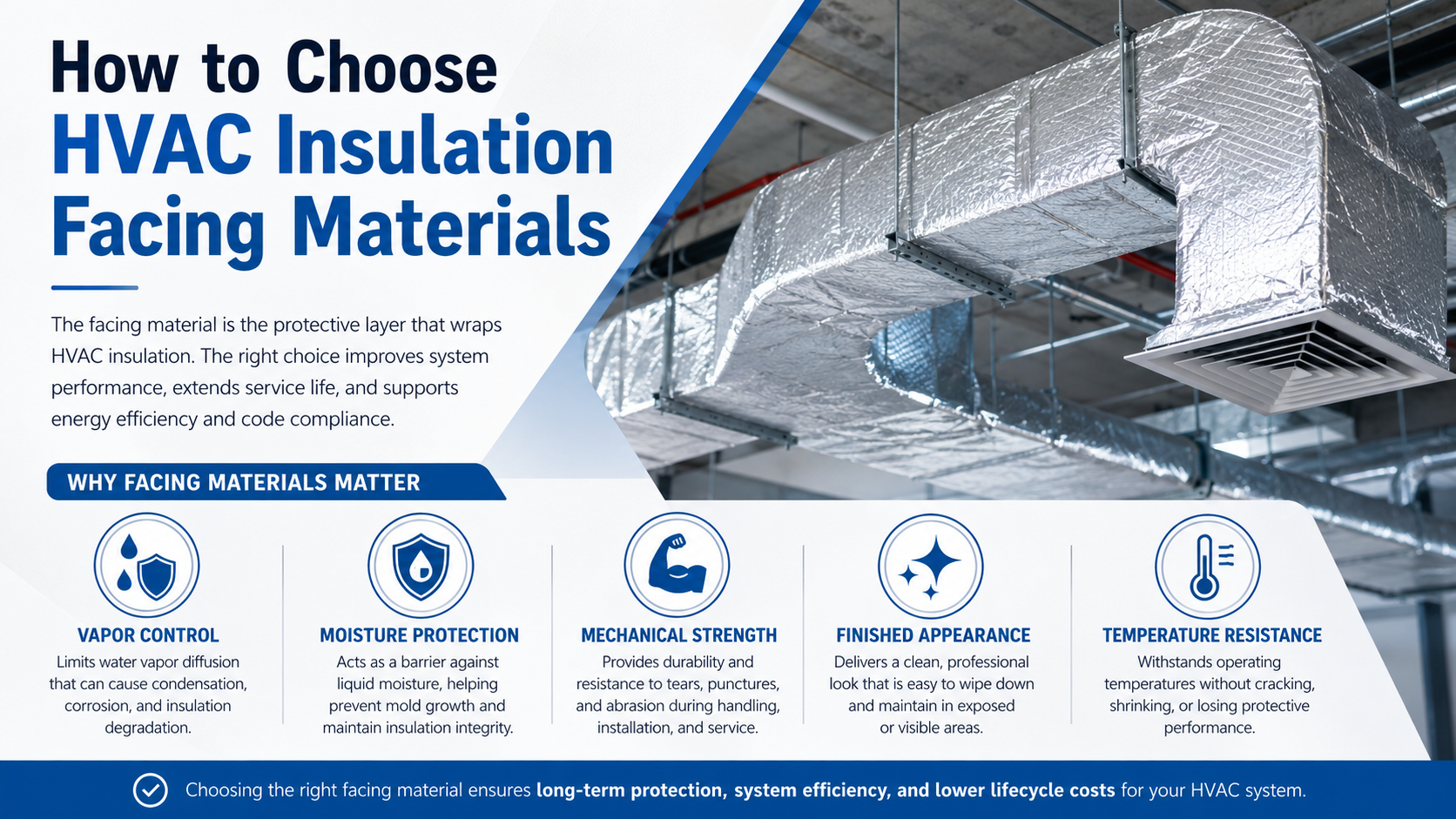
- HVAC insulation may require clean appearance, vapor control and fire-performance support.
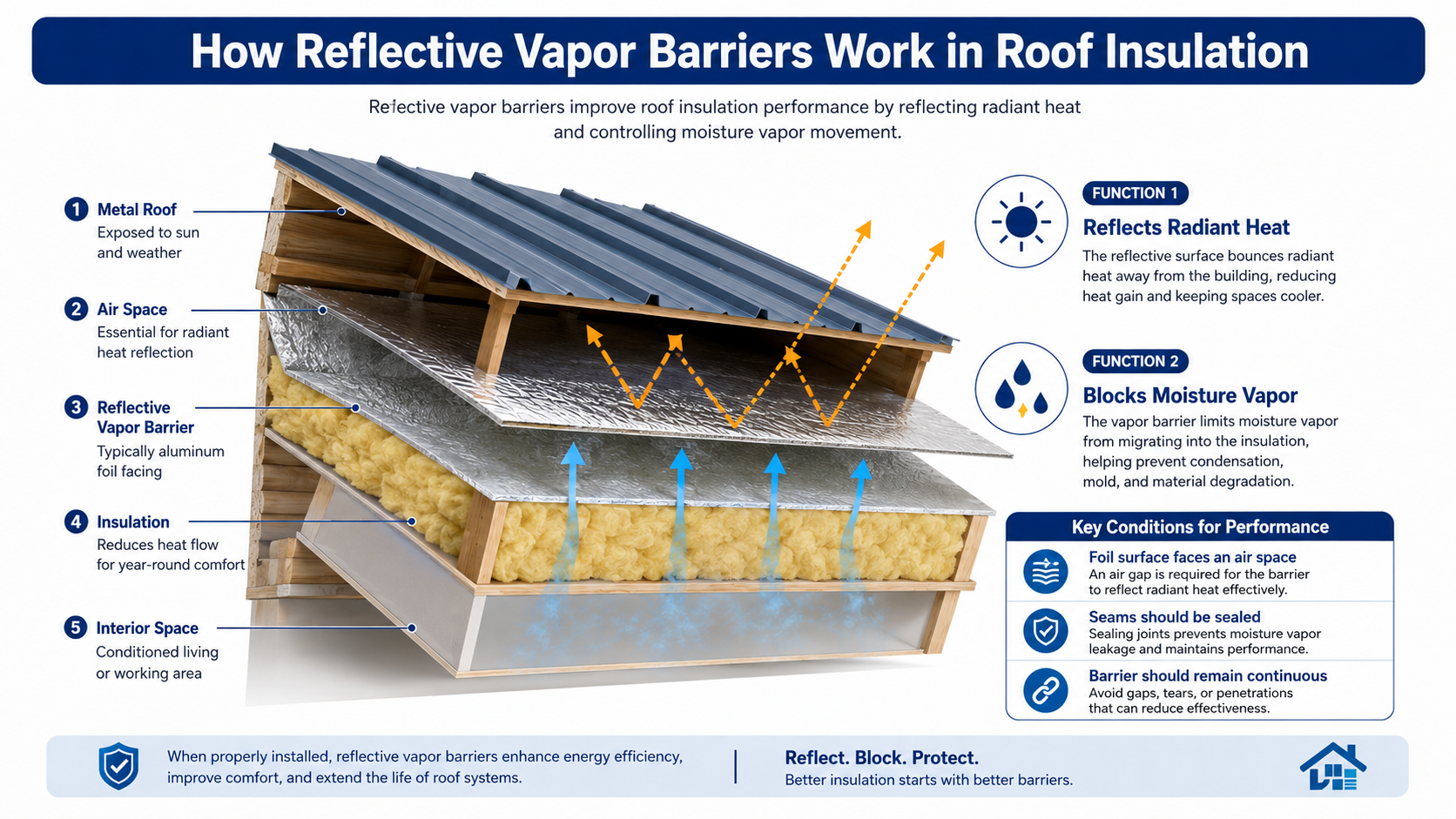
- Roof applications may require higher tear resistance and durability.
- Industrial insulation may require temperature resistance and heavy-duty reinforcement.
- Heat-sealing applications require a compatible thermoplastic surface.
Selecting additional layers without a clear functional reason may increase cost without improving practical performance.
Questions to Ask Before Confirming a Structure
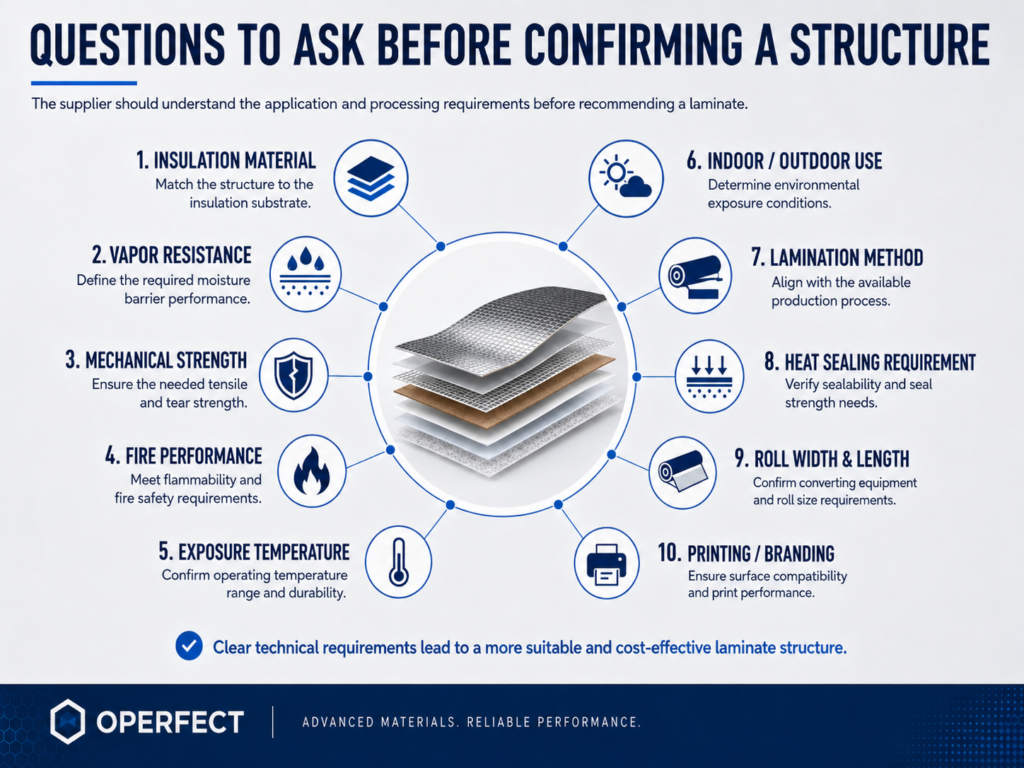
Before ordering an aluminum foil laminate, clarify:
- What insulation material will it be laminated to?
- Which side will be exposed?
- Is the material used indoors or outdoors?
- Is a vapor barrier required?
- Is radiant heat reflection required?
- What mechanical strength is needed?
- Will the product be heat sealed?
- What lamination method will be used?
- Are there fire-performance requirements?
- What roll dimensions are compatible with the production line?
- Is custom printing required?
These details allow the supplier to recommend a structure rather than simply quote a generic foil facing.
Conclusion
An aluminum foil laminate is a system of functional layers. Aluminum foil provides reflection and vapor control, while scrim, paper, film, cloth and adhesives provide the mechanical and processing properties required by the application.
Understanding the internal structure helps insulation manufacturers and buyers select materials based on performance rather than appearance alone.
OPERFECT® develops customized aluminum foil lamination structures for insulation manufacturing, HVAC, roofing and industrial thermal protection applications.