Learn how aluminum foil helps control radiant heat and moisture vapor in insulation systems, and what factors affect its practical performance.
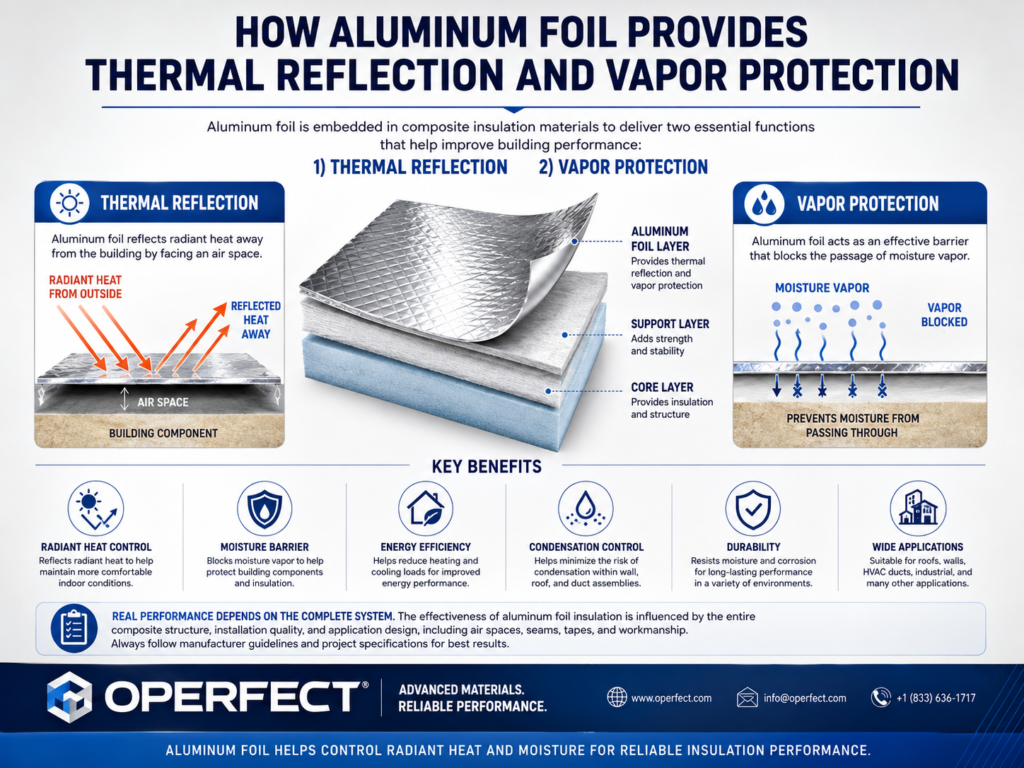
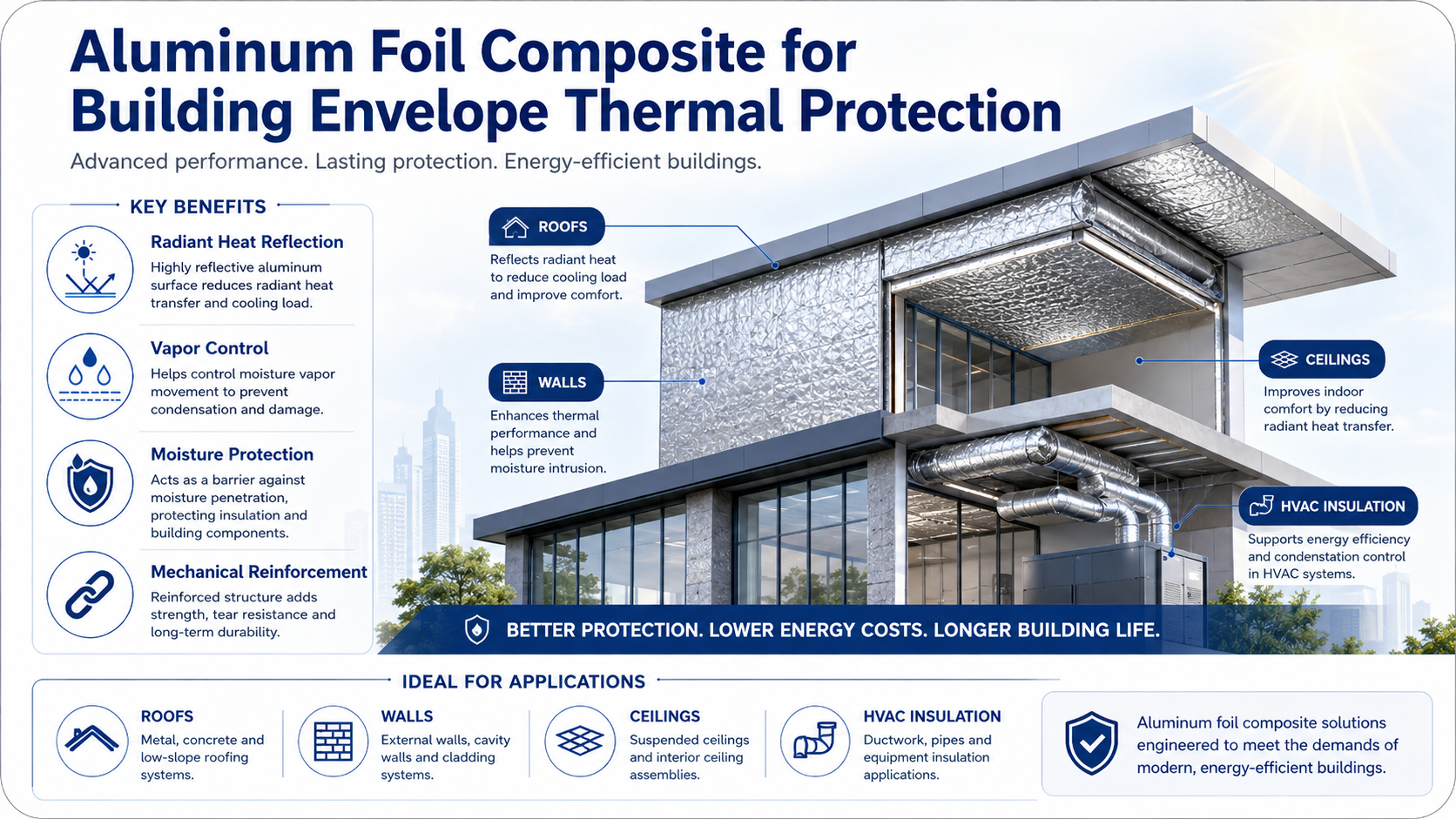
Aluminum foil is widely used in insulation systems because it can perform two important functions: reflecting radiant heat and limiting moisture-vapor transmission.
These two functions are related to the physical properties of aluminum, but they operate in different ways. Thermal reflection concerns radiant energy, while vapor protection concerns the movement of water vapor through a material.
Understanding the difference helps designers, insulation manufacturers and buyers use aluminum foil facings correctly.
The Three Main Forms of Heat Transfer
Heat moves through buildings and insulation systems in three primary ways:
- Conduction
- Convection
- Radiation
Conduction
Conduction occurs when heat passes through a solid material.
Fiberglass, rock wool and foam insulation are designed mainly to reduce conductive heat transfer.
Convection
Convection occurs through the movement of air or fluid.
Air barriers and properly sealed insulation systems help control convective heat flow.
Radiation
Radiation transfers heat in the form of electromagnetic energy between surfaces.
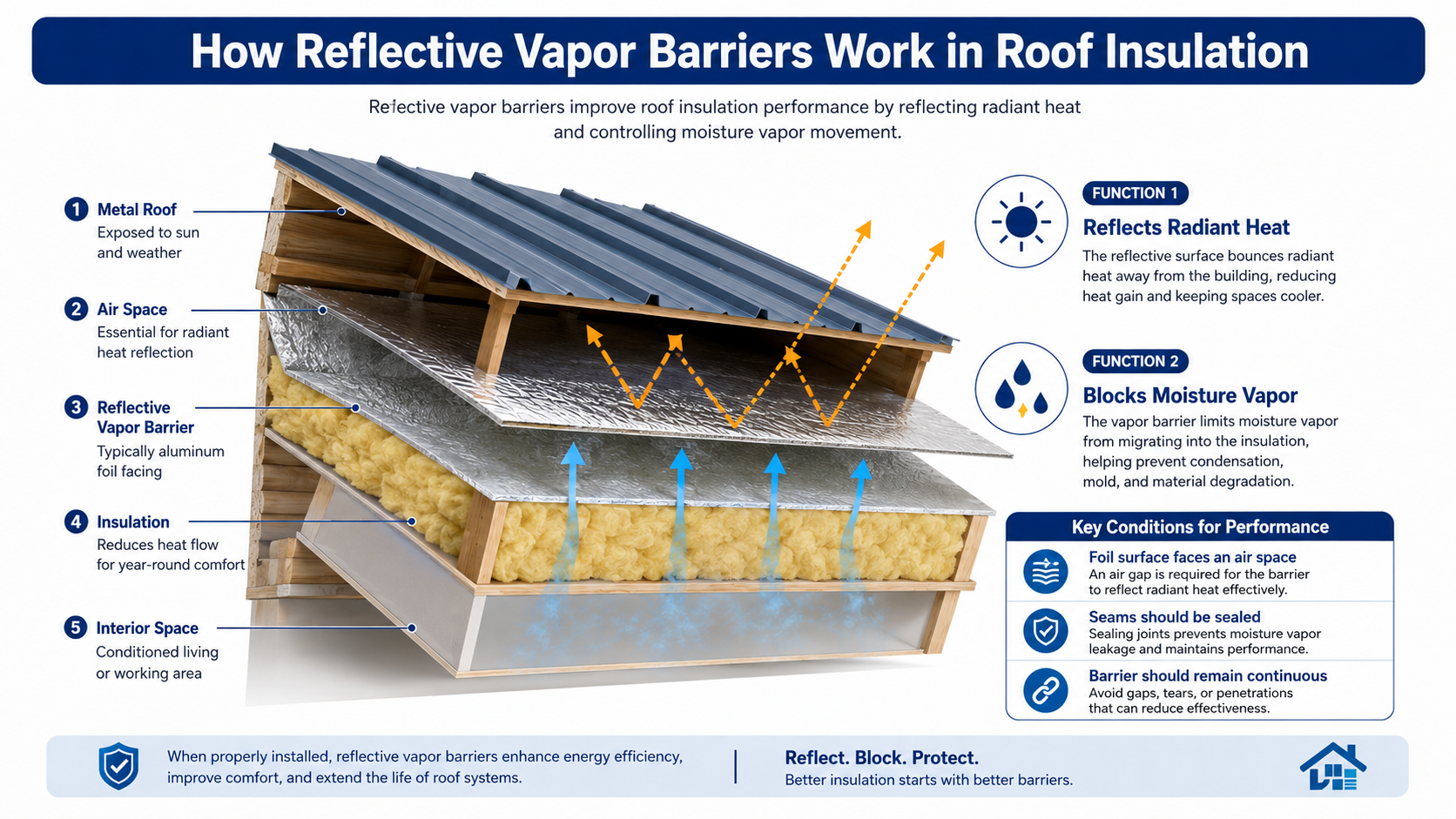
A low-emissivity aluminum foil surface can help reduce radiant heat transfer when it faces an air space.
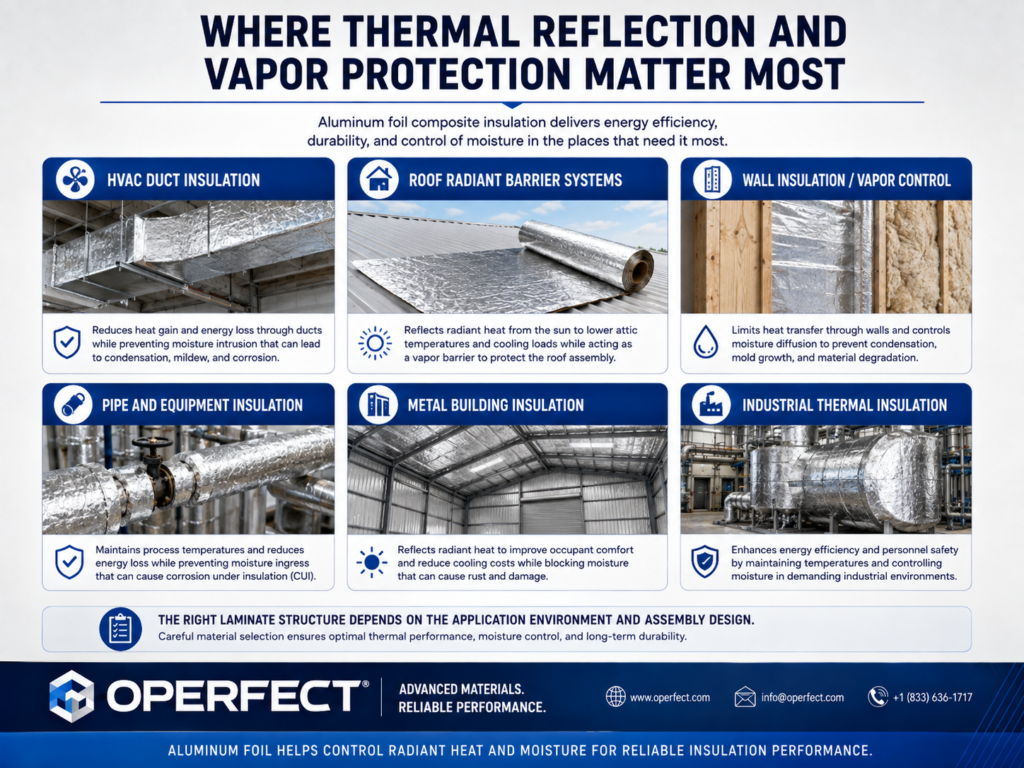
This is why aluminum foil is commonly used in radiant barriers, roof insulation, HVAC systems and metal-building insulation.
How Aluminum Foil Reflects Radiant Heat
A clean aluminum surface has low emissivity and high reflectivity compared with many non-metallic building surfaces.
When radiant heat reaches the foil surface, a large portion of the radiant energy can be reflected rather than absorbed and re-emitted.
However, foil does not work like bulk insulation.
Glass wool and rock wool reduce conductive heat flow through their thickness. Aluminum foil primarily affects radiant heat transfer at its surface.
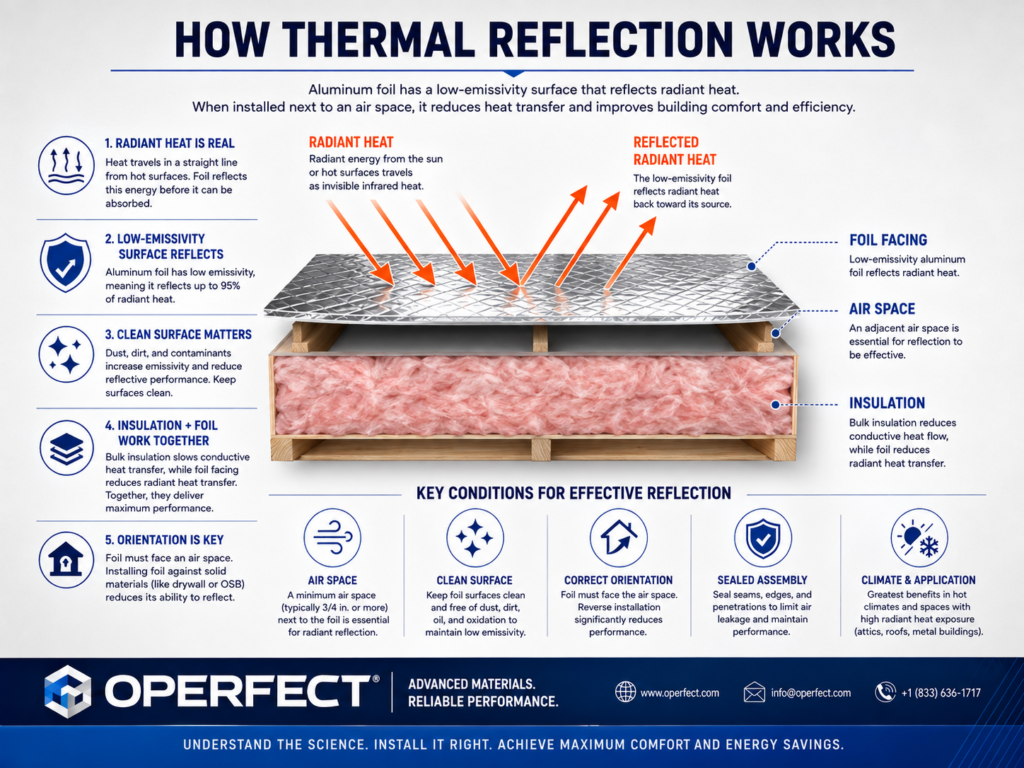
For effective radiant performance, the foil usually needs to face an air space. If the foil is tightly sandwiched between solid layers without an air gap, its radiant-reflection benefit may be reduced.
Factors Affecting Thermal Reflection
The practical performance of reflective foil depends on several conditions.
Surface Orientation
The foil surface should face the relevant air cavity or heat source.
Surface Cleanliness
Dust, oxidation, coatings or contamination may change surface emissivity and reduce reflective performance.
Air Space
A reflective surface generally requires an adjacent air space to provide meaningful radiant-barrier performance.
Installation Quality
Gaps, tears and poor sealing may reduce the overall effectiveness of the thermal and vapor-control system.
Climate and Building Design
The contribution of a reflective layer depends on roof design, wall construction, ventilation, insulation level and climate conditions.
Aluminum foil should therefore be considered part of the complete thermal system rather than a replacement for all other insulation.
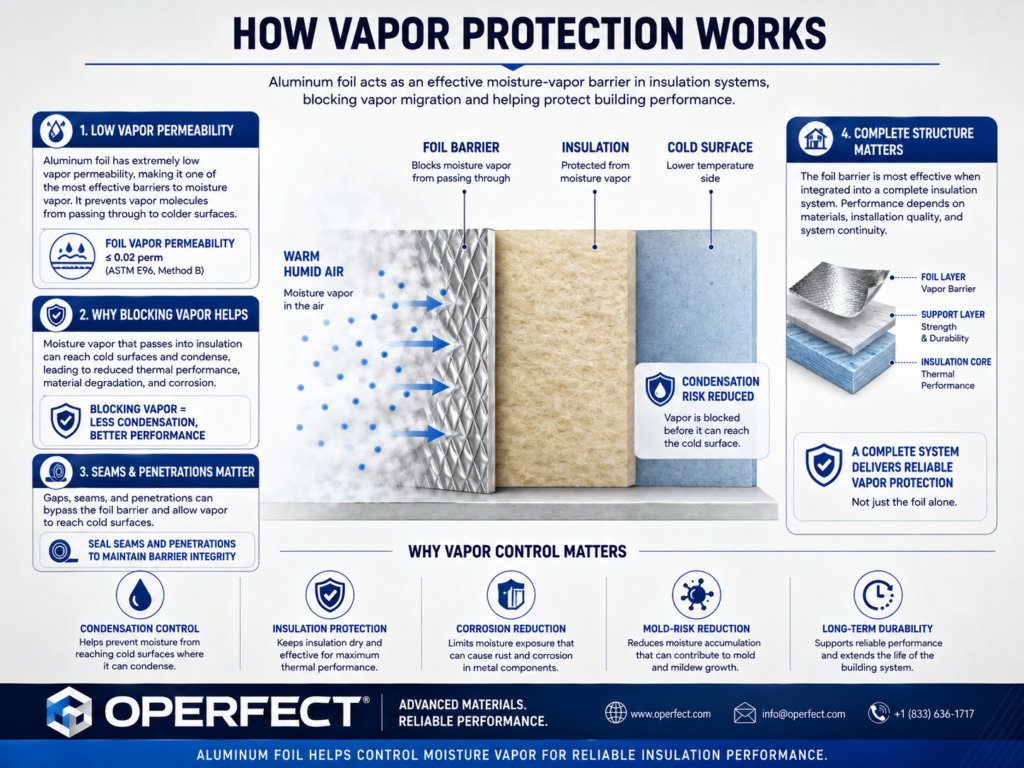
How Aluminum Foil Controls Water Vapor
Water vapor naturally moves from areas of higher vapor pressure toward areas of lower vapor pressure.
In buildings, this movement may occur through walls, roofs, ceilings, ducts and insulation systems.
If warm, humid air reaches a cold surface, condensation may occur. This can lead to:
- Reduced insulation efficiency
- Corrosion
- Mold risk
- Water staining
- Material deterioration
- Delamination
- Damage to ceilings or wall systems
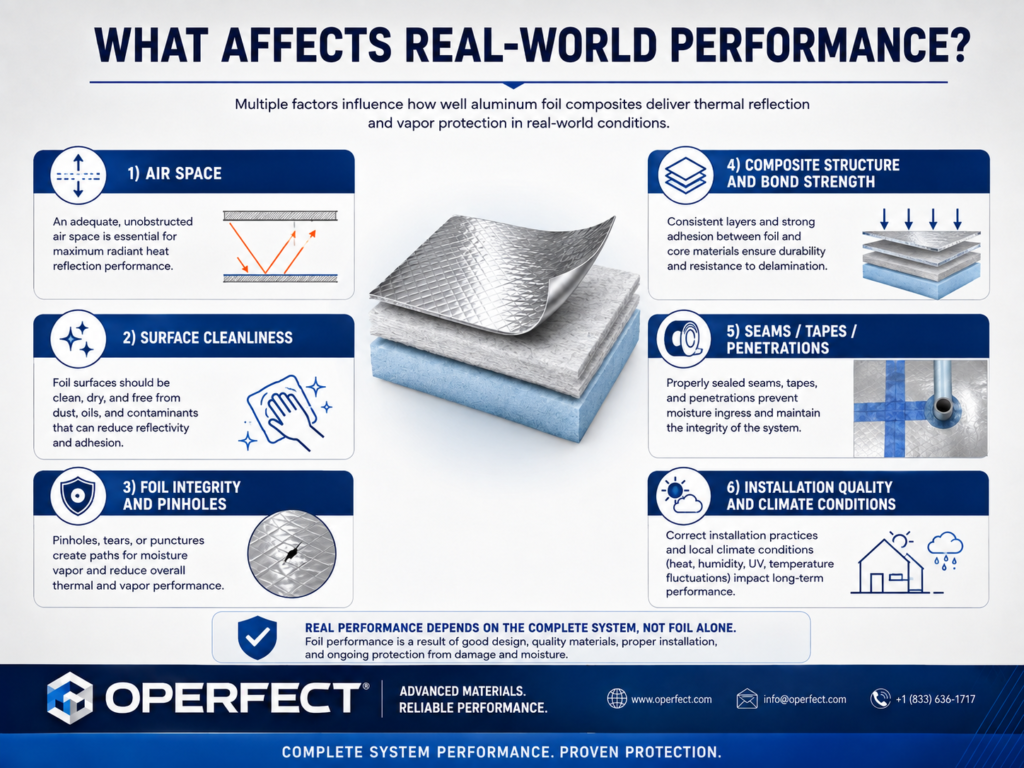
Aluminum foil has very low permeability to water vapor when it is continuous and free from pinholes or damage. It can therefore function as a vapor barrier or vapor retarder within an insulation assembly.
Why the Complete Composite Matters
The vapor performance of an aluminum foil facing is not determined by the aluminum layer alone.
The complete laminate may contain:
- Foil
- Adhesive
- Scrim
- Kraft paper
- PE film
- PET film
- Cloth or nonwoven reinforcement
Possible vapor paths can occur through:
- Pinholes in thin foil
- Damaged areas
- Open seams
- Unsealed overlaps
- Perforations
- Poorly bonded layers
- Cut edges
- Fastener penetrations
A strong composite structure reduces the risk of damage during manufacturing and installation.
For this reason, reinforced foil facing often provides more reliable field performance than very thin unsupported foil.
Vapor Barrier or Vapor Retarder?
The terms vapor barrier and vapor retarder are often used interchangeably in commercial discussions, but technically they may refer to different levels of vapor permeance.
Whether a material qualifies for a specific category depends on:
- Local building codes
- Test methods
- Measured permeance
- Climate zone
- Assembly design
Buyers should request tested water-vapor transmission or permeance data when a project has a defined technical requirement.
The supplier should not rely only on the presence of aluminum foil as proof that the complete product meets a specific regulatory classification.
Importance in HVAC Insulation
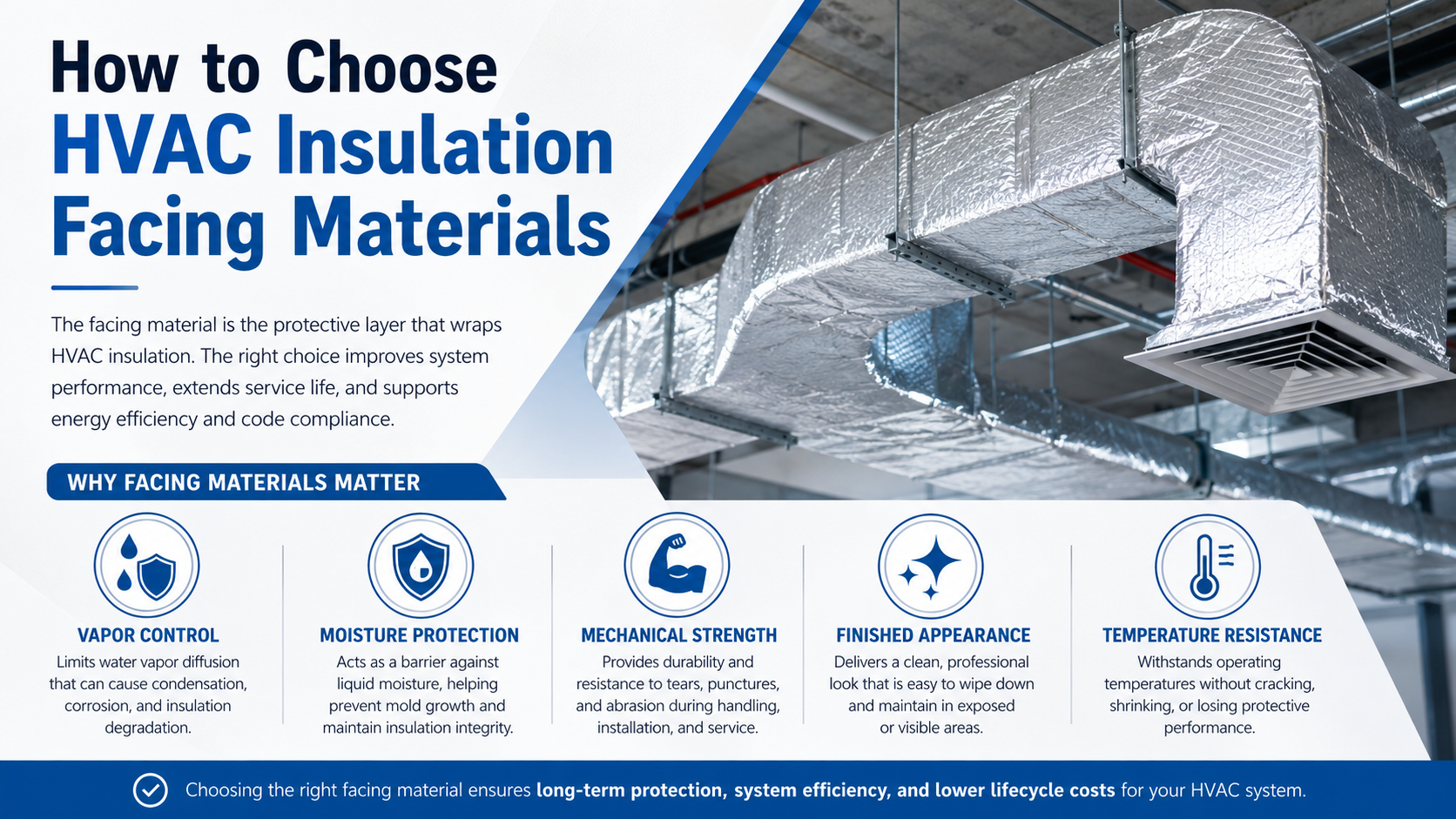
Vapor control is especially important in cold-air duct systems.
When cold ducts operate in warm, humid environments, moisture can condense on the outer surface if the vapor-control layer is incomplete.
An aluminum foil facing can help:
- Limit moisture vapor reaching the cold surface
- Protect the insulation
- Maintain a clean external appearance
- Support joint sealing with compatible foil tape
- Improve long-term system durability
Seams, joints and penetrations must also be sealed correctly.
Importance in Roof and Wall Systems
In roofs and walls, aluminum foil composites may contribute to:
- Radiant heat control
- Vapor management
- Protection of insulation
- Improved energy efficiency
- Reduced condensation risk
The required vapor-layer position depends on climate, indoor humidity and construction design.
In some climates, placing a low-permeance layer in the wrong position can trap moisture. System design should therefore follow local building practices and applicable regulations.
Foil Thickness and Pinholes
Very thin aluminum foil can contain microscopic pinholes caused by rolling, handling or converting.
Laminating foil to film, paper or scrim improves handling strength, but the complete product should still be evaluated when high vapor resistance is required.
Important quality-control considerations include:
- Foil thickness
- Pinholes
- Bond strength
- Surface damage
- Roll tension
- Edge quality
- Seam design
- Water-vapor transmission testing
Conclusion
Aluminum foil supports thermal protection in two different ways.
First, its low-emissivity surface can reduce radiant heat transfer when installed facing an air space. Second, its low vapor permeability can help control moisture movement through insulation assemblies.
Its real-world effectiveness depends on the complete laminate structure, installation quality, air-space design, sealing and compatibility with the overall building or HVAC system.
OPERFECT® supplies reinforced aluminum foil facings and vapor-control laminates for glass wool, rock wool, HVAC and building-envelope applications.