Learn how heat-sealing aluminum foil facings bond to glass wool, rock wool and other insulation products, and which factors affect sealing performance.
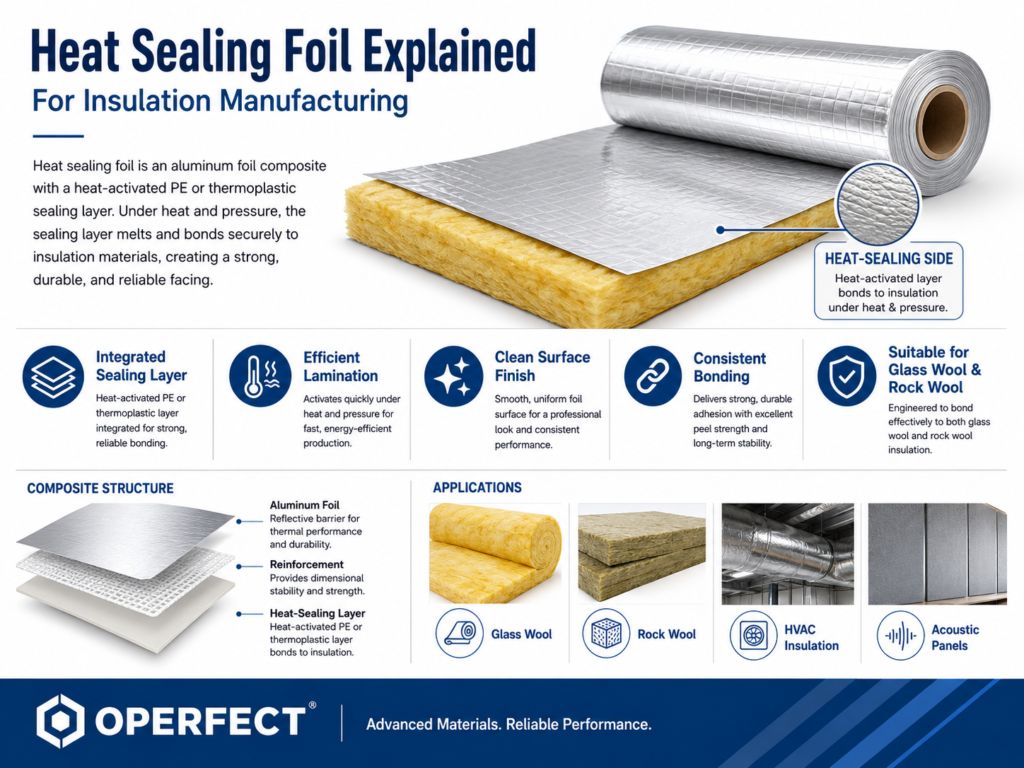
Heat-sealing foil is an aluminum foil composite with a thermoplastic or heat-activated surface that can bond to insulation under controlled heat and pressure.
It is commonly used by insulation manufacturers to laminate foil facing directly to glass wool, rock wool, foam or other substrates without applying a separate liquid adhesive during the final lamination step.
Heat-sealing foil can improve production efficiency, surface consistency and bond control when the structure is correctly matched to the insulation and equipment.
Typical Heat-Sealing Foil Structure
A heat-sealing facing may contain:
- Aluminum foil
- Reinforcement or supporting layer
- Heat-sealing PE film or coating
Common structures include:
- Aluminum foil + PE heat-sealing layer
- Aluminum foil + scrim + PE film
- Aluminum foil + kraft paper + heat-sealing coating
- Aluminum foil + PET + sealing layer
- Double foil + heat-sealing polymer
- Foil + fiberglass reinforcement + sealing film
The heat-sealing side is positioned against the insulation substrate.
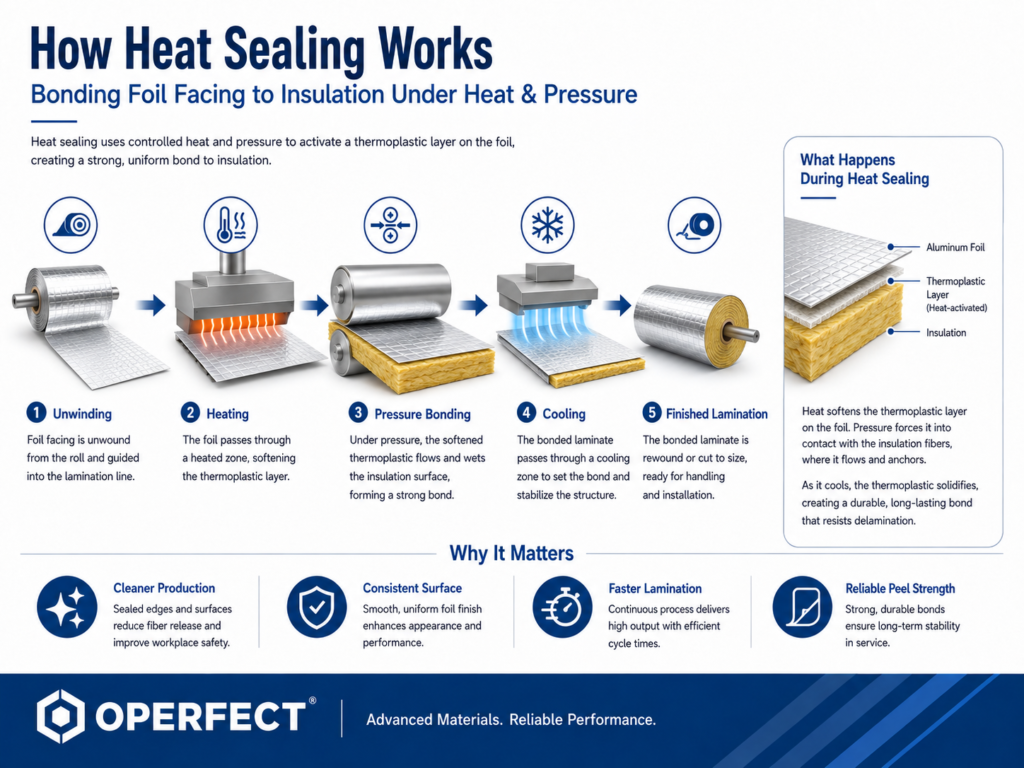
How Heat Sealing Works
During production, the heat-sealing layer is exposed to controlled temperature and pressure.
The thermoplastic surface softens and flows into the surface of the insulation or compatible substrate.
After cooling, the polymer solidifies and creates a bond.
The process generally involves:
- Material unwinding
- Facing and insulation alignment
- Heating
- Pressure application
- Cooling
- Bond stabilization
- Rewinding or cutting
The exact process depends on the production line.
Key Heat-Sealing Parameters
Sealing Temperature
The temperature must be high enough to activate the sealing layer but not so high that it damages the foil, film, insulation or adhesive layers.
Insufficient temperature can cause weak bonding.
Excessive temperature can lead to:
- Polymer degradation
- Distortion
- Shrinkage
- Blocking
- Surface damage
- Reduced seal strength
- Delamination
Pressure
Pressure helps the softened sealing layer contact the insulation surface.
Too little pressure may produce incomplete bonding.
Excessive pressure may compress the insulation or cause uneven thickness.
Dwell Time
Dwell time is the period during which heat and pressure act on the laminate.
High-speed lines have shorter dwell times and may require:
- Faster-activating polymers
- Higher heat-transfer efficiency
- Optimized coating weight
- Precise pressure control
Line Speed
Line speed affects the total heat energy received by the sealing layer.
A material that works on one production line may not perform identically on another line with different speed or heating configuration.
Cooling
The bond should be stabilized before the material is heavily tensioned, rolled or cut.
Insufficient cooling can lead to bond movement or blocking.
Role of the Heat-Sealing Layer
PE is commonly used because it provides:
- Heat activation
- Flexibility
- Moisture resistance
- Bonding capability
- Cost efficiency
- Compatibility with extrusion coating
However, different PE grades have different:
- Melting points
- Sealing windows
- Adhesion behavior
- Flexibility
- Temperature resistance
- Aging characteristics
Other heat-sealing polymers or coatings may be used for specialized applications.
Compatible Insulation Materials
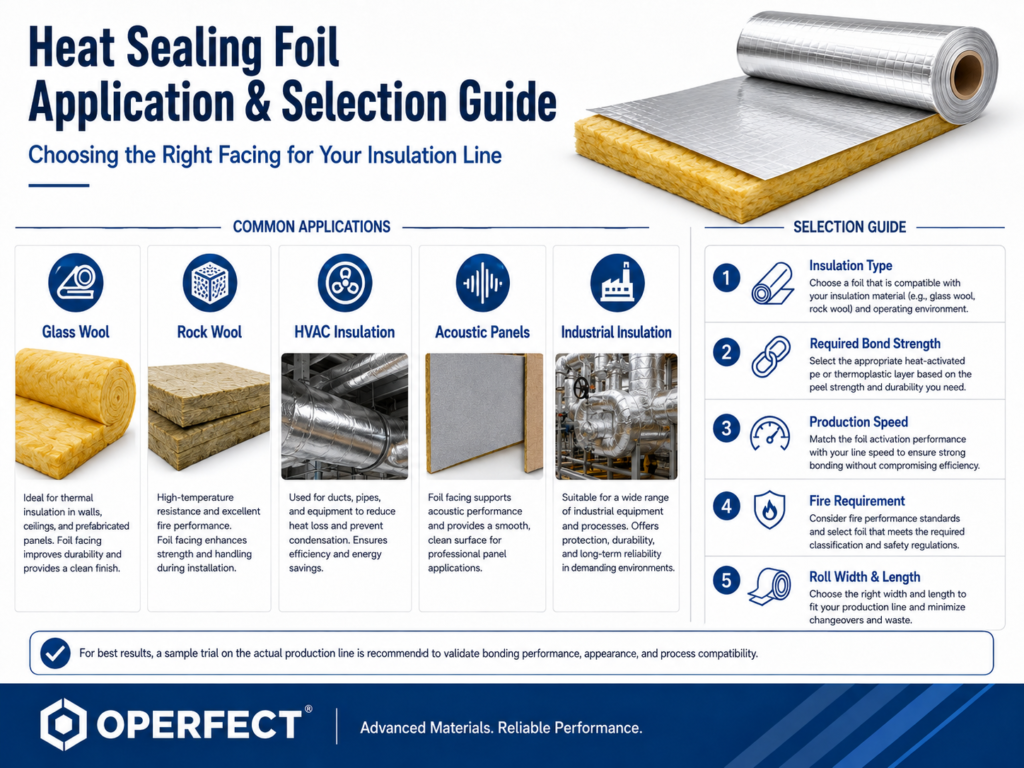
Heat-sealing foil may be used with:
- Стекловата
- Каменная шерсть
- Foam insulation
- Rubber foam
- Acoustic insulation
- Composite insulation boards
- Selected nonwoven substrates
Compatibility depends on surface structure, density, temperature resistance and production method.
A trial should be conducted before mass production.
Heat-Sealing Foil vs Standard Facing
A standard facing may require a separate adhesive to bond it to insulation.
Heat-sealing foil includes an integrated sealing layer.
Potential Advantages
- Reduced adhesive-handling steps
- Cleaner production
- More consistent coating weight
- Faster processing
- Reduced solvent use
- Better surface uniformity
- Easier production control
Potential Limitations
- Requires compatible heating equipment
- Sensitive to temperature settings
- May have a limited sealing window
- Must match the insulation surface
- May require line trials
- Higher temperatures may affect fire performance
- Incorrect storage can cause blocking or surface contamination
Bond Strength and Peel Performance
The finished laminate should have enough bond strength for:
- Rewinding
- Slitting
- Cutting
- Packaging
- Transportation
- Installation
- Long-term service
Bond strength may be evaluated through peel testing or application-specific tests.
The required bond should not be judged only by whether the foil can be attached initially. Long-term performance should also be evaluated after:
- Heat aging
- Humidity exposure
- Low-temperature conditioning
- Repeated bending
- Storage
- Transportation
Factors Affecting Seal Quality
Insulation Surface
Loose fibers, dust or uneven density can reduce contact.
Coating Weight
Too little sealing polymer may produce weak bonding.
Too much may increase cost, stiffness or blocking risk.
Surface Treatment
Foil, film or insulation surfaces may require corona treatment, primer or compatible adhesive chemistry.
Roll Storage
Heat-sealing rolls should be protected from:
- High temperature
- Direct sunlight
- Moisture
- Dust
- Excessive stacking pressure
- Damaged edges
Production Tension
Incorrect web tension may cause wrinkling, stretching or uneven bonding.
Fire-Performance Considerations
The heat-sealing polymer is part of the final composite and may affect flame spread, smoke development or other fire-test results.
If the insulation product requires a fire classification, the complete faced insulation system should be tested.
Changing the sealing-film grade, coating weight or backing structure may affect the result.
How to Select Heat-Sealing Foil
Before ordering, provide the supplier with:
- Insulation type
- Insulation density
- Insulation surface condition
- Production-line speed
- Heating method
- Sealing temperature
- Pressure range
- Required bond strength
- Facing structure
- Roll width and length
- Fire-performance requirement
- Storage conditions
- Final application
A sample trial on the actual production line is strongly recommended.
Production Trial Checklist
During a trial, check:
- Initial adhesion
- Peel strength
- Surface flatness
- Wrinkling
- Foil damage
- Insulation compression
- Bond uniformity
- Edge bonding
- Rewinding stability
- Blocking
- Performance after cooling
- Performance after aging
Adjust temperature, pressure and speed one factor at a time to identify the best processing window.
Conclusion
Heat-sealing foil is an engineered insulation-facing material that bonds to insulation through controlled heat and pressure.
Its performance depends on the complete laminate structure, sealing polymer, insulation surface and production conditions.
The best results are achieved when the material is tested on the actual production line before full-scale manufacturing.
OPERFECT® supplies customized heat-sealing foil facings for glass wool, rock wool, HVAC and industrial insulation manufacturing, with options for scrim reinforcement, PE sealing layers, custom widths and printed surfaces.