Black Fiberglass Fabric and Tissue for Insulation Manufacturers: Specifications, Surface Treatments and Supplier Selection
A Practical Sourcing Guide for Glass Wool, Rock Wool, Acoustic Panel and Industrial Insulation Manufacturers
For glass wool, rock wool and acoustic insulation manufacturers, choosing the right fiberglass facing material is an important part of product quality, production efficiency and long-term supply planning.
Black fiberglass fabric and black fiberglass tissue are both used in insulation-related applications, but their material structures, mechanical characteristics, surface treatments and processing requirements can differ significantly.
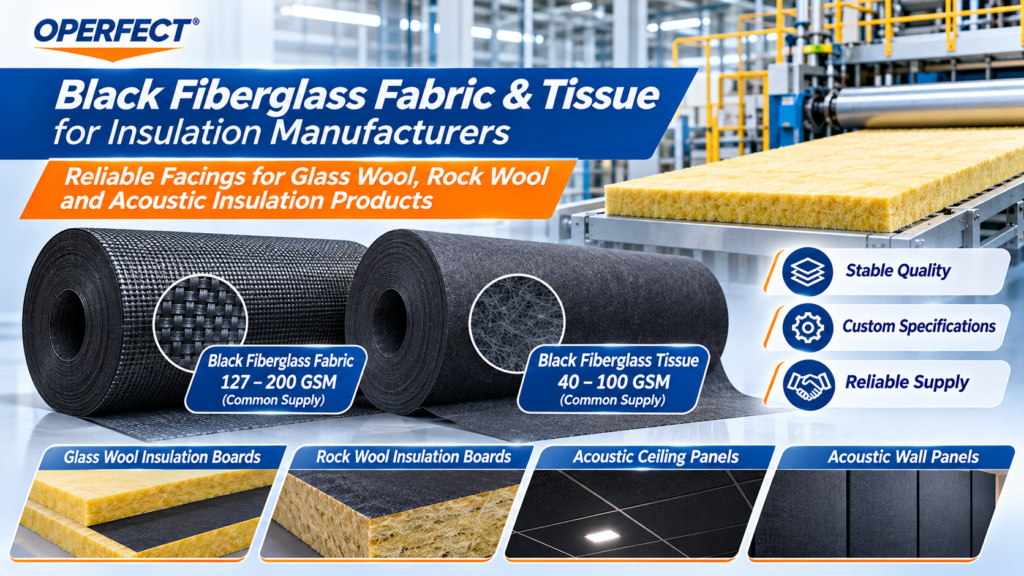
OPERFECT commonly supplies black fiberglass fabric in approximately 127–200 GSM and black fiberglass tissue in approximately 40–100 GSM. Other weights can be evaluated according to customer requirements.
For professional buyers, selecting the right material involves more than comparing weight or price. It requires understanding the material structure, bonding process, roll dimensions, surface appearance and intended application.
This guide explains the differences between black fiberglass fabric and tissue, their common specifications, surface treatment considerations and the key factors insulation manufacturers should verify before placing an order.
1. Why Fiberglass Facing Materials Matter in Insulation Manufacturing
Fiberglass-based facing materials are used in various insulation and acoustic products.
Depending on their construction and application, they may provide surface reinforcement, support lamination, improve handling characteristics or contribute to the finished product’s appearance.
Common applications include:
- Glass wool insulation boards
- Rock wool insulation boards
- Acoustic ceiling panels
- Sound-absorbing wall panels
- HVAC insulation components
- Industrial insulation composites
- Reinforced insulation facings
In acoustic applications, black fiberglass facings are often selected because their dark appearance can help conceal the underlying insulation core behind perforated or open decorative surfaces.
In other applications, manufacturers may prioritize reinforcement, dimensional stability or compatibility with adhesives and lamination processes.
However, the requirements for these applications are not identical.
A material suitable for an acoustic ceiling panel may not be the best choice for an industrial insulation facing.
Understanding the differences between fiberglass fabric and tissue is therefore the first step in selecting an appropriate material.
2. Black Fiberglass Fabric vs. Black Fiberglass Tissue: What Is the Difference?
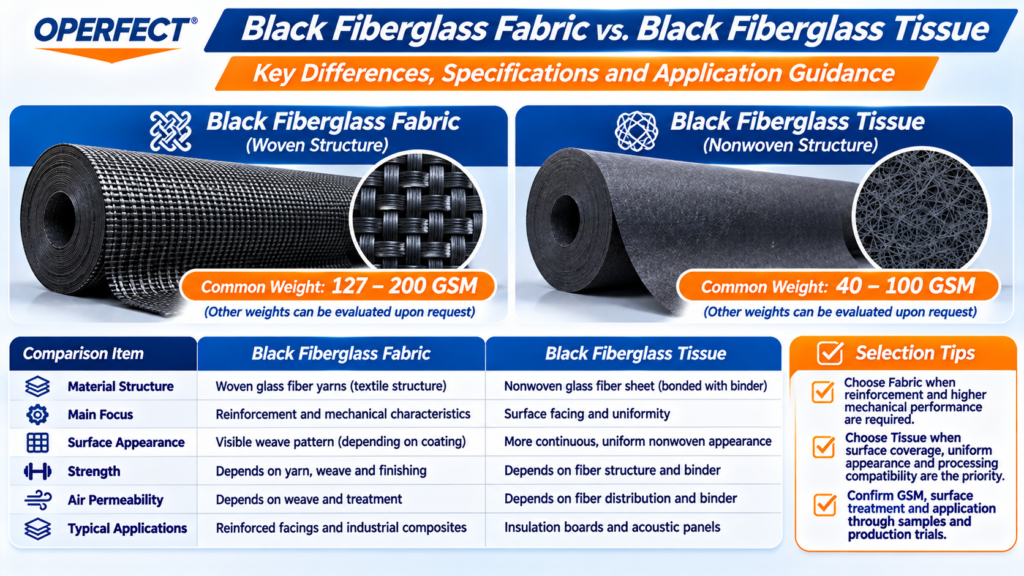
Although the names are sometimes used interchangeably in commercial discussions, fiberglass fabric and fiberglass tissue generally refer to different material structures.
Black Fiberglass Fabric: Woven Glass Fiber Structure
Black fiberglass fabric is generally produced by weaving glass fiber yarns into a structured textile.
Depending on the yarn specification, weave pattern and surface treatment, woven fiberglass fabric may provide reinforcement and dimensional stability.
OPERFECT commonly supplies black fiberglass fabric in weights of approximately 127–200 g/m².
Other weights can be evaluated according to the customer’s requirements.
Typical purchasing considerations include:
- Weave construction
- Yarn specification
- Basis weight
- Tensile strength
- Roll width and length
- Surface coating
- Flexibility
- Adhesive compatibility
For insulation manufacturers, woven fiberglass fabric may be considered when the finished product requires a defined textile structure or particular reinforcement characteristics.
Black Fiberglass Tissue: Nonwoven Glass Fiber Facing
Black fiberglass tissue is generally a nonwoven sheet formed from glass fibers and a binder system.
It is commonly considered for insulation surface facings, acoustic panels and selected composite applications.
OPERFECT commonly supplies black fiberglass tissue in weights of approximately 40–100 g/m².
Additional GSM options can be evaluated according to the intended application.
Typical purchasing considerations include:
- Basis weight
- Fiber distribution
- Surface uniformity
- Binder system
- Air permeability
- Roll width and length
- Tensile strength
- Black color consistency
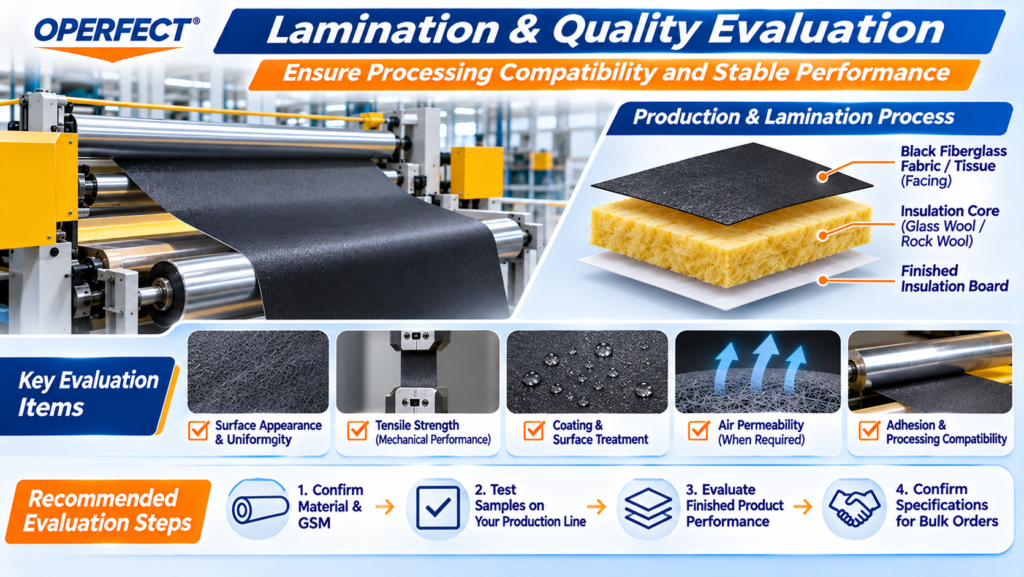
- Lamination compatibility
For acoustic insulation manufacturers, the balance between surface coverage, permeability and bonding performance can be particularly important.
Product Comparison
| Purchasing Factor | Black Fiberglass Fabric | Black Fiberglass Tissue |
|---|---|---|
| Material structure | Woven glass fiber yarns | Nonwoven glass fiber sheet |
| Common OPERFECT weight | Approximately 127–200 GSM | Approximately 40–100 GSM |
| Main purchasing focus | Reinforcement and mechanical characteristics | Surface facing and uniformity |
| Surface appearance | Textile weave, depending on coating | More continuous nonwoven appearance |
| Strength | Depends on yarn, weave and finishing | Depends on fiber structure and binder |
| Air permeability | Depends on weave and treatment | Depends on fiber distribution and binder |
| Typical applications | Reinforced facings and industrial composites | Insulation boards and acoustic panels |
| Customization | Weight, width, coating and packaging | Weight, width, surface treatment and packaging |
Buyer Tip: Do not select fiberglass fabric or tissue based only on product photographs or GSM. Request samples and evaluate their compatibility with your production process.
3. Understanding GSM: Standard Weight Ranges and Customization Options
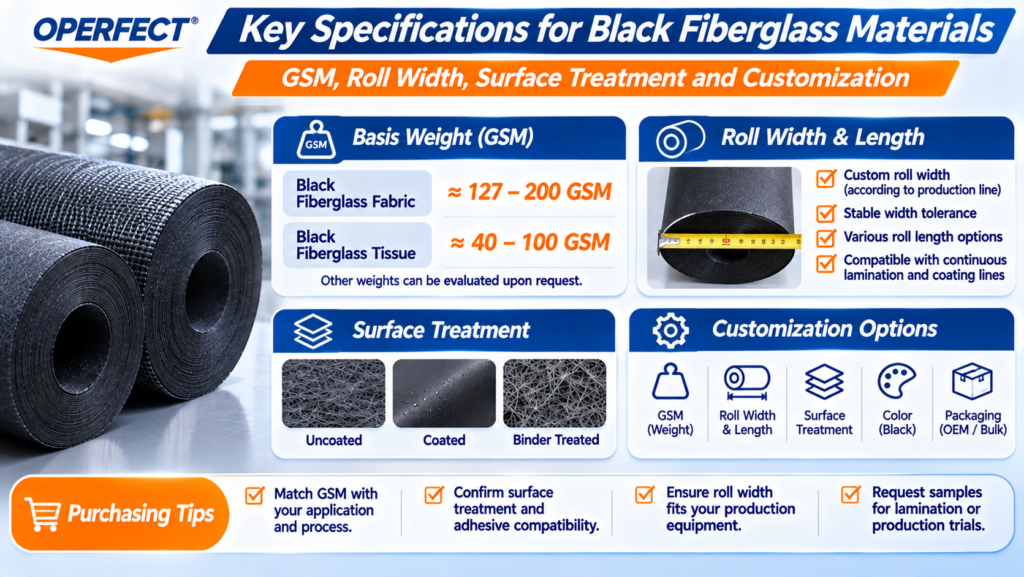
GSM means grams per square meter.
It is one of the key specifications when purchasing fiberglass materials for insulation manufacturing.
However, GSM alone does not determine tensile strength, thickness, air permeability or suitability for a particular application.
Two fiberglass materials with the same weight can perform differently because of variations in fiber structure, yarn construction, binder content or coating.
OPERFECT Common Supply Ranges
| Продукт | Common Basis Weight | Customization |
|---|---|---|
| Black Fiberglass Fabric | Approximately 127–200 g/m² | Other weights can be evaluated upon request |
| Black Fiberglass Tissue | Approximately 40–100 g/m² | Other weights can be evaluated upon request |
These are commonly supplied weight ranges rather than fixed manufacturing limits.
Black Fiberglass Fabric: Approximately 127–200 GSM
OPERFECT’s black fiberglass fabric options are commonly supplied in weights ranging from approximately 127 to 200 GSM.
Depending on the weave construction and surface treatment, these materials can be considered for insulation reinforcement, industrial composites and selected facing applications.
Buyers should evaluate:
- Yarn and weave structure
- Tensile strength
- Coating characteristics
- Flexibility
- Lamination requirements
- Finished product performance
A higher GSM does not automatically guarantee higher tensile strength or better suitability for every application.
Black Fiberglass Tissue: Approximately 40–100 GSM
OPERFECT’s black fiberglass tissue options are commonly supplied in weights ranging from approximately 40 to 100 GSM.
These materials can be considered for glass wool and rock wool insulation facings, acoustic panels and related applications.
The appropriate weight depends on:
- Insulation core construction
- Surface coverage requirements
- Bonding method
- Material handling
- Air permeability requirements
- Finished product appearance
Custom GSM Options
Different insulation production lines may require different material weights.
OPERFECT can evaluate additional GSM requirements according to material construction, production feasibility and order quantity.
Looking for a specific weight outside our common ranges?
Send us your required GSM, roll width, surface treatment and intended application.
Our team can help assess suitable sourcing options.
4. Roll Width and Dimensional Consistency: Why They Matter for Production Efficiency
For insulation manufacturers operating continuous production or lamination lines, roll width is a critical purchasing specification.
An unsuitable width can increase trimming waste, complicate material handling or interrupt production planning.
Matching Roll Width to Production Equipment
Buyers should consider:
- Production line working width
- Finished insulation board dimensions
- Trimming allowance
- Lamination method
- Roll handling capacity
- Core diameter
- Winding requirements
Custom roll widths may help reduce unnecessary material waste.
However, available widths depend on the selected fiberglass material, production equipment and order requirements.
Width Tolerance
Consistent width can be particularly important in automated and semi-automated processing.
Excessive width variation may affect material alignment and edge trimming.
Roll Winding Quality
Roll winding quality is another important consideration.
Uneven winding, inconsistent tension or damaged roll edges may create feeding problems during downstream processing.
Manufacturers should evaluate roll tension, edge alignment, core quality and packaging protection.
Questions to Ask Before Ordering
- What roll widths are available?
- What width tolerance can be maintained?
- What are the standard roll lengths?
- What core specifications are used?
- Can the material be supplied in widths suitable for our production line?
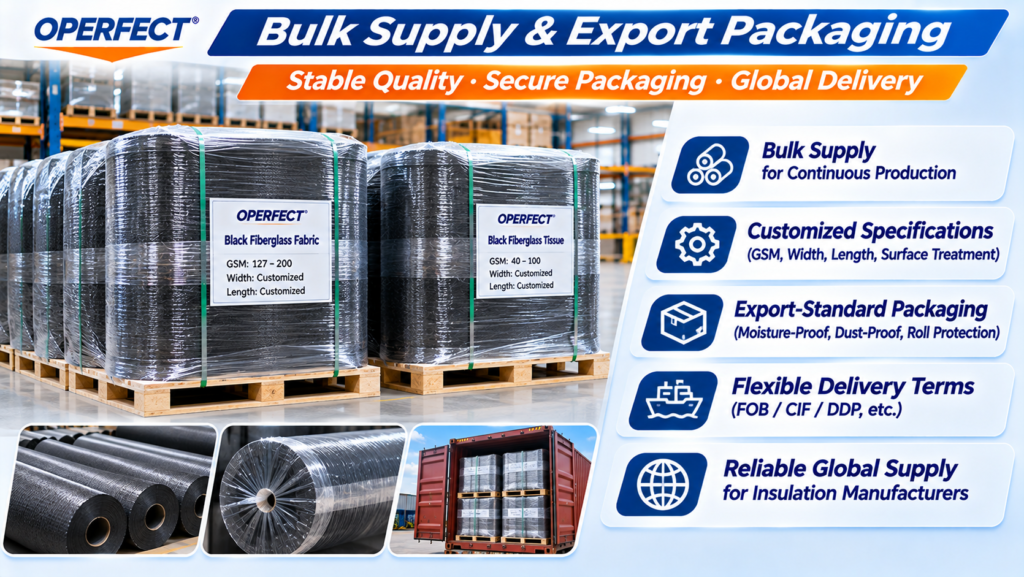
- How are rolls packaged for international transport?
The right fiberglass facing should fit both the finished insulation product and the manufacturer’s production process.
5. Black Color and Surface Treatments: What Should Insulation Manufacturers Consider?
Black fiberglass materials are often selected for their visual appearance, particularly in acoustic insulation applications.
However, the method used to achieve the black color and the type of surface treatment may influence the material’s performance.
Black Color Treatment
Depending on the product, black appearance may be achieved through pigmentation, coating or other finishing processes.
Manufacturers should evaluate:
- Color uniformity
- Surface appearance
- Color transfer or rubbing behavior
- Processing compatibility
- Batch-to-batch consistency
For acoustic ceiling and wall panels, consistent black appearance may be important because the facing can remain partially visible through the finished surface.
Surface Coating
Surface coatings may be used to modify appearance, handling or other characteristics.
Different coating systems can influence flexibility, surface texture, permeability and adhesive interaction.
A coating suitable for one insulation product may not be appropriate for another.
Binder Systems
Nonwoven fiberglass tissue generally relies on a binder system to maintain fiber integrity.
Binder chemistry and content can influence material strength, handling and downstream processing.
Buyers should consider whether the selected material is compatible with their intended adhesive, resin or lamination process.
Air Permeability
Air permeability can be particularly important for acoustic insulation applications.
A heavily coated material may behave differently from a more open facing.
However, acoustic performance cannot be determined from the facing alone.
It depends on the complete assembly, including the insulation core, facing, thickness and installation conditions.
Fire Performance
Glass fibers are inorganic, but finished fiberglass materials may contain organic binders, coatings or other components.
Black color does not mean that a fiberglass material is flame-retardant or noncombustible.
Where fire performance is required, buyers should request relevant technical documentation for the exact finished material or assembly.
6. Applications in Glass Wool, Rock Wool and Acoustic Insulation Manufacturing
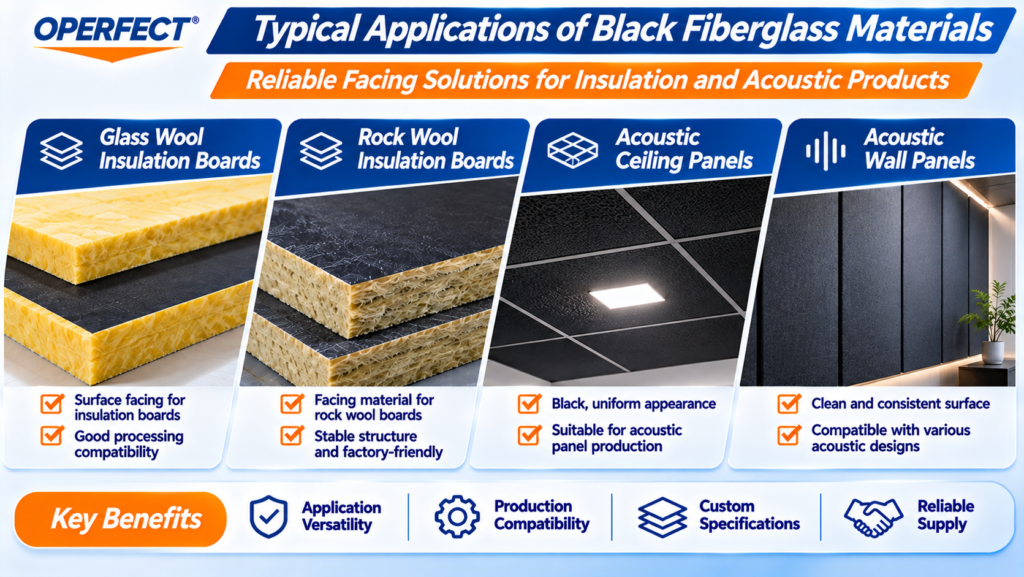
Black fiberglass fabric and tissue can be considered for different insulation products.
The correct choice depends on the insulation core, manufacturing method and intended end use.
Glass Wool Insulation Boards
Black fiberglass tissue may be considered as a surface facing for selected glass wool insulation boards.
Important purchasing considerations include:
- Surface uniformity
- Bonding compatibility
- Roll width
- Material handling
- Color consistency
- Appropriate permeability
Rock Wool Insulation Boards
Rock wool insulation boards may require facing materials with particular mechanical or surface characteristics.
Depending on the finished product, manufacturers may evaluate woven fiberglass fabric, nonwoven tissue or other specialized facings.
Important factors include adhesive compatibility, dimensional stability and required surface appearance.
Acoustic Ceiling Panels
Black fiberglass tissue can be considered for acoustic ceiling panel facings where a dark and uniform appearance is desired.
Manufacturers should evaluate:
- Surface appearance
- Air permeability
- Bonding performance
- Handling strength
- Compatibility with the acoustic panel structure
The finished panel’s acoustic and fire performance should be evaluated at the appropriate product or assembly level.
Acoustic Wall Panels
Similar considerations apply to wall-mounted sound-absorbing panels.
The facing material must be compatible with the panel construction, manufacturing process and intended installation.
Industrial Insulation Composites
For selected industrial applications, woven fiberglass fabric may be preferred where reinforcement characteristics are important.
However, suitability depends on operating conditions, composite structure and the finished material’s tested performance.
A material suitable for one insulation application should not automatically be recommended for every insulation product.
7. How Surface Treatment Affects Lamination and Bonding
For insulation manufacturers, compatibility with the production process is one of the most important factors in material selection.
A fiberglass facing may appear suitable during visual inspection but behave differently during lamination.
Adhesive Compatibility
Different adhesives and resins interact differently with fiberglass surfaces.
Coatings and binders may influence wetting, penetration and bonding.
Processing Temperature
If the facing passes through heated equipment, manufacturers should consider the behavior of the complete material, including coatings and binders.
The heat resistance of glass fibers alone does not establish the operating temperature limit of the finished facing.
Surface Absorption
Material structure may influence adhesive consumption and penetration.
Excessive penetration or insufficient bonding can create processing difficulties.
Flexibility
A facing that is too stiff for a particular application may create handling or forming problems.
Production Trials
Before placing a large order, buyers should evaluate samples using their actual production equipment whenever practical.
A successful production trial can provide more useful purchasing information than comparing material specifications alone.
8. What Technical Specifications Should Buyers Request?
Professional insulation manufacturers should use a consistent technical checklist when comparing fiberglass material suppliers.
| Specification | Why It Matters |
|---|---|
| Material Type | Confirms woven fabric or nonwoven tissue |
| Glass Fiber Construction | Identifies the material structure |
| Basis Weight (GSM) | Supports material comparison and cost calculation |
| Weight Tolerance | Helps evaluate batch consistency |
| Roll Width | Ensures compatibility with production equipment |
| Roll Length | Supports production and inventory planning |
| Thickness | Relevant for selected applications |
| Tensile Strength | Indicates mechanical performance under defined testing |
| Surface Treatment | Identifies coating, binder or finishing requirements |
| Color | Confirms black appearance and consistency requirements |
| Air Permeability | Important for selected acoustic applications |
| Fire Performance | Requires applicable product-specific evidence |
| Packaging | Supports handling, storage and transport |
Not every specification will be equally important for every application.
For example, an acoustic panel manufacturer may prioritize surface uniformity and air permeability, while a reinforced composite manufacturer may focus more heavily on mechanical strength.
The most useful technical data sheet is one that reflects the buyer’s intended application.
9. How to Evaluate Samples Before Bulk Purchasing
Samples play an important role in fiberglass material sourcing.
However, evaluating only the appearance of a small sample may not be sufficient.
Step 1: Confirm Material Construction
Verify whether the sample is woven fabric or nonwoven tissue.
Step 2: Check Basic Specifications
Compare the sample with the supplier’s declared GSM, thickness and other relevant characteristics.
Step 3: Evaluate Surface Appearance
For black facings, examine color uniformity, visible defects and surface consistency.
Step 4: Test Production Compatibility
Where practical, use the material in a small-scale lamination or production trial.
Step 5: Review Finished Product Performance
Evaluate the resulting insulation product according to its intended requirements.
Step 6: Confirm the Approved Specification
Once a suitable material has been selected, establish an agreed specification for future production.
Step 7: Plan Repeat-Order Verification
Discuss how future shipments will be checked against the approved specification.
For continuous insulation manufacturing, repeatability is often as important as initial sample performance.
10. Supplier Selection: What Should Insulation Manufacturers Verify?
A reliable fiberglass material supplier should provide more than a competitive quotation.
Professional buyers should evaluate product understanding, customization capability, quality consistency and export support.
Product Knowledge
Can the supplier explain the differences between woven fabric and nonwoven tissue?
Can the supplier identify which specifications are important for the intended application?
Customization Capability
Can the supplier evaluate requirements for GSM, roll width, surface treatment or packaging?
Not every specification is available for every material, so customization feasibility should be confirmed.
Quality Consistency
Can the supplier help maintain agreed product specifications across repeat orders?
Sample Support
Can samples be supplied for evaluation before bulk purchasing?
Technical Communication
Can the supplier provide clear answers about material construction, processing requirements and available technical information?
Export Packaging
Can the material be packed appropriately for international shipment?
Commercial Reliability
Can the supplier communicate clearly about MOQ, production scheduling, quotation terms and delivery arrangements?
For insulation factories, the best supplier is not necessarily the one offering the lowest price per kilogram. It is the one capable of supplying the right material consistently.
11. Why Work With OPERFECT for Fiberglass Facing Materials?
OPERFECT is the international building-materials brand of Jinan United Perfect Building Materials Corporation.
Our business combines long-term international trading experience, established manufacturing resources and coordinated supply-chain services.
Fiberglass-based materials and insulation facings are part of our established product supply experience.
For insulation manufacturers, we focus on helping buyers identify suitable materials and coordinate practical purchasing requirements.
Commonly Supplied Black Fiberglass Materials
Black Fiberglass Fabric
Common basis weight: approximately 127–200 GSM.
Other weights can be evaluated according to customer requirements.
Black Fiberglass Tissue
Common basis weight: approximately 40–100 GSM.
Additional GSM options can be discussed according to the intended application.
Specification Customization
Depending on the material and production feasibility, customization may involve:
- Basis weight
- Roll width
- Roll length
- Black color treatment
- Surface finishing
- Packaging configuration
Application-Oriented Communication
We encourage buyers to share their intended insulation product, production process and technical requirements before selecting a material.
Sample Coordination
Samples can be discussed for material evaluation and production trials.
International Supply Coordination
OPERFECT supports international purchasing and export arrangements, including agreed packaging and shipping terms.
Related Insulation Facing Materials
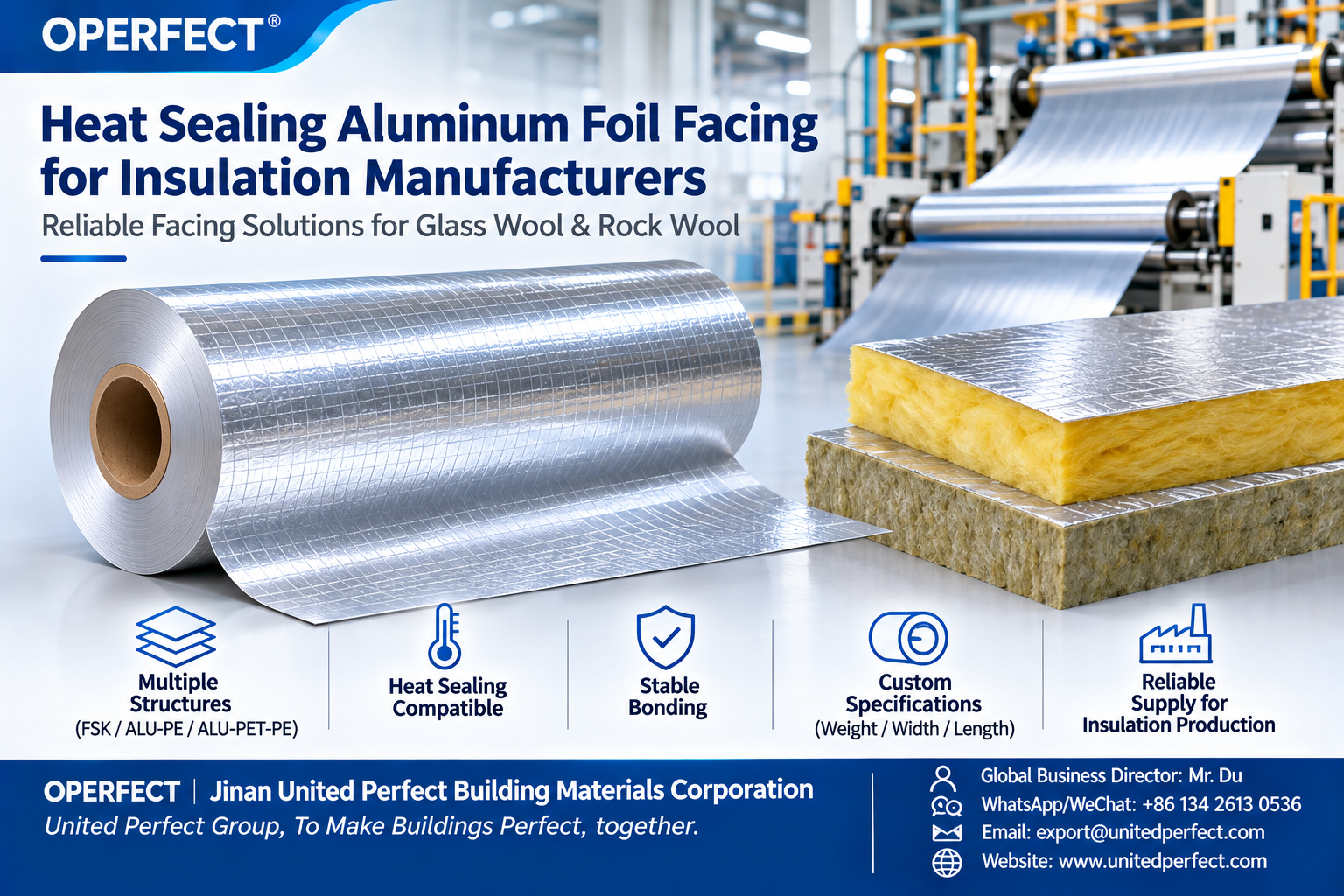
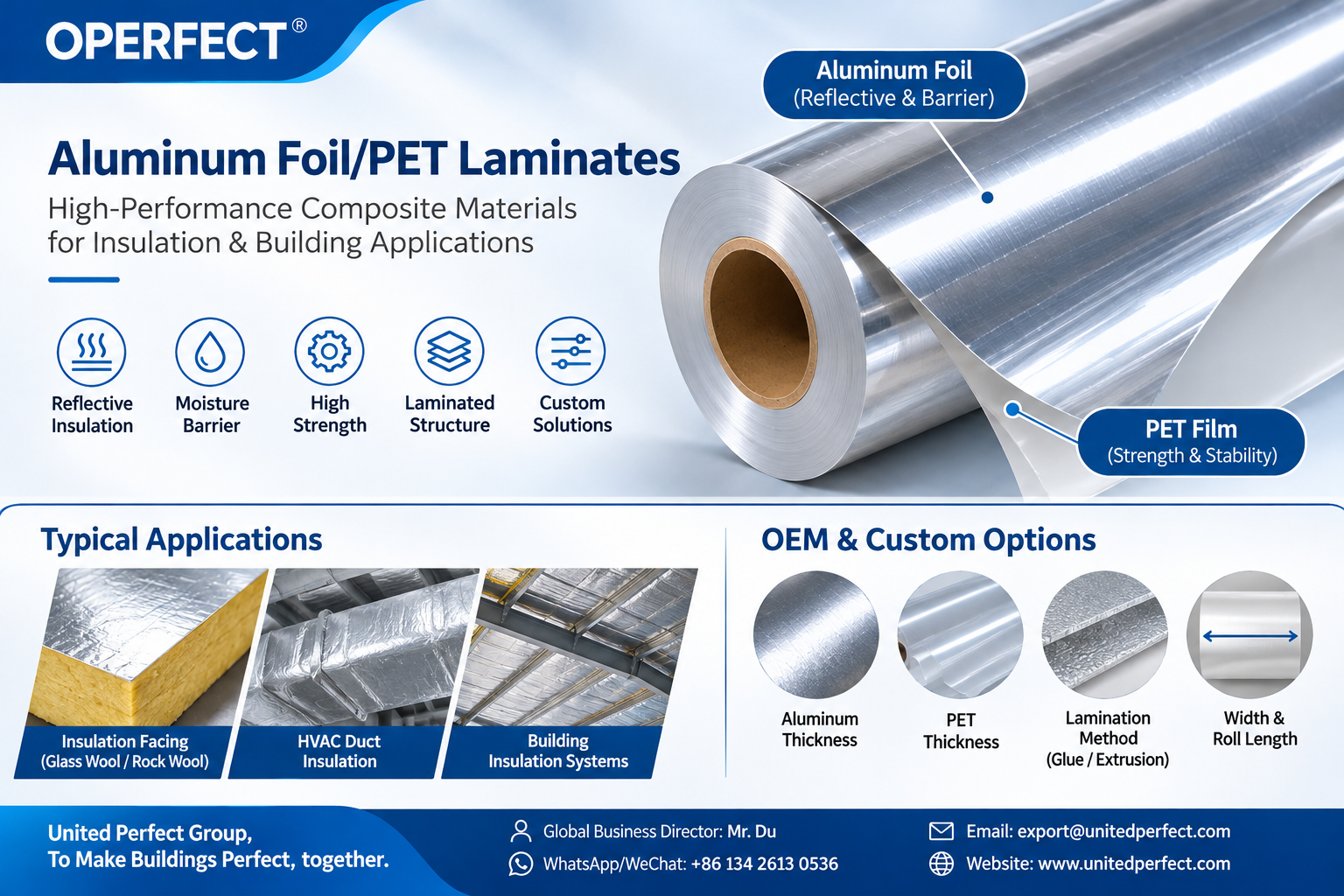
In addition to fiberglass-based materials, OPERFECT’s established supply portfolio includes selected aluminum foil composite facings used in insulation applications.
For manufacturers purchasing multiple facing materials, coordinated sourcing discussions may help simplify product evaluation and procurement.
Our objective is to support insulation manufacturers with practical material selection, clear specifications and dependable supply coordination.
12. Frequently Asked Questions
1. What is the difference between black fiberglass fabric and black fiberglass tissue?
Fiberglass fabric is generally woven from glass fiber yarns, while fiberglass tissue is a nonwoven sheet formed from glass fibers and binder. Their structures and applications can differ significantly.
2. What GSM options does OPERFECT offer for black fiberglass materials?
OPERFECT commonly supplies black fiberglass fabric in approximately 127–200 GSM and black fiberglass tissue in approximately 40–100 GSM.
Other weights can be evaluated according to customer requirements.
3. Is black fiberglass tissue suitable for acoustic panels?
It may be suitable for selected acoustic panel applications, depending on its surface characteristics, permeability, bonding behavior and the complete panel design.
4. Does higher GSM always mean stronger fiberglass material?
No. Strength also depends on fiber construction, yarn structure, binder and coating.
5. Can black fiberglass materials be supplied in customized widths?
Custom widths may be available depending on the selected material and production requirements.
6. Does black fiberglass fabric have fire-retardant properties?
Fire performance depends on the finished material, including coatings and binders. Buyers should request relevant technical evidence rather than assume performance based on color or glass fiber content.
7. What surface treatments are available?
Available treatments depend on the material and manufacturing process. Buyers should provide their requirements for color, bonding, permeability and other relevant characteristics.
8. Which is better for rock wool boards: fiberglass fabric or tissue?
The correct choice depends on the board construction, required reinforcement, surface appearance, bonding method and intended application.
9. Can I test the material on my own production line?
Yes. Production trials are recommended when compatibility with adhesives, equipment or finished insulation products is important.
10. What is the MOQ for customized black fiberglass materials?
MOQ depends on material construction, weight, width, surface treatment and order requirements. Please provide your specifications for evaluation.
11. Can OPERFECT supply other insulation facing materials?
OPERFECT also coordinates selected aluminum foil composite facing materials for insulation applications. Product availability and specifications should be confirmed during quotation.
13. Request Black Fiberglass Fabric or Tissue Samples and Specifications
Are you manufacturing glass wool boards, rock wool insulation, acoustic panels or other insulation composites?
Selecting the right fiberglass facing begins with understanding your product and production requirements.
OPERFECT supports professional insulation material buyers with material sourcing, specification coordination, sample discussions and international supply services.
Send Us Your Requirements
For a more accurate quotation, please provide:
- Material Type: Black Fiberglass Fabric or Black Fiberglass Tissue
- Application: Glass Wool, Rock Wool, Acoustic Panel or Other
- Basis Weight: Required GSM and tolerance
- Roll Width: Required width and tolerance
- Roll Length: Preferred length or roll configuration
- Surface Treatment: Black coating, binder or other finishing requirements
- Performance Requirements: Strength, permeability, fire performance or other relevant characteristics
- Production Process: Lamination, bonding or other application details
- Estimated Quantity: Trial order, monthly demand or annual purchasing volume
- Shipping Destination: Country, port or delivery address
Tell us about your insulation product and production requirements. Our team can help you evaluate suitable fiberglass facing options.
OPERFECT | Jinan United Perfect Building Materials Corporation
United Perfect Group, To Make Buildings Perfect, together.
Global Business Director: Mr. Du
WhatsApp/WeChat: +86 134 2613 0536
Электронная почта: export@unitedperfect.com
Веб-сайт: www.unitedperfect.com