Aluminum Foil/PET Laminates: How to Select the Right Multilayer Structure for Industrial Applications
What Is an Aluminum Foil/PET Laminate?
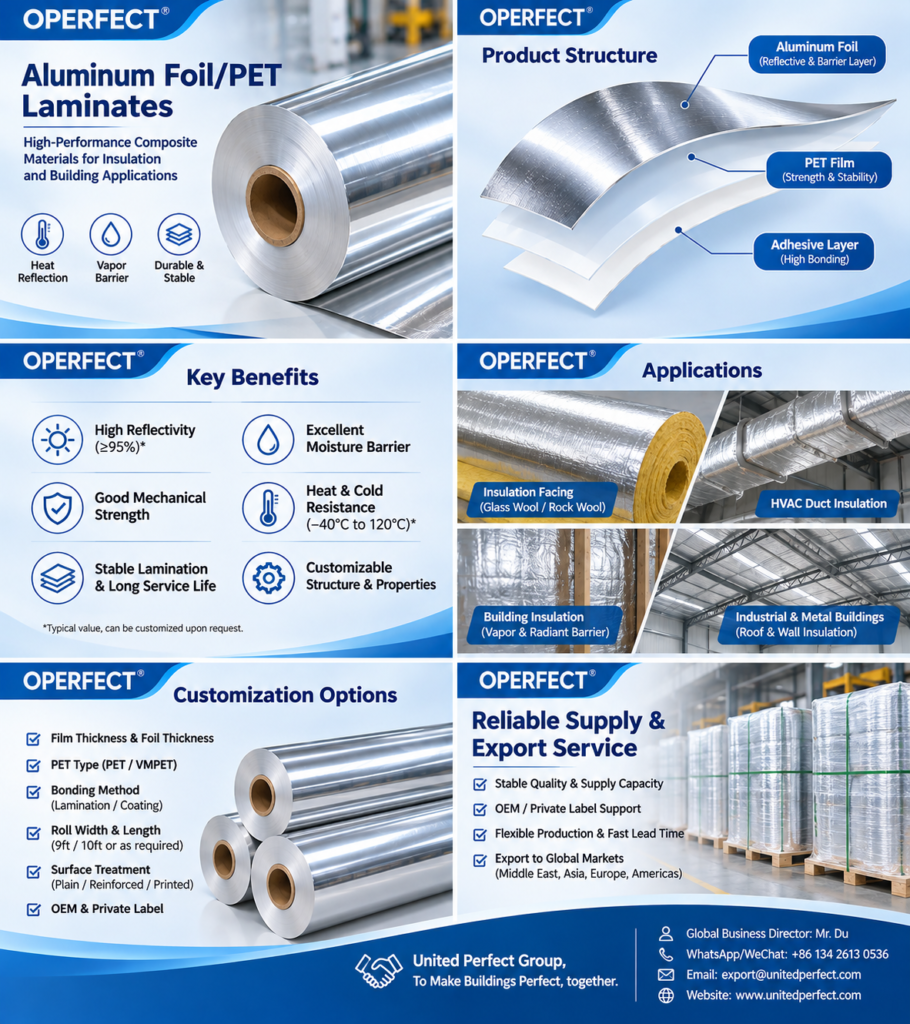
An aluminum foil/PET laminate is a flexible composite material that combines aluminum foil with polyethylene terephthalate (PET) film through a suitable lamination process.
Aluminum foil provides a high-barrier metallic layer, while PET contributes mechanical support, dimensional stability and surface protection.
Depending on the intended application, additional polymer layers such as polyethylene (PE) may be incorporated to provide flexibility or heat-sealing functionality.
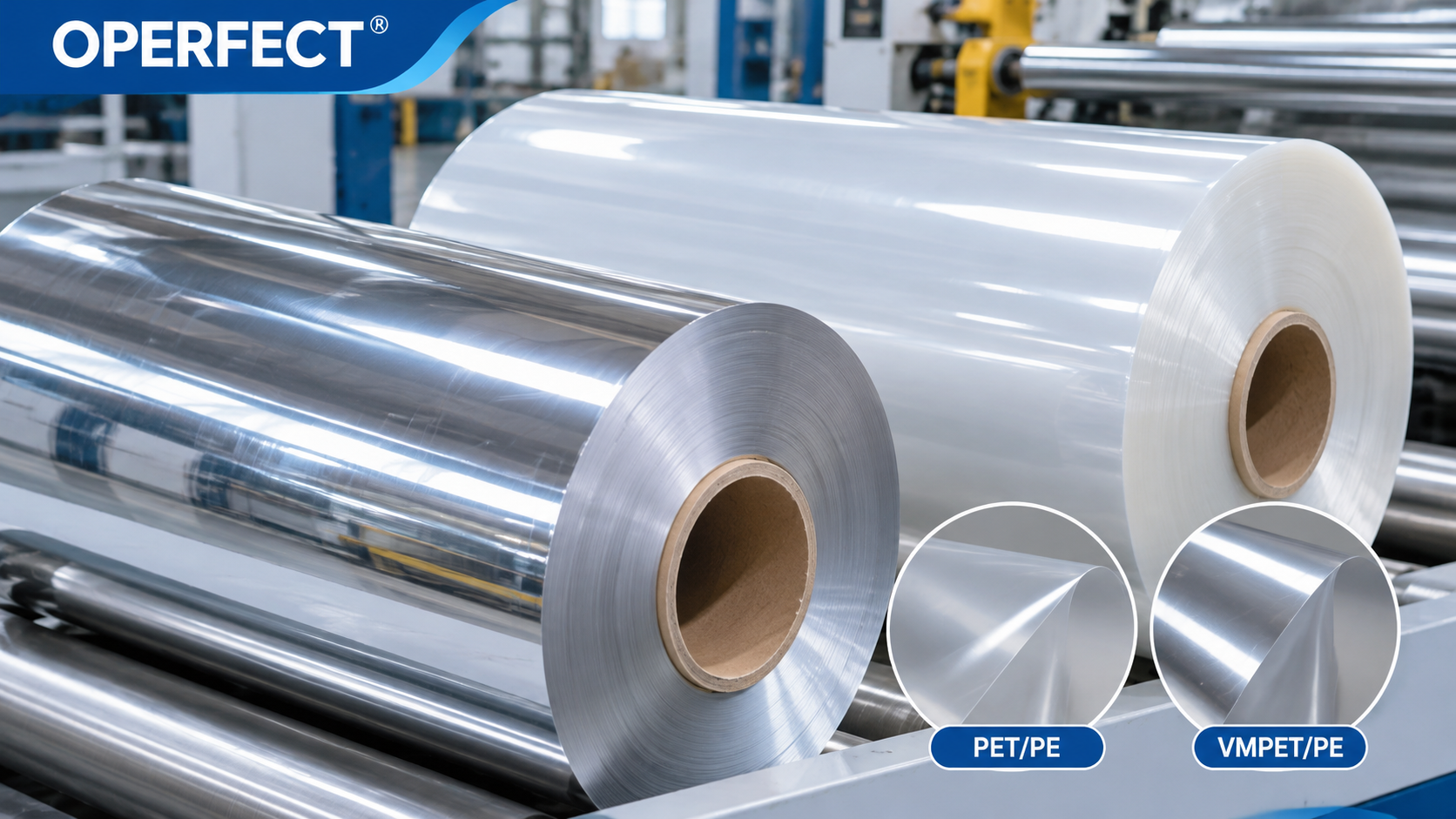
Common constructions include ALU/PET, PET/ALU/PET, ALU/PET/PE and ALU/PE.
However, these structures are not interchangeable. Differences in layer thickness, material orientation, adhesive systems and converting requirements can significantly influence finished-product performance.
For industrial buyers, selecting the right laminate begins with understanding what each layer must do—not simply choosing the lowest-priced material.
OPERFECT supports customized aluminum foil and polymer laminates through material structure analysis, production resource coordination, sample development and international export services.
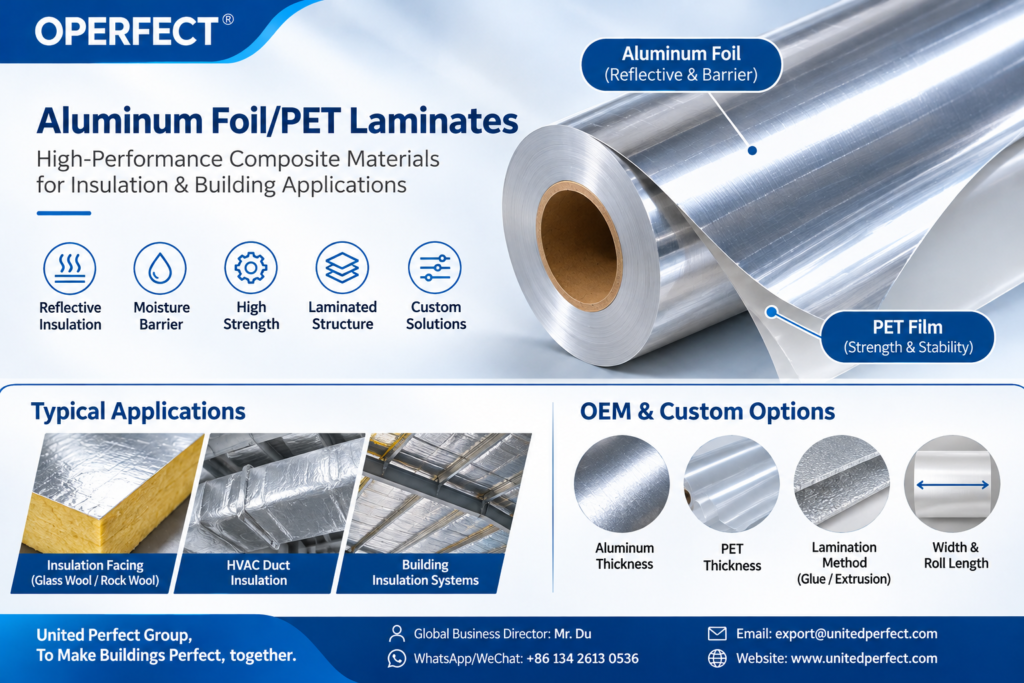
Common Aluminum Foil Laminate Structures
1. ALU/PET — Aluminum Foil + Polyester Film
ALU/PET is a two-material laminate combining aluminum foil with PET film.
The aluminum foil layer contributes barrier characteristics, while PET can improve handling, mechanical support and dimensional stability.
This construction may be suitable for industrial converting, protective materials and specialized composite applications, depending on the specified performance requirements.
Key parameters include:
- Aluminum foil thickness
- PET film thickness
- Adhesive and lamination method
- Exposed surface and winding orientation
- Roll width and converting requirements
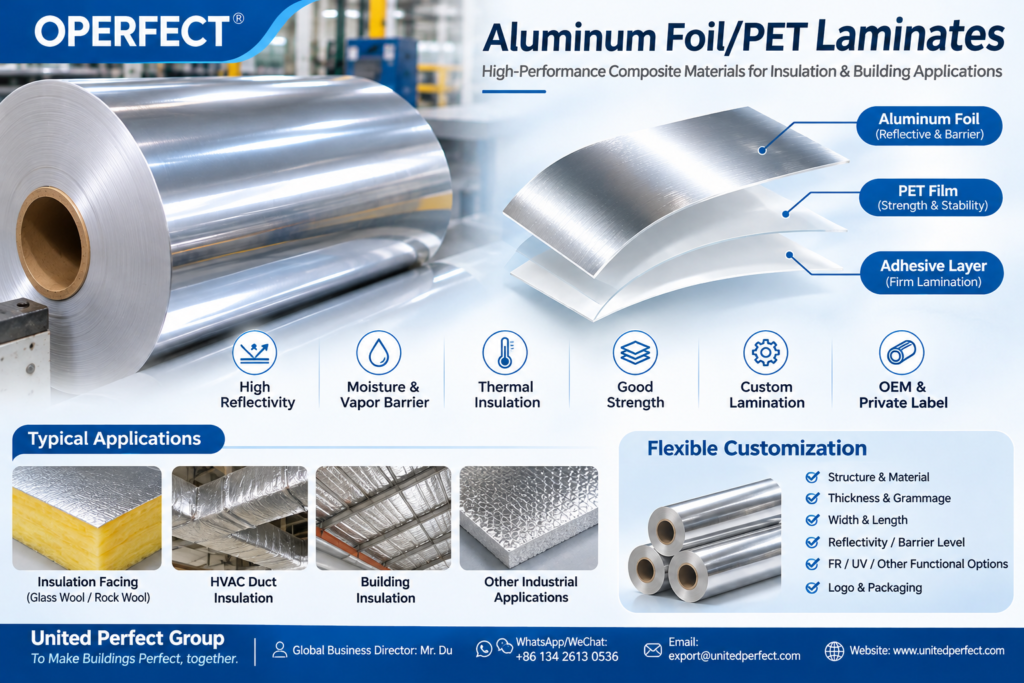
2. PET/ALU/PET — Polyester + Aluminum Foil + Polyeste
PET/ALU/PET is a three-material structure in which aluminum foil is positioned between two PET films.
The PET layers provide polymer surfaces on both sides of the foil, which may be useful when the application requires defined surface characteristics or additional handling protection.
Importantly, the PET films on either side do not necessarily need to have identical thicknesses or finishes.
For example, a customer may require a white-printed PET surface on one side and a transparent PET surface on the other.
The exact structure must be confirmed through technical evaluation and production feasibility assessment.
3. ALU/PET/PE — Aluminum Foil + Polyester + Polyethylene
ALU/PET/PE combines the barrier characteristics of aluminum foil, the mechanical support of PET and the potential heat-sealing functionality of PE.
It may be evaluated for specialized flexible converting and industrial composite applications.
However, heat-sealing performance depends on the PE grade, layer arrangement and actual sealing conditions.
Buyers should verify compatibility with their equipment through representative samples and application-specific testing.
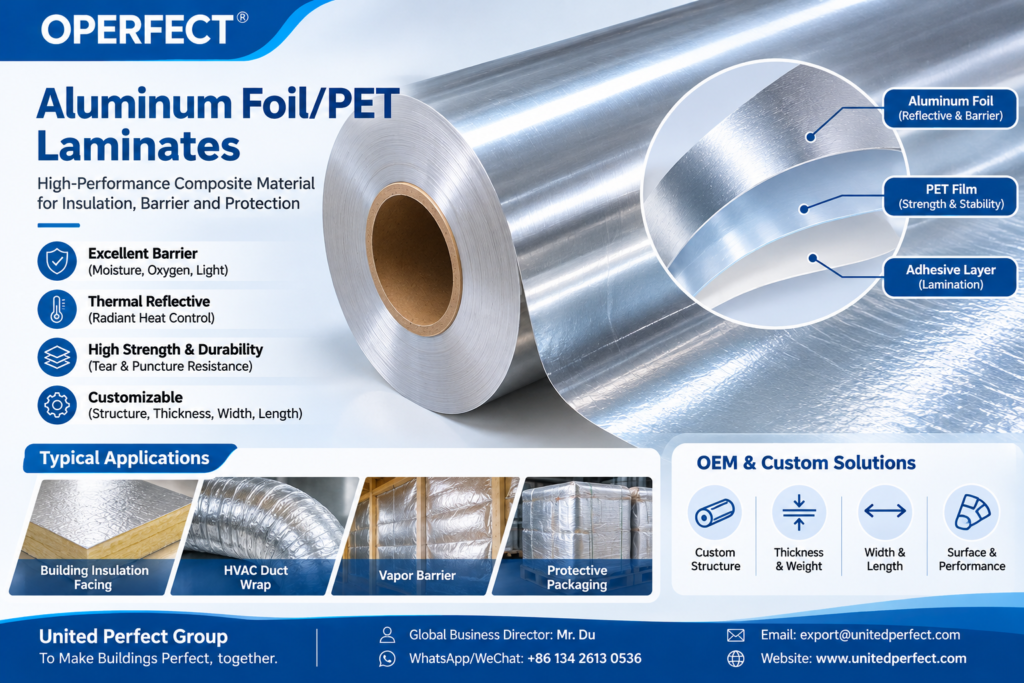
4. ALU/PE — Aluminum Foil + Polyethylene
ALU/PE is a comparatively straightforward foil/polymer construction.
It may be considered where aluminum foil barrier properties and PE flexibility or sealing characteristics are required.
The suitability of this structure depends on the final application, bonding quality, foil integrity and downstream processing conditions.
ALU/PET vs. PET/ALU/PET vs. ALU/PET/PE
| Laminate Structure | Main Characteristics | Key Selection Considerations |
|---|---|---|
| ALU/PET | Aluminum foil with PET support | Foil thickness, PET thickness, surface orientation |
| PET/ALU/PET | Aluminum foil between two PET films | Two-sided protection, printing, dimensional stability |
| ALU/PET/PE | Foil, PET and PE combined | Barrier, strength, flexibility and heat sealing |
| ALU/PE | Foil with PE layer | Sealing requirements, flexibility and adhesion |
Important: The structure name alone does not establish a finished laminate’s measured barrier performance, peel strength, temperature resistance or regulatory suitability.
These characteristics should be verified against the customer’s technical requirements.
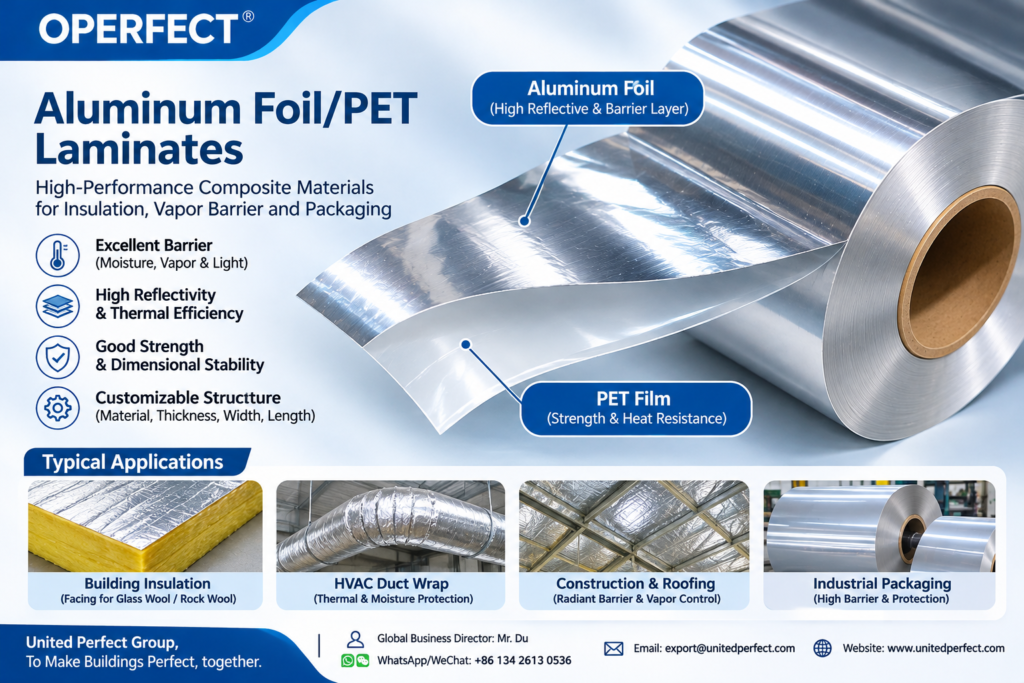
Six Critical Factors When Selecting a Custom Aluminum Foil Laminate
1. Aluminum Foil Thickness and Integrity
Aluminum foil thickness influences handling characteristics, mechanical robustness and resistance to damage during converting.
Very thin foil may be more vulnerable to pinholes or processing damage.
However, selecting a thicker foil is not automatically the best solution. Material cost, flexibility and downstream process compatibility must also be considered.
Buyers should specify the required foil thickness and any relevant barrier or mechanical acceptance criteria.
2. PET and PE Film Thickness
Polymer film thickness can influence stiffness, flexibility, tensile behavior, dimensional stability and sealing characteristics.
A total laminate thickness specification is often insufficient.
For customized structures, it is preferable to identify individual layer thicknesses wherever possible.
This helps suppliers evaluate material availability, manufacturing feasibility and potential performance differences.
3. Lamination Quality and Interlayer Adhesion
The lamination process is essential to finished-product reliability.
Poor bonding can cause delamination during converting, winding, handling or subsequent processing.
Depending on the application, relevant evaluation may include peel strength, visual defects, temperature exposure and aging performance.
The appropriate acceptance criteria should be agreed upon before commercial production.
4. Printing, Surface Appearance and Material Orientation
Aluminum foil laminates are often recognized by their metallic silver appearance.
However, finished materials may also have white or other printed surfaces.
For example, a white-printed PET layer can produce a white external appearance even when the underlying laminate contains aluminum foil.
A laminate’s visible color does not necessarily identify its internal material structure.
Industrial buyers should confirm:
- Which surface is printed
- Which layer faces outward
- Whether printing is exposed or protected
- Surface appearance and color requirements
- Compatibility with downstream processing
5. Roll Width, Length and Winding Direction
Correct material structure is only part of a successful custom laminate project.
Roll specifications must also match the customer’s equipment.
Important parameters include roll width, roll length, core diameter, maximum outside diameter, winding tension and surface orientation.
For asymmetric laminates, inside/outside winding direction can be especially important.
Incorrect winding orientation may create production interruptions or require additional rewinding.
6. Export Packaging and Transportation Protection
Finished laminate rolls should be protected against handling damage, contamination and unsuitable storage conditions.
Depending on the product and shipment requirements, protective wrapping, pallet packaging and appropriate roll support may be necessary.
OPERFECT coordinates packaging and international delivery arrangements based on the agreed technical and commercial specifications.
Custom Aluminum Foil Laminates: Why a Reference Sample Can Be More Useful Than a Product Name
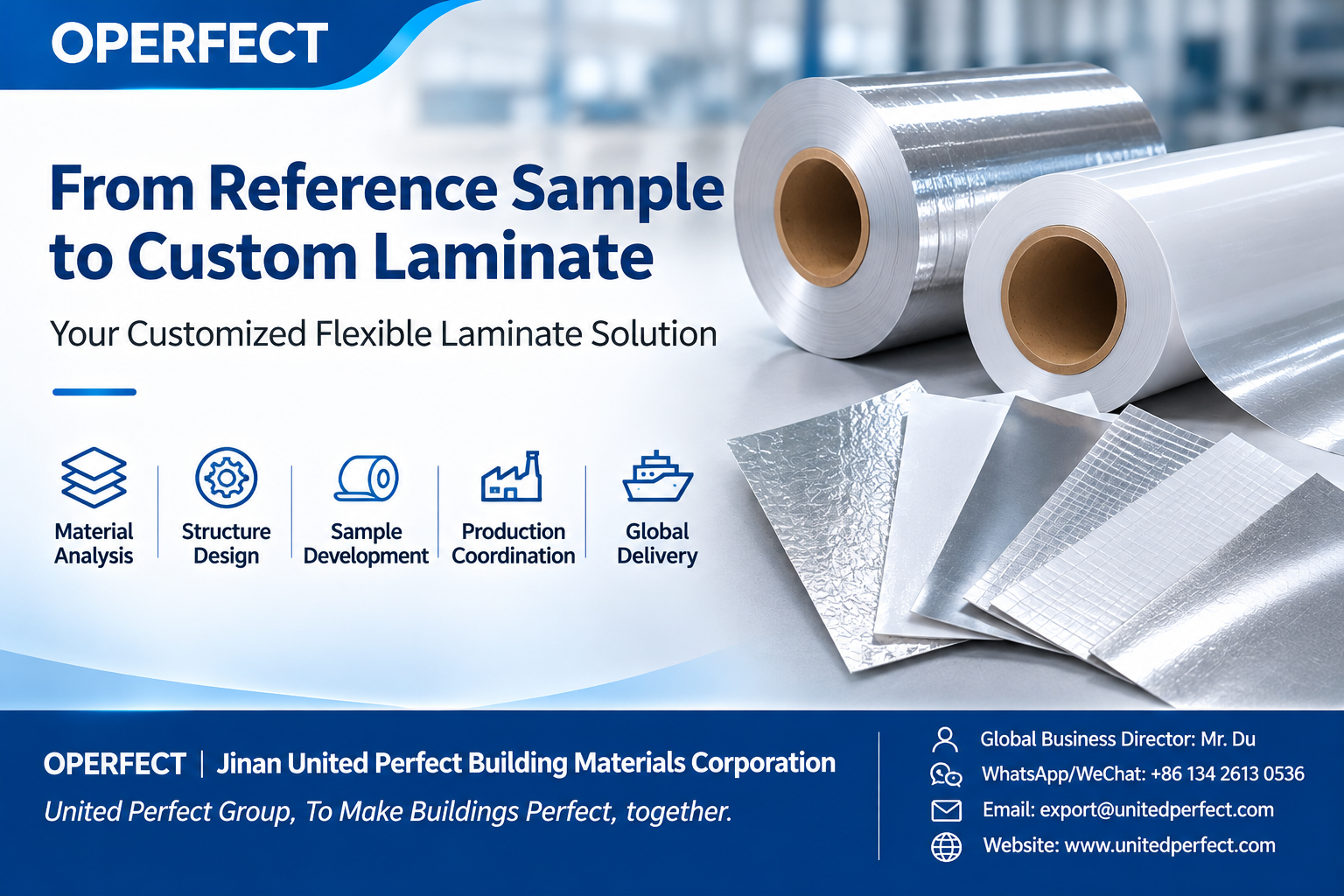
Many industrial buyers approach suppliers with an existing material sample rather than a complete technical specification.
They may know that the material works in their production process but not know its precise construction.
A supplier who only offers standard catalog products may struggle to identify a suitable alternative.
OPERFECT approaches these projects through a structured technical review.
Step 1 — Receive the reference sample or technical requirements.
Customers can provide an existing laminate, drawings, layer specifications or relevant performance requirements.
Step 2 — Analyze the material structure.
The available sample and documentation are reviewed to identify likely layers, thicknesses, surfaces and construction characteristics.
Where necessary, additional analysis or testing may be required.
Step 3 — Evaluate production feasibility.
OPERFECT assesses whether the requested structure can be manufactured using available materials and suitable production processes.
Step 4 — Match suitable manufacturing resources.
Different factories have different capabilities. OPERFECT coordinates with appropriate manufacturing partners based on the project’s technical requirements.
Step 5 — Arrange sampling and customer evaluation.
Where feasible, representative samples are prepared for customer review and application trials.
Step 6 — Confirm commercial production and delivery.
Following specification approval, OPERFECT coordinates production, roll configuration, packaging and export shipment.
This approach is particularly valuable for specialized multilayer laminates that cannot be selected reliably from appearance or a generic product description alone.
OEM Customization Options
OPERFECT can evaluate a range of customization requirements for aluminum foil/polymer laminates.
Material construction: ALU/PET, PET/ALU/PET, ALU/PET/PE, ALU/PE and other technically feasible multilayer combinations.
Layer specifications: Aluminum foil and polymer film thicknesses according to the customer’s requirements.
Surface appearance: Natural silver, white printing and other feasible printing or finishing options.
Roll configuration: Width, length, core size, roll diameter and winding direction.
Packaging: Protective wrapping, pallet arrangements and export shipment preparation.
Sample-based development: Technical review of existing materials when the original construction is unknown or incomplete.
Minimum order quantities, tolerances, printing requirements and production lead times depend on the proposed structure and manufacturing process.
Typical Industrial Applications
Depending on the actual construction and verified performance, aluminum foil/polymer laminates may be evaluated for:
- Industrial protective and barrier materials
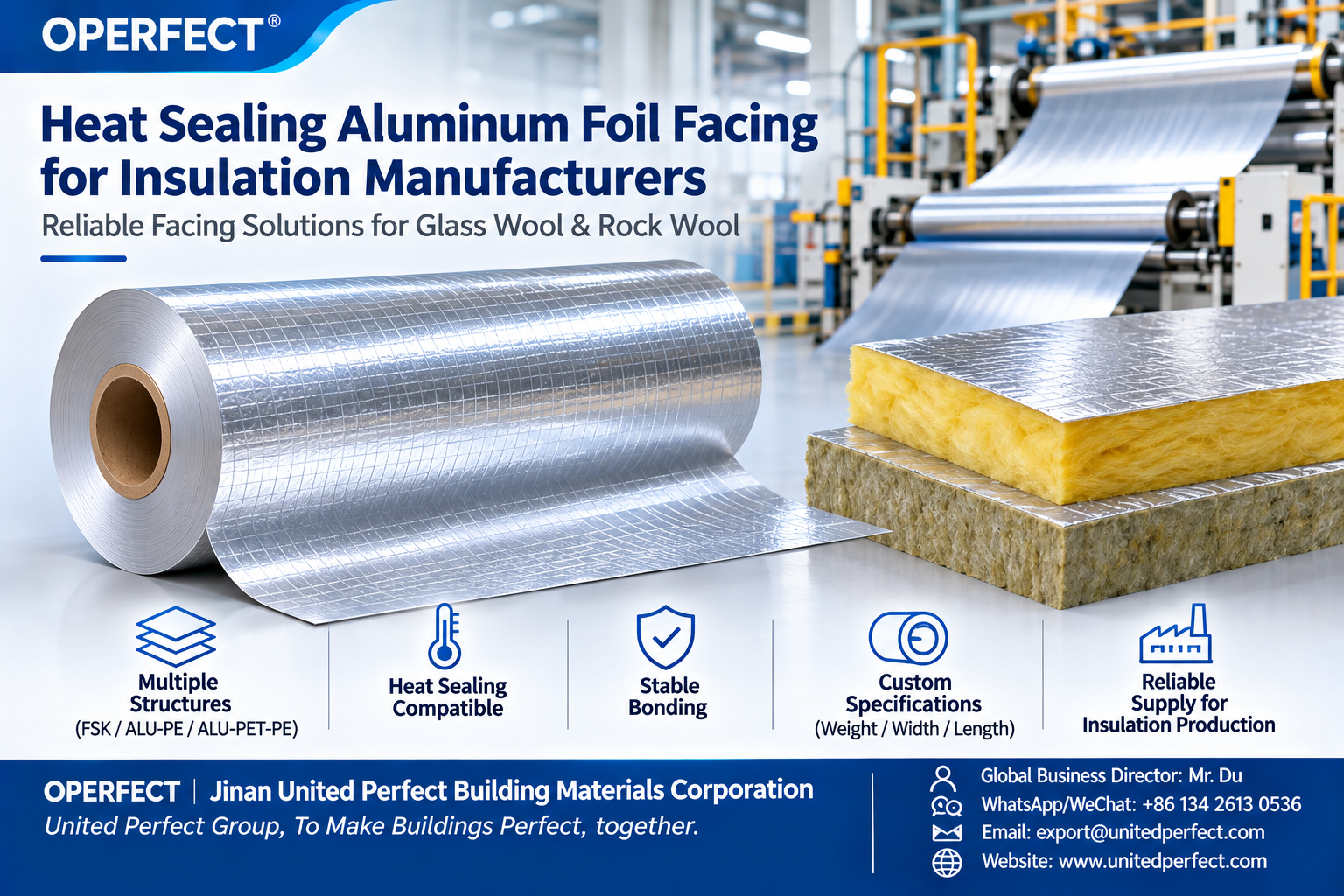
- Insulation facing and composite applications
- Flexible converting and specialty laminating
- Heat-sealable composite materials
- Printed multilayer films
- Customer-specific industrial material development
Not every laminate is suitable for every application.
Projects involving food contact, flame resistance, electrical insulation or other regulated uses require appropriate material selection, testing and supporting documentation.
Why International Buyers Work with OPERFECT
Custom laminate sourcing requires more than access to production equipment.
It requires an understanding of material structures, the ability to communicate technical requirements and the experience to coordinate manufacturing and international delivery.
OPERFECT draws on extensive experience in aluminum foil composite materials and international building-material supply.
Rather than presenting every project as a standard product, our team works to understand the customer’s actual requirements and identify practical manufacturing solutions.
Our capabilities include:
- Material structure review and sample-based development
- Coordination with suitable manufacturing partners
- Customized roll specifications and printing requirements
- Sampling and technical communication
- Export packaging and international logistics support
- Long-term supply coordination for repeat orders
Our objective is to help customers source materials that fit their applications—not simply supply a laminate with a familiar product name.
Frequently Asked Questions
What is the difference between ALU/PET and PET/ALU/PET?
ALU/PET combines aluminum foil and PET film. PET/ALU/PET places aluminum foil between two PET films, creating PET surfaces on both sides.
Can the two PET layers have different thicknesses?
Different PET thicknesses can be evaluated according to the customer’s requirements and manufacturing feasibility.
Can aluminum foil laminates be white instead of silver?
Yes. A white appearance may be achieved through printing or an appropriate surface construction. The visible color does not necessarily indicate the internal material structure.
Can OPERFECT develop a custom laminate from my existing sample?
Yes. Customers may provide physical samples or technical documentation for structure review and production feasibility evaluation.
Is aluminum foil laminate completely moisture-proof?
An intact aluminum foil layer can provide excellent barrier properties, but actual finished-product performance depends on foil integrity, pinholes, converting damage and the complete construction. Specific performance claims require appropriate testing.
Can you customize the winding direction?
Winding direction and inside/outside surface orientation can be specified, subject to production capability.
What should I provide to receive a quotation?
Please share the laminate structure or reference sample, required thickness, roll width and length, printing requirements, quantity, destination and any critical performance specifications.
Does OPERFECT support international delivery?
Yes. OPERFECT coordinates export packaging and international shipping arrangements according to the agreed order terms.
Request a Custom Aluminum Foil Laminate Quotation
Do you need ALU/PET, PET/ALU/PET, ALU/PET/PE or another specialized multilayer laminate?
Send us your existing material sample, technical drawing or required layer structure.
Our team can help review the construction, evaluate customization feasibility and coordinate a suitable supply solution.
OPERFECT | Jinan United Perfect Building Materials Corporation
United Perfect Group — To Make Buildings Perfect, together.
Contact Our Global Team
Global Business Director: Mr. Du
WhatsApp/WeChat: +86 134 2613 0536
Электронная почта: export@unitedperfect.com
Official Website: www.unitedperfect.com