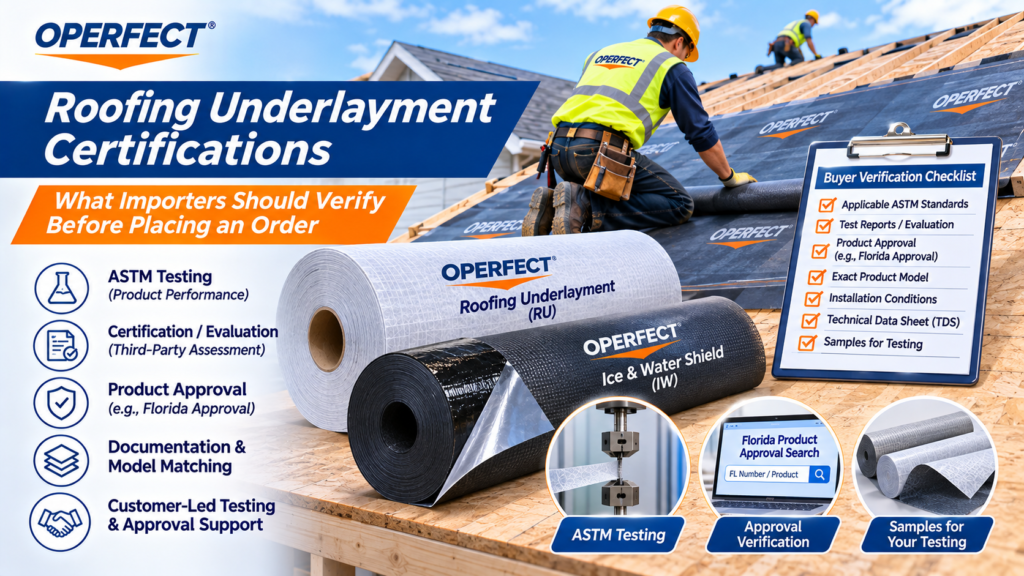
Roofing Underlayment Certifications: What Importers Should Verify Before Placing an Order
A Practical Guide to ASTM Testing, Florida Product Approval, Technical Documentation and Customer-Led Compliance for North American Roofing Importers
For roofing material importers, distributors and private-label brands in the United States and Canada, sourcing roofing underlayment involves more than comparing prices, roll weights and product specifications.
One important question is often overlooked:
Does the roofing underlayment meet the technical and regulatory requirements of your target market?
For example, buyers sourcing roofing materials for Florida may need to consider specific product approval requirements. Canadian importers may focus on cold-weather performance, ice-dam protection and relevant building-code provisions.
However, there is an important distinction between a product that has undergone ASTM testing, a product with third-party certification and a product that has received regulatory approval.
Understanding these differences helps importers make informed purchasing decisions, reduce compliance risks and develop suitable private-label roofing product programs.
This guide explains what buyers should verify before ordering synthetic roofing underlayment (RU) and ice and water shield (IW), including how importers can work with suppliers to support customer-led product testing and approval projects.
1. Why Roofing Underlayment Documentation Matters
Roofing underlayment serves as a secondary protective layer beneath the primary roof covering.
Depending on the material and roofing assembly, it can help protect roof decking against moisture intrusion and provide additional protection during installation.
However, roofing requirements vary across North America.
A roofing underlayment suitable for one application may not be appropriate for another.
For example:
- Florida projects may involve high-wind requirements and specific product approval conditions.
- Canadian roofing systems may require particular attention to cold-weather performance and ice-dam protection.
- Metal roofing applications may involve different temperature and material compatibility considerations.
- Asphalt shingle installations may have different fastening, overlap and underlayment requirements.
For importers, this means that product selection should be based on both technical performance and applicable market requirements.
A product that performs well in laboratory testing is not automatically approved for every building application.
Before placing an order, buyers should verify the product construction, technical documentation, applicable standards, installation conditions and relevant local requirements.
2. ASTM Testing vs. Certification vs. Product Approval
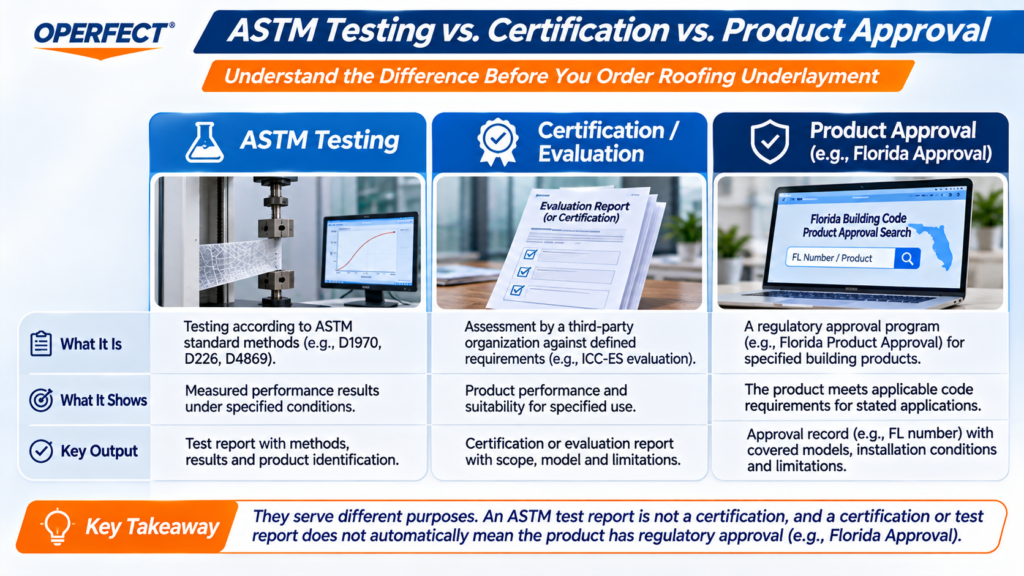
These terms are often used together, but they do not mean the same thing.
ASTM Testing
ASTM International develops standards and test methods used to evaluate construction materials.
A roofing underlayment may be tested according to relevant ASTM standards to measure particular performance characteristics.
A test report typically identifies the tested product, testing method, test conditions and results.
However, passing an ASTM test does not automatically mean that a product has received regulatory approval.
Third-Party Certification or Evaluation
Third-party certification or evaluation may provide additional evidence of conformity with defined requirements.
Depending on the program, the documentation may include product identification, performance requirements, evaluation findings and conditions of use.
The scope of the certification or evaluation must be reviewed carefully.
Product Approval
Product approval is a separate regulatory or administrative process.
In Florida, for example, certain building products are subject to product approval requirements under the applicable Florida Building Code framework.
A product approval may identify specific models, installation methods, limitations and permitted applications.
Key Differences for Importers
| Document Type | What It Demonstrates | What Buyers Should Verify |
|---|---|---|
| ASTM Test Report | Performance under specified testing conditions | Test method, results and product identification |
| Third-Party Certification | Conformity within a defined certification program | Certification scope, validity and covered models |
| Evaluation Report | Technical assessment against stated criteria | Product coverage, limitations and applicable code |
| Florida Product Approval | Approval under an applicable Florida approval pathway | Approval status, covered models and installation conditions |
| Installation Instructions | Required or recommended installation procedures | Compatibility with the intended roofing system |
Buyer Tip: Do not accept the general statement “ASTM certified” without asking which standard applies and what documentation supports the claim.
3. Which ASTM Standards Are Relevant to Roofing Underlayment?
Different roofing underlayment materials may be evaluated under different standards.
The applicable requirements depend on product construction, intended use, roofing assembly and local building regulations.
ASTM D1970 — Self-Adhering Polymer-Modified Bituminous Sheet Materials
ASTM D1970 is an important specification for qualifying self-adhering polymer-modified bituminous sheet materials used as steep-roofing underlayment for ice-dam protection.
It is particularly relevant when evaluating certain ice and water shield products.
Importers should request documentation showing whether the exact proposed membrane has been evaluated against the applicable requirements.
ASTM D226 — Asphalt-Saturated Organic Felt
ASTM D226 covers specified asphalt-saturated organic felt materials used in roofing and waterproofing applications.
It should not automatically be applied to all synthetic roofing underlayments.
ASTM D4869 — Asphalt-Saturated Organic Felt Underlayment
ASTM D4869 applies to specified asphalt-saturated organic felt underlayment materials.
Its applicability depends on the actual product construction.
ASTM D6757 — Underlayment Felt Containing Inorganic Fibers
ASTM D6757 addresses certain underlayment materials containing inorganic fibers.
It is not a universal standard for every roofing membrane.
Synthetic Roofing Underlayment Evaluation
Synthetic roofing underlayment may be assessed through other applicable standards, code provisions or evaluation criteria.
For example, ICC-ES AC188 is used in the evaluation of certain roof underlayments.
Buyers should verify which requirements apply to the proposed product rather than assume that all synthetic membranes are evaluated under the same standard.
The correct approach is to identify the product first, determine the applicable requirements and then review the supporting technical evidence.
4. Understanding Florida Product Approval
Florida is an important market for roofing materials because of its building-code requirements and exposure to severe weather conditions.
For importers and private-label brands, understanding Florida Product Approval can help prevent unsuitable purchasing decisions.
What Is Florida Product Approval?
Florida operates a statewide product approval system for specified building products, including roofing products.
The system provides a formal mechanism for evaluating covered products against applicable requirements.
However, Florida also recognizes local approval pathways, and the appropriate route depends on the product and intended application.
What Is an FL Number?
An FL number identifies a product approval record within Florida’s statewide product approval database.
Buyers can search the official database to review available information.
However, having an FL number does not mean that every product supplied by the same company is approved.
The approval must cover the exact product and applicable conditions.
Is Florida Approval the Same as Miami-Dade NOA?
No.
A Miami-Dade Notice of Acceptance (NOA) is associated with a separate product approval process.
The relevant approval pathway, scope and acceptance conditions must be verified for the intended project.
What About High-Velocity Hurricane Zones?
Certain Florida locations are subject to High-Velocity Hurricane Zone requirements.
Not every roofing product approval covers these applications.
Buyers should confirm whether the product and installation method are suitable for the intended location.
Important: ASTM testing, Florida statewide approval and Miami-Dade NOA are not interchangeable.
5. How to Verify Roofing Underlayment Approval Before Ordering
Before committing to a commercial order, importers should verify the applicable documentation.
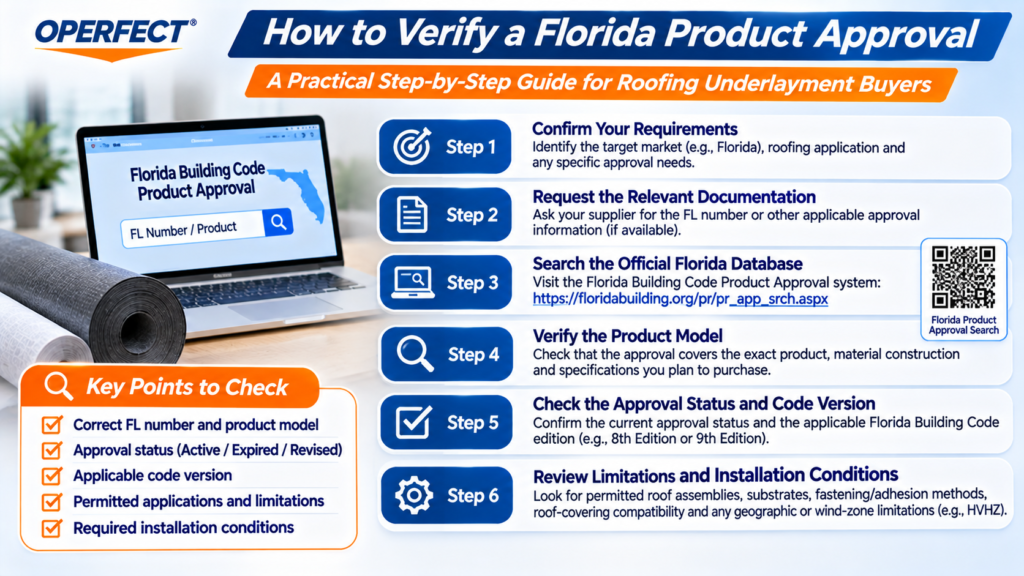
Step 1: Identify Your Market Requirements
Determine the intended country, state, province and roofing application.
If the project requires a particular product approval, establish that requirement before selecting the product.
Step 2: Request the Relevant Documentation
Ask the supplier whether the proposed product has applicable test reports, evaluation reports, certifications or product approvals.
If a particular document is unavailable, the supplier should communicate this clearly.
Step 3: Verify the Product Model
Confirm that the documentation identifies the exact material construction and model being quoted.
A similar product name or appearance is not sufficient evidence.
Step 4: Check the Document’s Scope and Status
Review the applicable code edition, document status, limitations and any relevant expiration or renewal requirements.
Step 5: Review Installation Conditions
Verify substrate compatibility, fastening or adhesion requirements, roof-covering compatibility and other installation limitations.
Step 6: Confirm With the Relevant Authority
Where necessary, consult the appropriate building department, qualified design professional or evaluation organization.
For Florida statewide approvals, buyers can use the official product approval database:
A product approval should be evaluated together with the product specifications and intended installation—not simply by checking whether an approval number exists.
6. Synthetic Roofing Underlayment vs. Ice & Water Shield: What Should Buyers Verify?
Synthetic roofing underlayment and ice and water shield serve related but different functions within roofing protection systems.
Their technical evaluation priorities are therefore different.
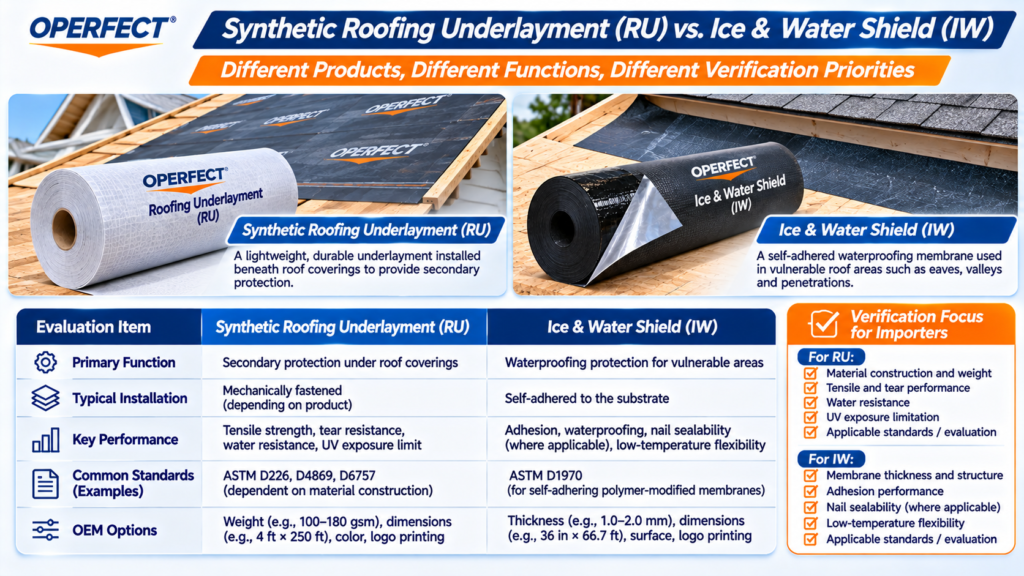
Synthetic Roofing Underlayment (RU)
Synthetic roofing underlayment is commonly installed beneath compatible roof coverings to provide secondary protection.
Depending on the product, it may be mechanically fastened to the roof deck.
Key purchasing considerations include:
- Material construction and weight
- Tensile strength
- Tear resistance
- Water resistance
- Slip resistance
- UV exposure limitations
- Roll width and length
- Fastening and overlap requirements
- Applicable testing and evaluation documentation
Ice & Water Shield (IW)
Ice and water shield is typically a self-adhered waterproofing membrane used in vulnerable roofing areas.
Applications may include roof eaves, valleys, penetrations and other locations requiring additional water protection.
Key purchasing considerations include:
- Membrane structure
- Total thickness
- Adhesive construction
- Adhesion performance
- Nail sealability, where applicable
- Low-temperature flexibility
- Water resistance
- Installation temperature limitations
- Substrate compatibility
- Applicable testing and approval requirements
RU vs. IW: Technical Verification Priorities
| Evaluation Factor | Synthetic Roofing Underlayment | Ice & Water Shield |
|---|---|---|
| Typical installation | Mechanically fastened, depending on product | Self-adhered |
| Main performance focus | Strength, water resistance and installation | Adhesion, waterproofing and vulnerable roof protection |
| Key installation concerns | Fastening, overlaps and exposure limits | Substrate preparation, adhesion and temperature |
| OEM options | Weight, dimensions, color, logo | Dimensions, thickness, surface configuration, logo |
| Compliance review | Applicable underlayment standards and evaluation | Applicable membrane standards and evaluation |
Buyer Insight: The technical documents requested for RU and IW should reflect their different material constructions and intended applications.
7. What If Your Supplier Does Not Already Hold North American Product Approval?
This is an important consideration for importers developing their own roofing material brands.
Not every international roofing material supplier maintains product approvals for every North American market.
Testing, evaluation and approval processes can require substantial investment, technical preparation and ongoing compliance obligations.
For some manufacturers and export suppliers, obtaining multiple approvals independently may not be commercially practical.
However, the absence of an existing approval does not automatically mean that a product cannot be considered for a customer-led testing or approval project.
Importers planning long-term private-label product programs may choose to arrange independent testing and pursue applicable evaluation or approval pathways for selected materials.
This approach requires careful planning.
A Practical Customer-Led Evaluation Process
1. Define the Target Market
Identify the country, state or province where the product will be sold or used.
2. Establish Applicable Requirements
Consult qualified testing, evaluation or approval organizations to determine the appropriate standards and process.
3. Select a Suitable Product
Work with the supplier to identify a material construction that may be appropriate for evaluation.
4. Review Available Technical Information
Request product specifications, material information and any existing relevant technical documentation.
5. Arrange Independent Testing
The customer coordinates testing with an appropriate laboratory or evaluation organization.
6. Evaluate the Results
Review whether the product meets the applicable technical criteria.
7. Pursue Approval Where Required
If the evaluation results and program requirements permit, the customer proceeds through the applicable approval pathway.
8. Establish Repeat-Order Specifications
After successful evaluation, agree on product identification, specifications, production consistency and ongoing documentation requirements.
Important Commercial Considerations
Before beginning a testing or approval project, the buyer and supplier should discuss:
- Testing and application costs
- Responsibility for the approval process
- Product identification and branding
- Technical documentation availability
- Expected purchasing quantities
- Commercial pricing
- Long-term supply arrangements
- Responsibilities for future material changes
Testing or approval cannot be guaranteed. A customer-led project must follow the requirements of the relevant testing organization and approval authority.
8. How OPERFECT Supports Customer-Led Testing and Product Approval
OPERFECT understands that North American importers and private-label roofing brands may require product testing, evaluation or regulatory approval before entering certain markets.
We also recognize that certification and approval processes can involve significant costs.
OPERFECT does not currently claim independent North American product approvals for its RU and IW product range.
Instead, we offer a practical sourcing approach for customers who wish to evaluate selected materials and arrange their own testing or approval projects.
Product Sample Support
OPERFECT can coordinate samples of selected synthetic roofing underlayment and ice and water shield products for customer evaluation.
Sample specifications and availability should be confirmed before testing.
Technical Specification Support
We can provide available product specifications and material information to support preliminary technical discussions.
The availability of additional documentation depends on the selected product and manufacturing resources.
Manufacturing Coordination
Where appropriate, we can communicate with manufacturing partners regarding material specifications, production requirements and technical questions.
OEM and Private Label Support
For customers developing their own brands, OPERFECT can discuss:
- Custom logo printing
- Roll dimensions
- Material specifications
- Product identification
- Packaging customization
- Repeat-order requirements
Any proposed customization should be evaluated for its potential effect on testing or approval applicability.
Long-Term Supply Coordination
For customers investing in product evaluation, maintaining consistent material specifications across future orders is an important consideration.
OPERFECT can work with buyers and manufacturing partners to establish agreed purchasing specifications and coordinate repeat supply.
Our Approach to Testing and Approval Responsibilities
Independent testing, evaluation and approval applications are normally arranged and funded by the customer unless otherwise agreed.
The relevant laboratory, evaluation organization or approval authority determines whether the product meets the applicable requirements.
OPERFECT can provide agreed product and supply-chain support, but cannot guarantee successful testing, certification or approval.
For private-label roofing brands, this cooperation model offers a way to evaluate suitable materials while maintaining control over their own market-entry and compliance strategy.
9. Private Label Roofing Products: Why Model Consistency Matters
Private-label roofing products require particular attention to product identification and documentation.
An importer may sell a roofing membrane under its own brand while sourcing the material through an overseas supplier.
However, a customer logo does not automatically establish that the private-label product is covered by an existing test report or approval.
Before beginning an evaluation project, buyers should clarify:
- The exact product model
- Material construction and specifications
- Manufacturer identification requirements
- Applicant and approval-holder responsibilities
- Private-label product identification
- Packaging and labeling requirements
- Procedures for material changes
- Repeat-order consistency
Changes in material structure, weight, adhesive formulation or other critical specifications may affect test results or approval applicability.
For this reason, product customization and compliance planning should be coordinated from the beginning.
A successful private-label roofing program requires both a recognizable brand and a technically consistent product.
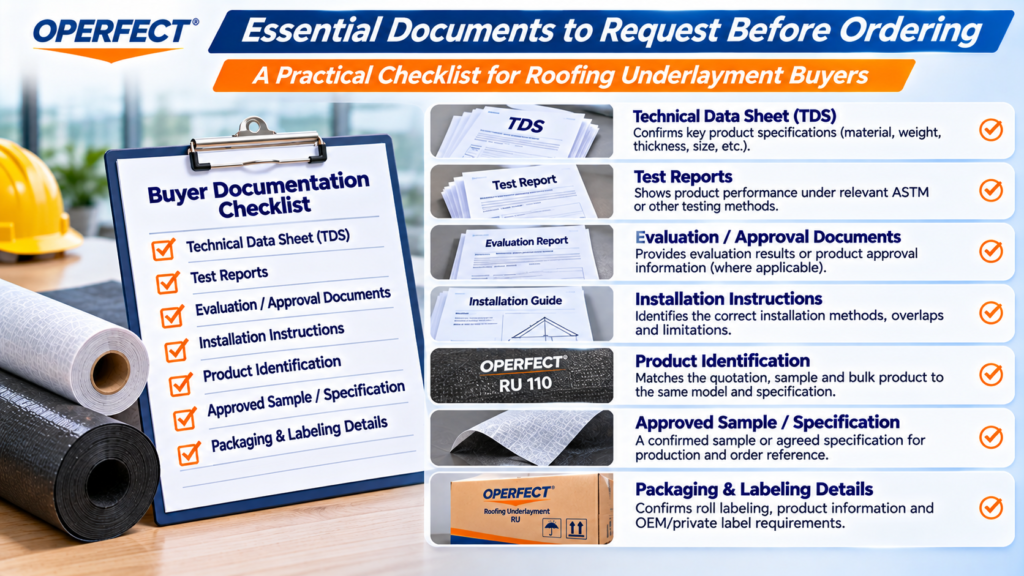
10. Seven Documents Importers Should Request Before Ordering
A structured documentation checklist can help buyers evaluate roofing underlayment suppliers more efficiently.
| Document | Why It Matters |
|---|---|
| Technical Data Sheet (TDS) | Identifies the proposed product specifications |
| Available Test Reports | Shows documented performance under specified methods |
| Applicable Approval or Evaluation Documents | Identifies regulatory or evaluation coverage, where available |
| Installation Instructions | Clarifies installation conditions and limitations |
| Product Identification Information | Connects samples, quotations and bulk orders |
| Approved Sample or Specification | Establishes the agreed purchasing reference |
| Packaging and Labeling Details | Confirms product identification and OEM requirements |
Not every product will have every document.
Where testing or approval has not yet been completed, buyers should establish the necessary process before making claims about regulatory compliance or purchasing the product for a regulated application.
The goal is not to collect the largest number of certificates. It is to obtain the right technical evidence for the exact product and market.
11. Common Mistakes Importers Should Avoid
Mistake 1: Assuming ASTM Testing Equals Product Approval
A test report does not automatically establish regulatory approval.
Mistake 2: Accepting an Approval Number Without Checking the Model
The approval may cover a different product or material construction.
Mistake 3: Ignoring Local Building Requirements
Requirements can vary between jurisdictions and roofing applications.
Mistake 4: Starting Certification Without Confirming Product Specifications
Testing a material before establishing its final construction may create additional costs if the specification later changes.
Mistake 5: Assuming Custom Branding Does Not Affect Documentation
Private-label arrangements must be evaluated under the applicable testing or approval program.
Mistake 6: Investing in Testing Without Discussing Commercial Supply
Before beginning an expensive evaluation project, buyers should consider expected order volumes, pricing and long-term material availability.
Mistake 7: Assuming a Supplier Can Guarantee Approval
Approval outcomes depend on test results, technical evaluation and the requirements of the relevant authority.
12. Frequently Asked Questions
1. Does every roofing underlayment need Florida Product Approval?
Not every roofing underlayment purchase is subject to the same requirements. The applicable approval pathway depends on the product, jurisdiction and intended application. Buyers should verify the relevant requirements before ordering.
2. Is ASTM D1970 the same as Florida Product Approval?
No. ASTM D1970 is a product specification. Florida Product Approval is a separate regulatory process.
3. Can I import roofing underlayment without Florida Approval?
Importation, distribution and permitted installation are different matters. Whether a product may be used in a particular project depends on the applicable requirements. Importers should verify compliance before marketing or supplying the product for regulated applications.
4. Does OPERFECT currently have Florida Product Approval for RU or IW?
OPERFECT does not currently claim Florida Product Approval for its RU or IW product range.
Customers requiring such approval should discuss their intended application and documentation requirements with us before ordering.
5. Can OPERFECT support customers who want to arrange their own testing?
Yes. OPERFECT can discuss sample supply, available technical information and manufacturing coordination for selected products.
Testing arrangements and responsibilities must be agreed upon for each project.
6. Who pays for testing and approval?
For customer-led testing and approval projects, the customer normally arranges and funds the process unless otherwise agreed.
7. Can OPERFECT guarantee that a roofing product will pass testing?
No. Results depend on the product, testing methods and applicable requirements. Independent testing and approval outcomes cannot be guaranteed.
8. Can I develop my own roofing brand using OPERFECT products?
Yes. OPERFECT supports OEM and private-label customization for selected roofing materials, including logo printing, dimensions and packaging.
Any applicable testing or approval requirements should be addressed as part of product development.
9. Can I change the product specification after completing testing?
Changes may affect the validity or applicability of existing documentation. Buyers should consult the relevant testing, evaluation or approval organization before making changes.
10. What should I provide when requesting a technical quotation?
Please provide the product type, intended market, required standards, material specifications, roll dimensions, estimated quantity, branding requirements and delivery destination.
13. Looking for a Roofing Underlayment Supplier That Supports Your Technical Requirements?
Whether you are sourcing synthetic roofing underlayment or ice and water shield for an established distribution business, or developing a new private-label roofing product for North America, technical planning should begin before bulk purchasing.
OPERFECT supports international roofing material buyers with product selection, OEM customization, sample coordination and export services.
For customers planning independent product testing or approval projects, we can discuss the available product and supply-chain support.
Tell Us About Your Project
To help us evaluate your requirements, please share:
- Product Type: Synthetic Roofing Underlayment (RU) or Ice & Water Shield (IW)
- Target Market: USA or Canada, including state or province
- Intended Application: Roofing type and installation requirements
- Technical Requirements: Relevant ASTM standards, evaluation criteria or product approvals
- Product Specifications: Material construction, weight, thickness and roll dimensions
- OEM Requirements: Logo printing, packaging and labeling
- Estimated Quantity: Trial order, annual demand or expected container volume
- Testing Plan: Existing approval requirements or proposed customer-led testing
- Shipping Terms: FOB, CIF or DDP
- Destination: Port or warehouse delivery location
Let OPERFECT help you evaluate suitable roofing materials and coordinate the next steps in your sourcing project.
OPERFECT | Jinan United Perfect Building Materials Corporation
United Perfect Group, To Make Buildings Perfect, together.
Global Business Director: Mr. Du
WhatsApp/WeChat: +86 134 2613 0536
Электронная почта: export@unitedperfect.com
Веб-сайт: www.unitedperfect.com