Learn how to choose HVAC insulation facing materials based on vapor barrier performance, moisture resistance, strength, appearance, temperature requirements and production needs. Compare FSK, FSV, WMP/WPSK, DFC and aluminum foil fiberglass cloth.
Introduction
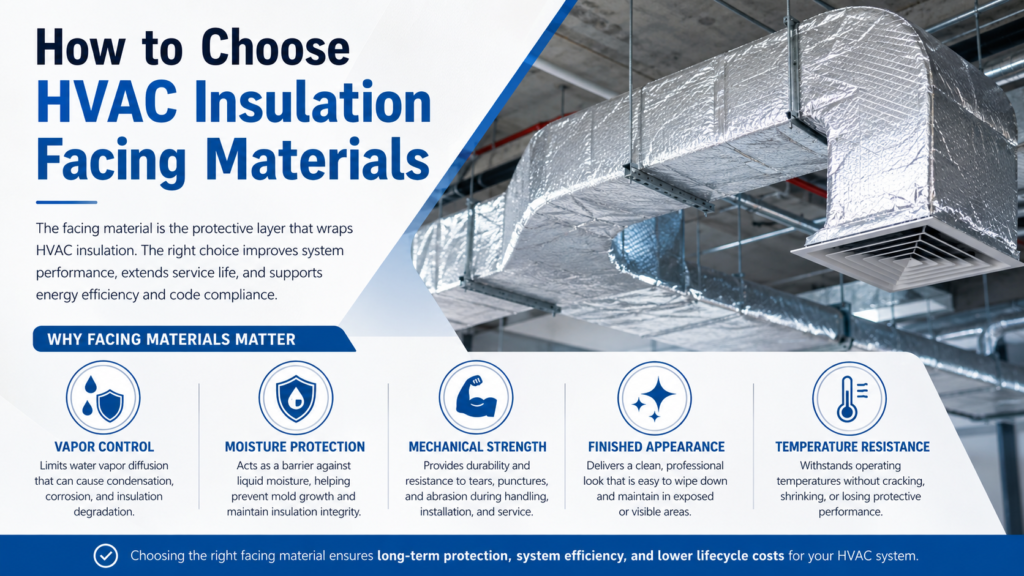
HVAC insulation facing is not only an outer covering.
The correct facing material helps protect insulation, control moisture vapor, improve durability and provide the required finished appearance for ductwork, piping and mechanical insulation systems.
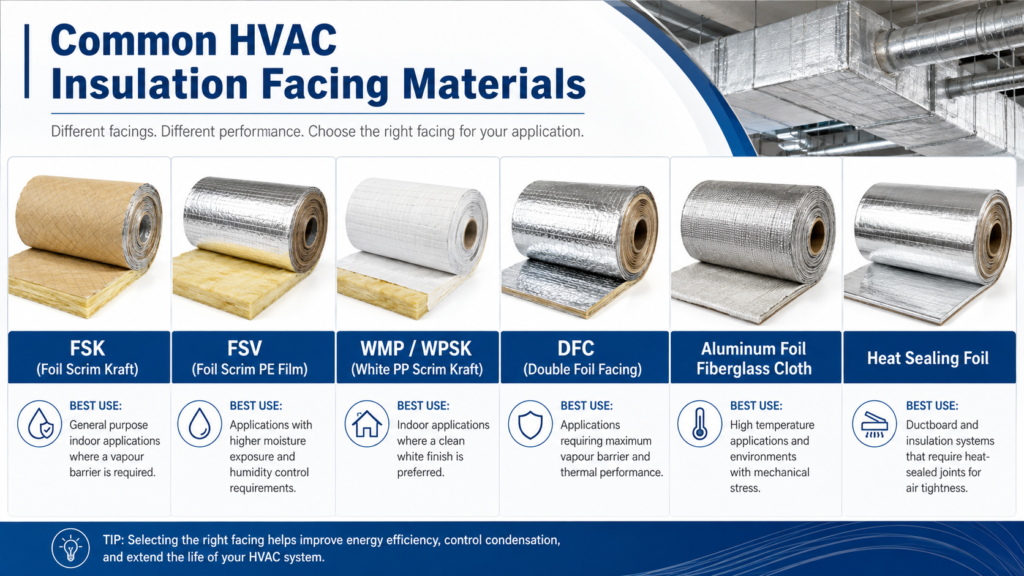
Common HVAC insulation facing materials include:
- FSK
- FSV
- WMP / WPSK
- DFC
- Aluminum foil fiberglass cloth
- Heat sealing foil
- Other customized reinforced foil composites
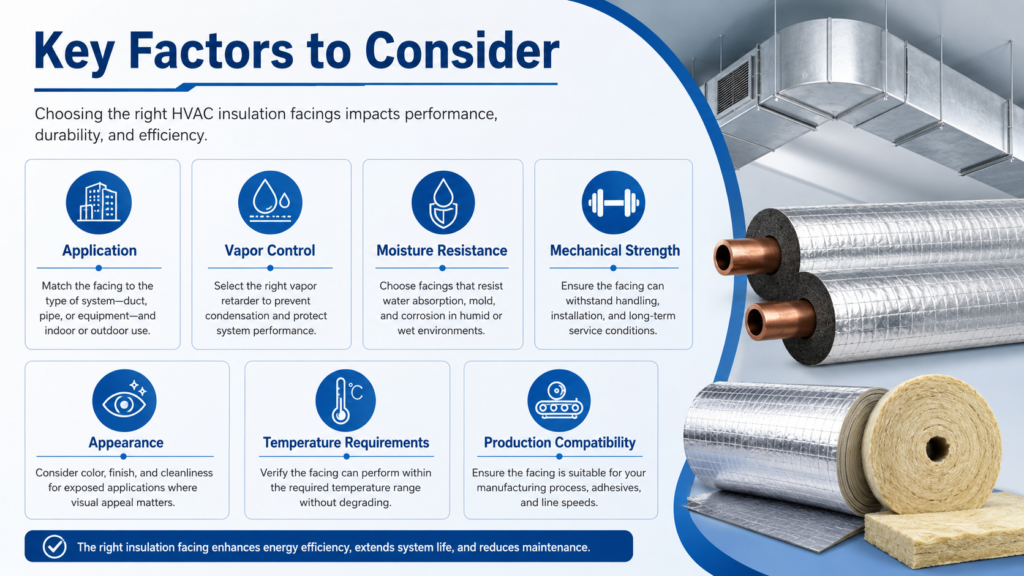
Each structure provides a different balance of:
- Vapor barrier performance
- Moisture resistance
- Mechanical strength
- Flexibility
- Surface appearance
- Temperature resistance
- Processing compatibility
- Cost
The best facing depends on where the HVAC insulation will be used and how demanding the service environment is.
Why Is HVAC Insulation Facing Important?
HVAC systems frequently operate under conditions where temperature differences can create condensation risks.
A suitable insulation facing helps provide several functions.
Vapor Control
A low-permeability facing helps reduce water vapor migration into the insulation system.
This is particularly important for:
- Air-conditioning ducts
- Chilled-water systems
- Cold piping
- Mechanical equipment
Moisture Protection
Moisture can negatively affect insulation performance and system durability.
The facing helps protect the insulation from:
- Humidity
- Condensation
- Accidental moisture exposure
- Environmental contamination
Mechanical Protection
During manufacturing, transportation and installation, insulation may be:
- Pulled
- Folded
- Wrapped
- Cut
- Compressed
Reinforced facing helps improve resistance to tearing and handling damage.
Finished Appearance
In exposed HVAC systems, the facing may remain visible after installation.
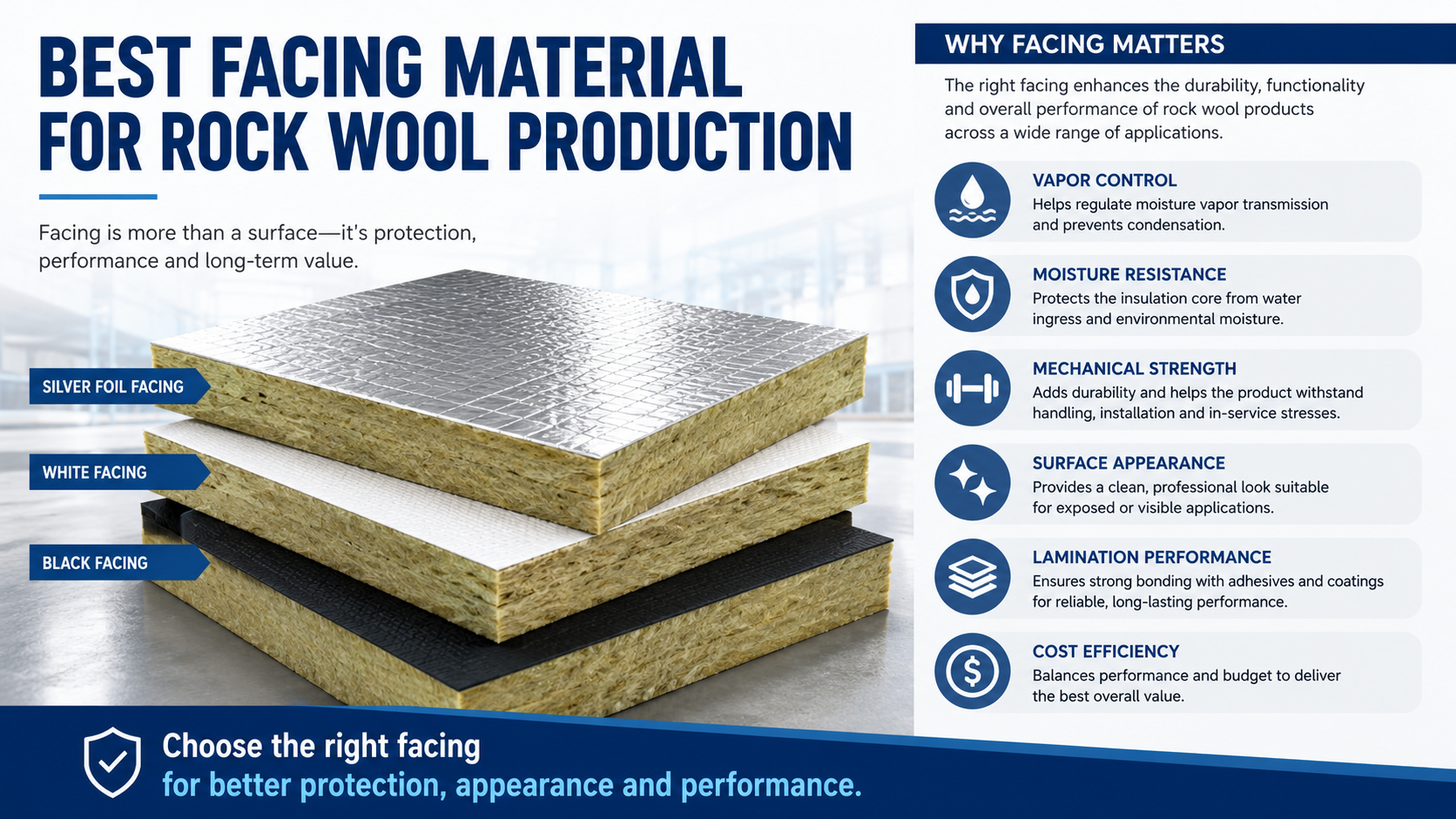
Silver foil and white facings can provide a cleaner, more professional finished surface.
Step 1: Identify the HVAC Application
The first question should be:
Where will the insulation be used?
Different HVAC applications have different facing requirements.
HVAC Duct Wrap
Common requirements:
- Vapor control
- Good flexibility
- Tear resistance
- Easy installation
- Cost efficiency
Common choices:
FSK or FSV
Duct Board
Facing materials may need:
- Good dimensional stability
- Reliable lamination
- Strong surface appearance
- Mechanical reinforcement
Common options:
- FSK
- FSV
- WMP / WPSK
Pipe Insulation
Pipe insulation often requires more flexibility because the facing must conform to curved surfaces.
Important properties include:
- Flexibility
- Tear resistance
- Vapor control
- Moisture resistance
FSV or stronger reinforced foil structures may be suitable depending on the environment.
Mechanical Equipment Insulation
Equipment insulation can require:
- Higher mechanical strength
- Better abrasion resistance
- Higher temperature stability
- Long-term durability
For more demanding applications, aluminum foil fiberglass cloth may be preferred.
Step 2: Determine Vapor Barrier Requirements
Vapor control is one of the most important considerations in HVAC insulation.
For cold-side systems, moisture vapor can migrate toward colder surfaces and potentially lead to condensation.
A suitable facing should provide sufficient vapor resistance for the system design.
FSK for Standard HVAC Vapor Control
FSK structure:
Aluminum Foil
↓
Fiberglass Scrim
↓
Kraft Paper
FSK provides:
- Excellent foil-based vapor control
- Good reinforcement
- Reliable handling
- Cost efficiency
It is widely used for standard HVAC insulation.
FSV for Higher Moisture Resistance
FSV structure:
Aluminum Foil
↓
Fiberglass Scrim
↓
PE Film
Compared with kraft-backed FSK, PE backing provides improved resistance to moisture.
FSV is suitable when:
- Humidity is higher
- Moisture resistance is more important
- A more flexible backing is preferred
Step 3: Consider Moisture and Condensation Conditions
Ask:
- Is the system operating below ambient temperature?
- Is condensation a concern?
- Is the installation located in a humid environment?
- Is the facing likely to be exposed to moisture?
For standard controlled indoor HVAC systems:
→ FSK may be sufficient
For higher-humidity or moisture-sensitive environments:
→ FSV may be more suitable
The complete HVAC system design, including seams and installation quality, also affects final vapor-control performance.
Step 4: Determine Mechanical Strength Requirements
Not every HVAC application requires the same reinforcement level.
Standard Fiberglass Scrim
Fiberglass scrim provides:
- Good tensile strength
- Tear resistance
- Dimensional stability
- Lightweight reinforcement
It is widely used in:
- FSK
- FSV
- WMP / WPSK
For most conventional HVAC insulation, scrim reinforcement provides a good balance of strength and cost.
Fiberglass Cloth
Fiberglass cloth is a full woven fiberglass fabric.
Compared with open scrim, it provides:
- Higher tensile strength
- Better tear resistance
- Better puncture resistance
- Better abrasion resistance
It is more suitable for:
- Industrial HVAC
- Mechanical equipment
- High-stress installations
- Heavy-duty insulation systems
Step 5: Decide Whether Appearance Matters
HVAC insulation may be hidden above ceilings or completely exposed.
This changes the facing selection.
Standard Silver Appearance
Choose:
- FSK
- FSV
Suitable for:
- General duct insulation
- Mechanical rooms
- Standard HVAC installations
White Finished Appearance
WMP / WPSK structure:
White PP Film
↓
Fiberglass Scrim
↓
Kraft Paper
Advantages:
- Clean white surface
- Good reinforcement
- Professional appearance
Suitable for:
- Exposed duct systems
- Commercial interiors
- Visible ceiling areas
- Mechanical rooms requiring a clean finish
Double Foil Appearance
DFC structure:
Aluminum Foil
↓
Fiberglass Scrim
↓
Kraft Paper
↓
Additional Aluminum Foil
DFC provides:
- Aluminum foil surface on both sides
- Premium appearance
- Additional surface protection
It is suitable for premium HVAC and insulation products.
Step 6: Check Temperature Requirements
The temperature resistance of a facing should always be evaluated as a complete composite.
Do not evaluate aluminum foil alone.
The final temperature capability depends on:
- Aluminum foil
- Adhesive
- Fiberglass scrim
- Kraft paper
- PE or PP film
- Surface coating
Standard HVAC Applications
FSK and FSV are commonly used for conventional duct and pipe insulation.
Higher-Temperature or Industrial HVAC
For more demanding temperature conditions, consider:
Aluminum Foil + Fiberglass Cloth
Fiberglass cloth provides:
- Excellent thermal stability
- Strong mechanical performance
- Industrial durability
However, the adhesive and other composite layers must also meet the required service temperature.
Step 7: Consider Flexibility and Installation
For duct wrap and pipe insulation, facing flexibility can significantly affect installation efficiency.
A facing that is too rigid may:
- Wrinkle
- Crack
- Be difficult to wrap
- Increase installation time
A facing that is too lightweight may not provide sufficient durability.
The goal is to balance:
Strength + Flexibility + Processability
Step 8: Check Production Compatibility
For insulation manufacturers, the facing must work efficiently on the production line.
Important factors include:
- Roll width
- Roll length
- Core diameter
- Roll tension
- Adhesive compatibility
- Lamination temperature
- Production speed
- Slitting performance
Heat Sealing Foil for Automated Production
Heat sealing foil includes a heat-activated bonding layer.
Advantages can include:
- Reduced adhesive handling
- Cleaner lamination
- Stable bonding
- Higher automation potential
It may be suitable for manufacturers with compatible heat-sealing equipment.
HVAC Facing Material Comparison
| Facing | Typical Structure | Vapor Control | Moisture Resistance | Strength | Appearance | Best Use |
|---|---|---|---|---|---|---|
| FSK | Foil + Scrim + Kraft | Excellent | Good | Good | Silver / Kraft | Standard HVAC |
| FSV | Foil + Scrim + PE | Excellent | Better | Good | Silver / PE | Humid HVAC |
| WMP / WPSK | White PP + Scrim + Kraft | Good | Good | Good | White | Visible HVAC |
| DFC | Foil + Scrim + Kraft + Foil | Excellent | Excellent | Good | Double Foil | Premium HVAC |
| Foil + Fiberglass Cloth | Foil + Woven Fiberglass Cloth | Excellent | Excellent | Excellent | Industrial Silver | Heavy-duty HVAC |
| Heat Sealing Foil | Foil + Heat-Sealable Layer | Depends on structure | Depends on structure | Depends on reinforcement | Silver | Automated production |
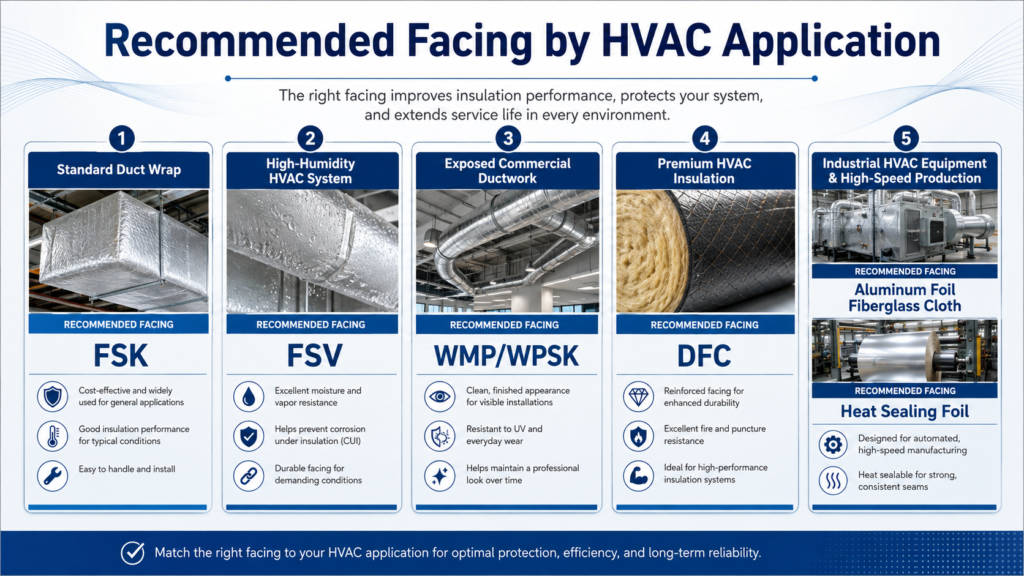
Recommended Facing by HVAC Application
Standard HVAC Duct Wrap
Recommended: FSK
Why:
- Reliable vapor control
- Good reinforcement
- Cost-effective
- Widely used
High-Humidity HVAC System
Recommended: FSV
Why:
- PE backing
- Better moisture resistance
- Good flexibility
- Strong vapor-control performance
Exposed Commercial Ductwork
Recommended: WMP / WPSK
Why:
- Clean white appearance
- Professional surface
- Good reinforcement
Premium HVAC Insulation
Recommended: DFC
Why:
- Double foil surface
- Premium appearance
- Additional surface protection
Industrial HVAC Equipment
Recommended: Aluminum Foil Fiberglass Cloth
Why:
- Higher tensile strength
- Better tear and puncture resistance
- Stronger durability
- Better suited to demanding environments
High-Speed Insulation Production
Recommended: Heat Sealing Foil
Why:
- Efficient bonding process
- Reduced adhesive handling
- Suitable for automated production
Buyer Checklist
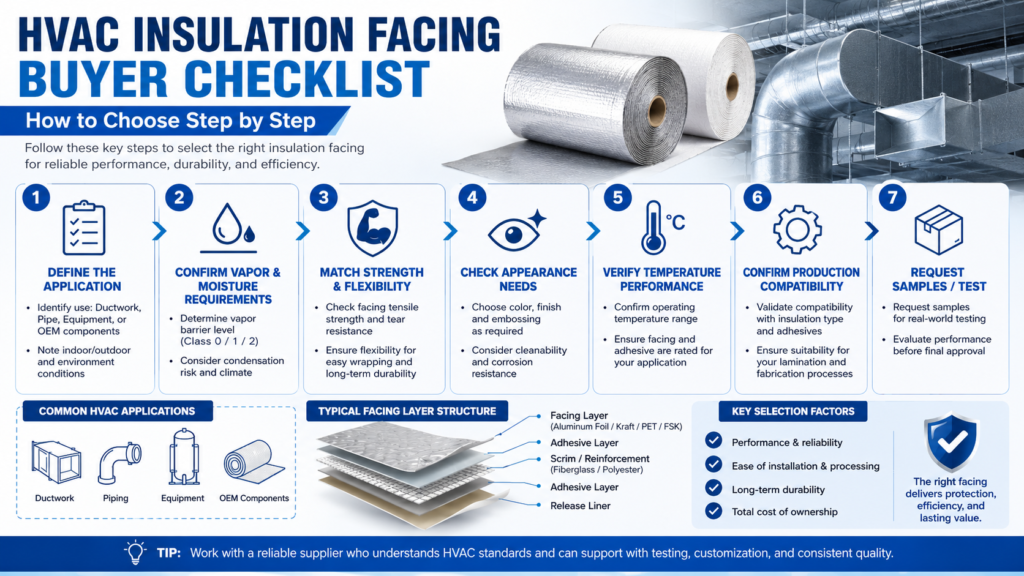
Before ordering HVAC insulation facing, confirm:
Application
- Duct wrap?
- Duct board?
- Pipe insulation?
- Mechanical equipment?
- Industrial HVAC?
Vapor Control
- Required vapor transmission level
- Condensation risk
- Seam sealing requirements
Moisture
- Indoor humidity
- Water exposure
- Operating conditions
Mechanical Performance
- Tensile strength
- Tear strength
- Puncture resistance
- Abrasion resistance
Temperature
- Continuous service temperature
- Short-term peak temperature
Structure
- Foil thickness
- Scrim specification
- Kraft paper weight
- PE / PP film thickness
- Fiberglass cloth specification
Production
- Roll width
- Roll length
- Core diameter
- Adhesive system
- Heat-sealing capability
- Line speed
Appearance
- Silver
- White
- Double foil
- Industrial finish
Customization
- Printing
- Logo
- Roll dimensions
- Packaging
- OEM / private label
Common Buyer Mistakes
Choosing Only by Price
The lowest-cost facing may not provide the best overall value if it causes:
- Breakage
- Production waste
- Poor lamination
- Installation damage
Ignoring Vapor-Control Requirements
HVAC insulation is particularly sensitive to condensation.
Facing selection should consider the complete moisture-control strategy.
Assuming All Silver Facings Are the Same
Silver appearance does not tell you:
- Foil thickness
- Scrim structure
- Backing material
- Vapor performance
- Mechanical strength
Always confirm the complete structure.
Over-Specifying the Facing
Heavy fiberglass cloth may be unnecessary for standard commercial duct wrap.
Use the reinforcement level that matches the real application.
Ignoring Production-Line Compatibility
Facing materials should be tested with the manufacturer’s:
- Adhesive
- Lamination temperature
- Production speed
- Cutting and slitting process
FAQ
What is the most common facing for HVAC insulation?
FSK is one of the most widely used facings for standard HVAC insulation because it offers a good balance of vapor control, reinforcement and cost.
Is FSV better than FSK?
Not necessarily.
FSV is generally more suitable when improved moisture resistance and PE backing are required.
FSK remains an economical and widely accepted solution for standard applications.
What facing should be used for exposed HVAC ducts?
WMP / WPSK is a good option where a clean white surface is preferred.
FSK, FSV or DFC may also be used depending on the required appearance and performance.
What is best for industrial HVAC insulation?
For heavy-duty mechanical applications requiring higher strength, aluminum foil fiberglass cloth can be a stronger option.
Can HVAC insulation facing be customized?
Yes.
Customization may include:
- Foil thickness
- Scrim specification
- Backing material
- Roll width
- Roll length
- Heat-sealing layer
- Printing
- Surface treatment
- OEM packaging
Conclusion
Choosing the right HVAC insulation facing requires balancing vapor control, moisture resistance, mechanical strength, appearance, temperature performance and manufacturing compatibility.
For standard HVAC insulation, FSK provides a reliable and economical solution.
For humid environments, FSV provides improved moisture resistance.
For visible commercial installations, WMP / WPSK provides a clean white finish.
For premium products, DFC provides a double foil surface.
For heavy-duty industrial HVAC applications, aluminum foil fiberglass cloth provides higher mechanical durability.
For automated manufacturing lines, heat sealing foil can provide a more efficient bonding solution.
OPERFECT® supplies customized HVAC insulation facing materials including FSK, FSV, WMP/WPSK, DFC, aluminum foil fiberglass cloth and heat-sealing foil, with customized structures, roll specifications, printing and OEM/private-label solutions.