Learn how foil-scrim vapor barriers work, their typical structures, benefits and applications in HVAC, insulation, roofing and building-envelope systems.
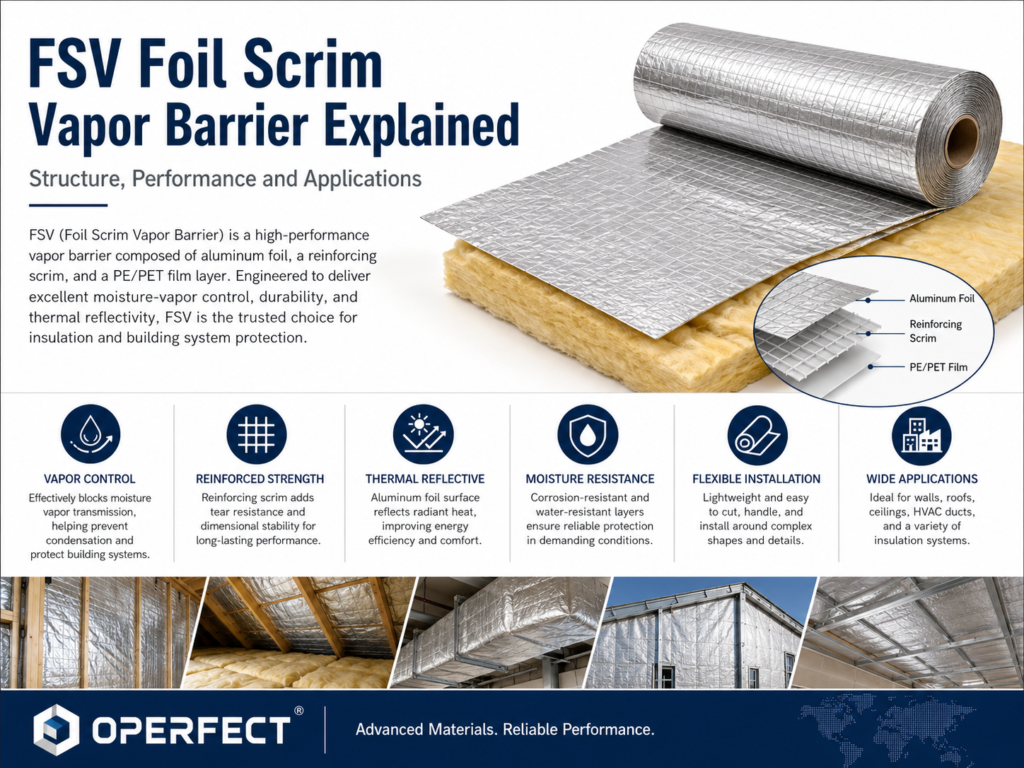
FSV foil scrim vapor barrier is a reinforced aluminum foil composite designed primarily for moisture-vapor control.
It generally combines an aluminum foil layer with reinforcing scrim and a film or other moisture-resistant backing.
Unlike conventional FSK, which uses kraft paper, many FSV structures use polymer film to improve flexibility and moisture resistance.
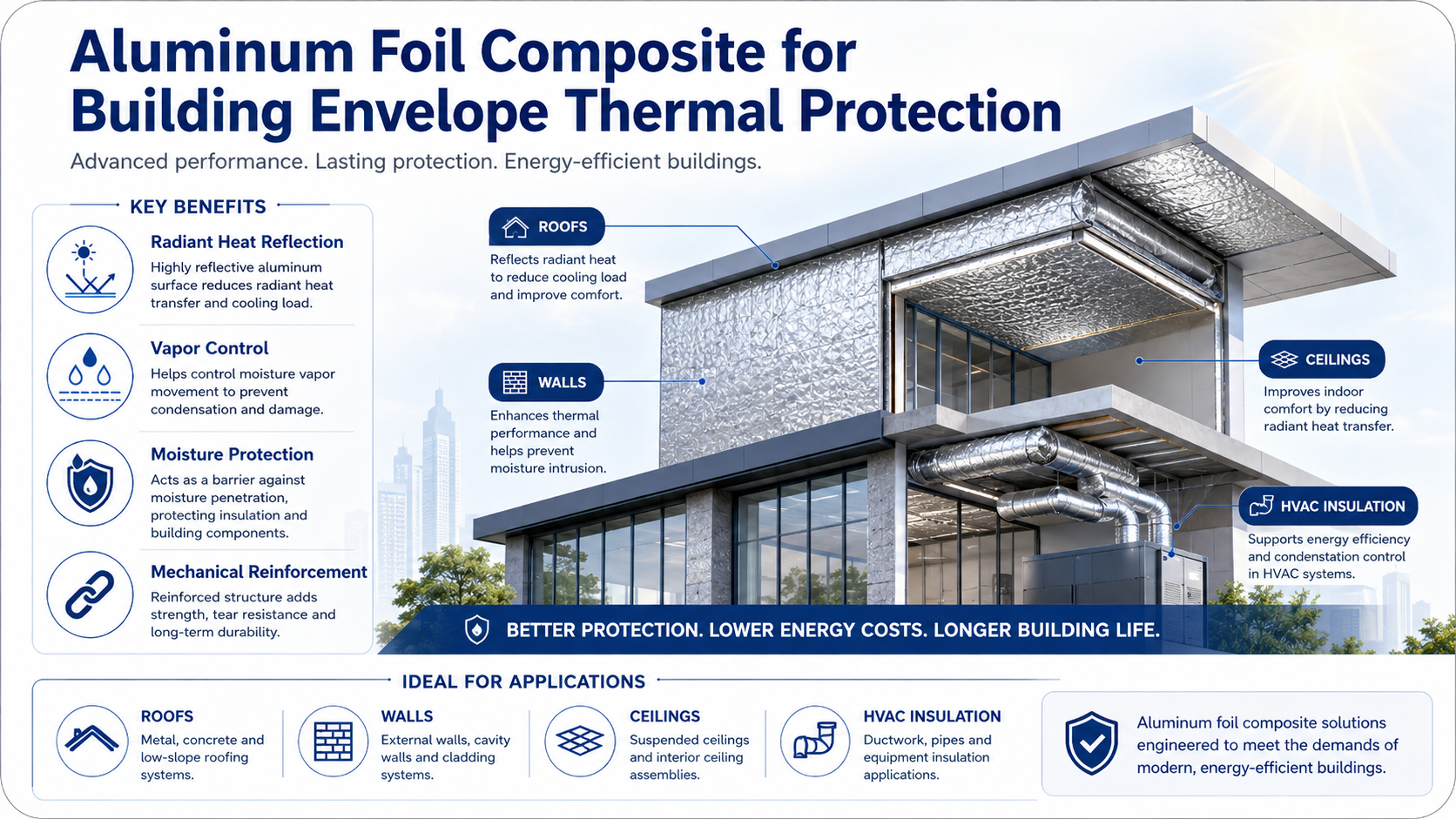
FSV materials are used in HVAC, thermal insulation, roof systems, wall assemblies and industrial insulation.
Typical FSV Structure
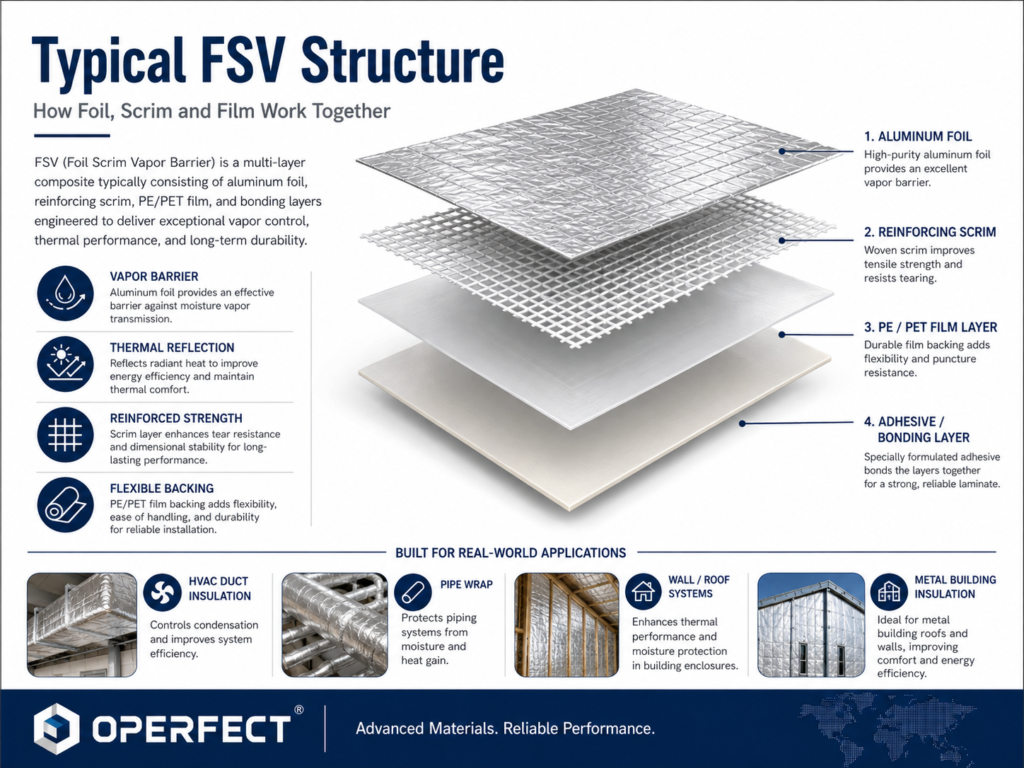
A common FSV structure may contain:
- Aluminum foil
- Adhesive or extrusion-bonding layer
- Reinforcing scrim
- PE film or another polymer backing
Other versions may include:
- Aluminum foil + scrim + PET film
- Aluminum foil + fiberglass scrim + PE
- Aluminum foil + polyester scrim + film
- Double foil + scrim
- Foil + scrim + reinforced woven film
The structure should be selected according to vapor resistance, strength, heat sealing and installation requirements.
Function of Each Layer
Aluminum Foil
The foil provides:
- Low water-vapor permeability
- Radiant heat reflection
- Surface protection
- Metallic appearance
- Compatibility with foil tape
Scrim Reinforcement
The scrim provides:
- Tensile strength
- Tear resistance
- Dimensional stability
- Stress distribution
- Better wide-width handling
Polymer Film
PE, PET or another film can provide:
- Moisture resistance
- Flexibility
- Heat-sealing capability
- Protection of the reinforcement
- Smooth backing
- Improved durability in humid environments
Bonding Layer
The adhesive or polyethylene bonding layer keeps the composite together and affects resistance to delamination.
How an FSV Vapor Barrier Works
Water vapor moves through building and insulation assemblies because of differences in temperature and vapor pressure.
If moisture vapor reaches a cold surface, it may condense.
FSV helps limit this movement by creating a low-permeance continuous layer.
It can help protect:
- Insulation materials
- Metal ducts
- Pipes
- Roof systems
- Wall assemblies
- Industrial equipment
The vapor-control layer must remain continuous across seams, joints and penetrations.
FSV vs FSK
FSV and FSK may both contain foil and scrim, but their backing layers are different.
FSK
FSK generally uses kraft paper.
Typical characteristics include:
- Higher stiffness
- Economical support
- Good converting performance
- Paper-based backing
- Suitability for standard insulation facings
FSV
FSV generally uses film or another moisture-resistant backing.
Typical characteristics include:
- Better resistance to humidity
- Greater flexibility
- Possible heat-sealing performance
- Reduced water absorption
- Suitability for paper-free structures
The correct choice depends on application conditions.
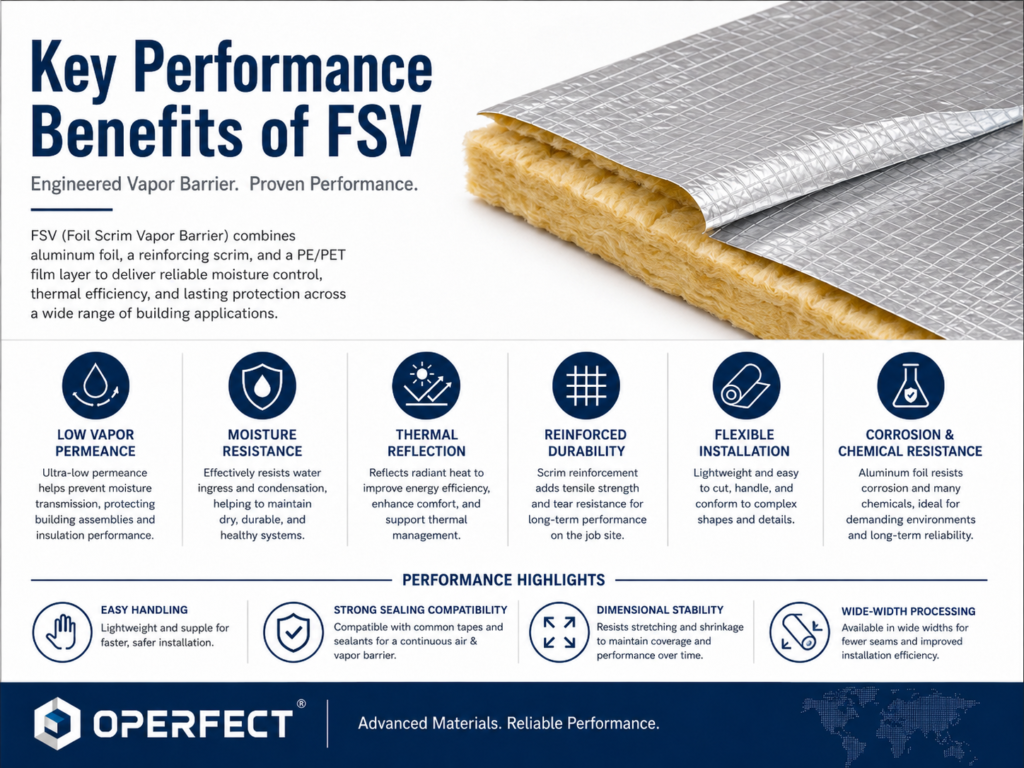
Main Advantages of FSV
Moisture Resistance
Polymer-film backing makes FSV suitable for applications where kraft paper may absorb moisture.
Reinforced Strength
Scrim improves tensile and tear performance.
Flexibility
FSV is often more flexible than paper-backed facing.
This can help with wrapping ducts, pipes and irregular surfaces.
Heat-Sealing Potential
Some PE-backed FSV materials can be heat sealed to insulation or another substrate.
The actual sealing performance depends on polymer grade, coating weight, temperature, pressure and production speed.
Clean Surface
Film-backed structures can provide a cleaner, non-paper surface for demanding applications.
Typical Applications
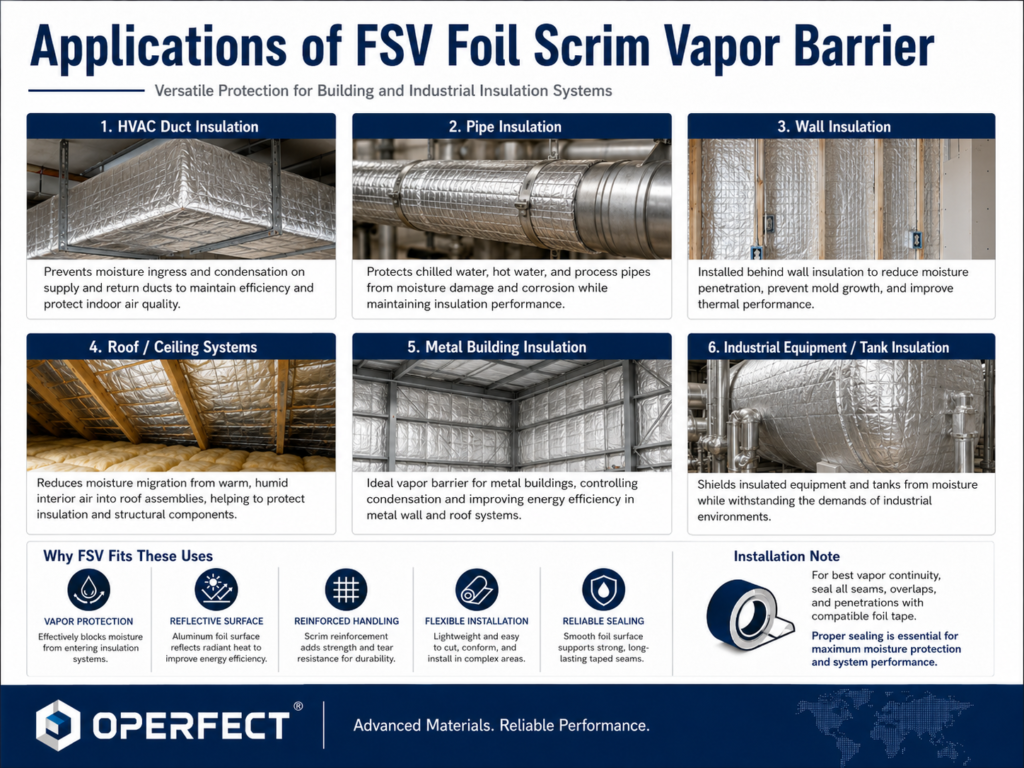
HVAC Duct Insulation
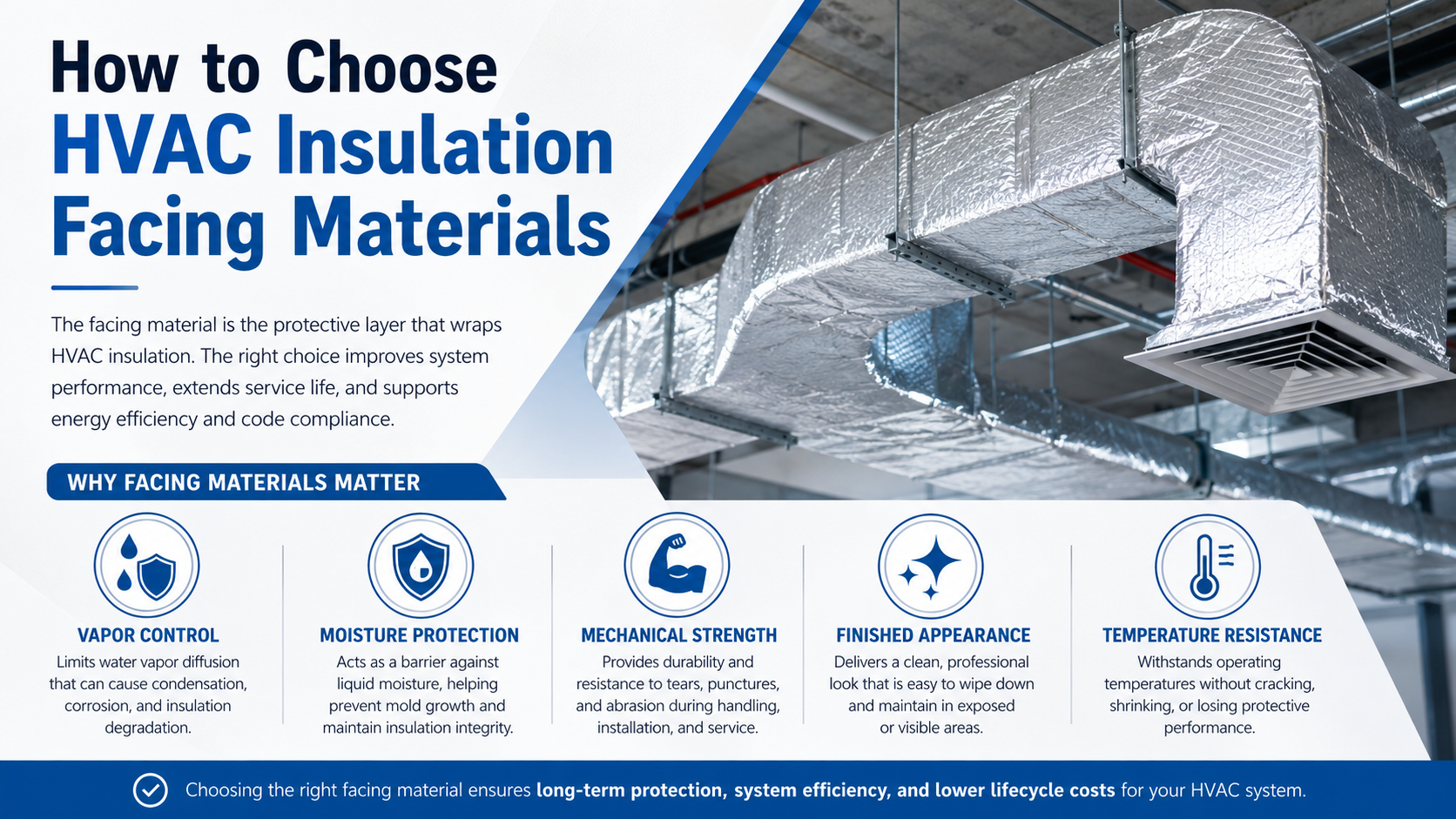
FSV can serve as a vapor-control jacket on duct wrap and duct insulation.
It helps reduce moisture reaching cold duct surfaces.
Pipe Insulation
Flexible reinforced foil can be wrapped around insulated pipes and sealed at overlaps.
Roof Insulation
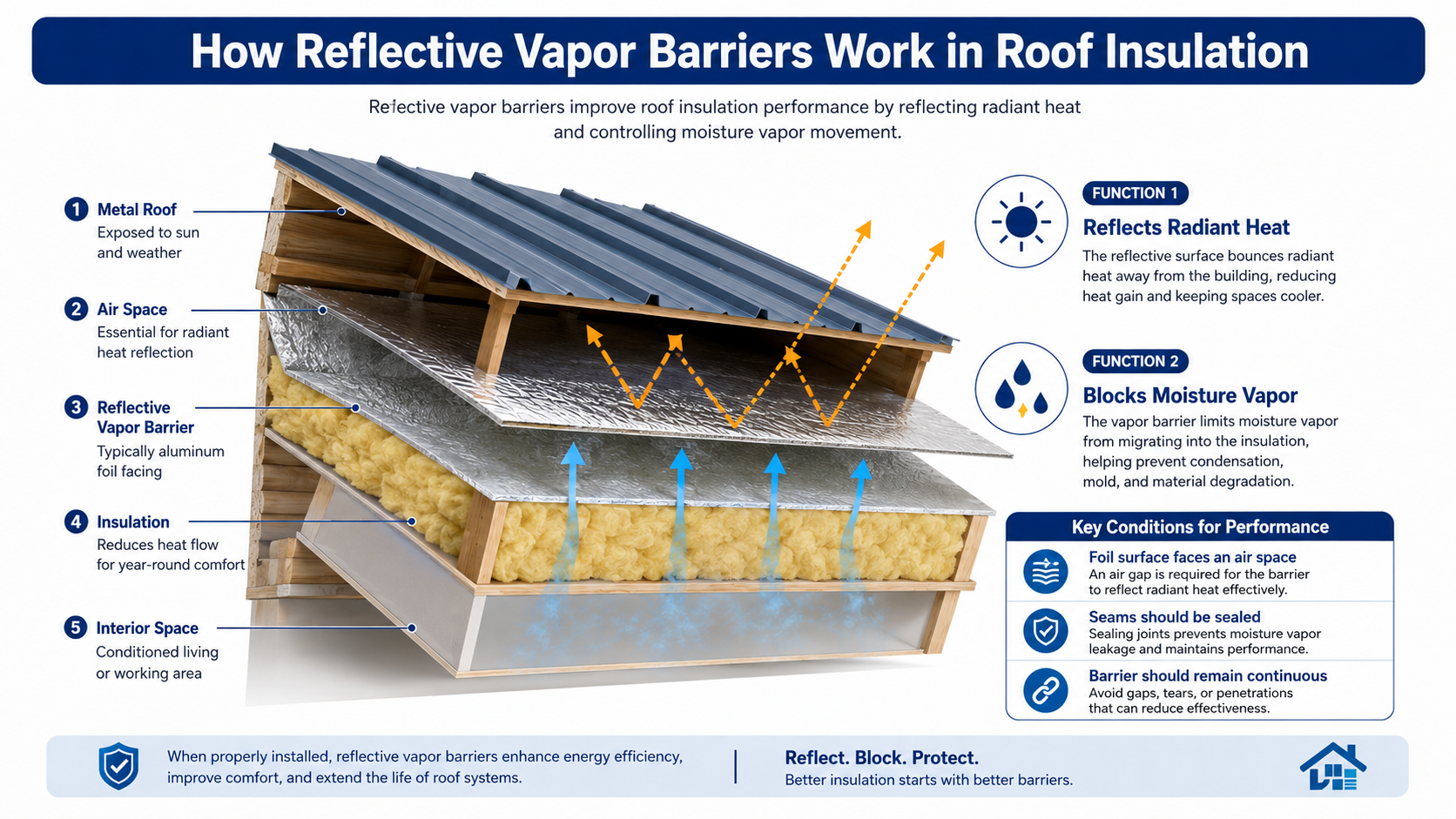
FSV may be used as a reflective vapor-control layer in selected roof systems.
Wall and Ceiling Assemblies
It can help manage moisture vapor and protect insulation in building-envelope assemblies.
Metal Buildings
Wide-width reinforced FSV may be used with insulation blankets in warehouses, workshops and industrial buildings.
Industrial Equipment
FSV can protect insulation installed on tanks, ducts and mechanical equipment.
FSV Is Not Automatically an Air Barrier
A low-permeance material may control vapor but does not automatically qualify as an air barrier.
Air-barrier performance depends on:
- Material air permeability
- Seam sealing
- Connection details
- Fasteners
- Penetrations
- Installation continuity
- System testing
The terms vapor barrier and air barrier should not be used interchangeably without technical verification.
Vapor Barrier vs Vapor Retarder
The classification depends on tested vapor permeance and applicable standards.
Project requirements may define whether the material must function as:
- A low-permeance vapor barrier
- A moderate-permeance vapor retarder
- A reflective insulation facing
- A combined vapor- and air-control layer
Buyers should request test data for the complete laminate rather than assume performance from the foil surface alone.
Important Quality Factors
FSV quality should be evaluated through:
- Foil thickness
- Pinhole control
- Scrim consistency
- Film thickness
- Bond strength
- Delamination resistance
- Tensile strength
- Tear resistance
- Water-vapor transmission
- Surface treatment
- Roll flatness
- Edge quality
Installation Considerations
Reliable vapor control requires attention to:
- Compatible foil tape
- Sealed overlaps
- Repair of punctures
- Sealing around fasteners
- Continuity at corners
- Edge protection
- Pipe and duct penetrations
- Correct facing orientation
A high-quality material cannot compensate for discontinuous installation.
Conclusion
FSV foil scrim vapor barrier combines aluminum foil, reinforcement and moisture-resistant backing to create a flexible, durable vapor-control material.
Compared with paper-backed FSK, it is particularly suitable for humid environments, flexible wrapping and selected heat-sealing applications.
OPERFECT® supplies customized FSV materials with fiberglass or polyester scrim, PE or PET backing, single- or double-foil structures and custom roll dimensions.