Learn how to choose heavy duty aluminum foil composite materials based on reinforcement type, strength, temperature resistance, vapor barrier performance and application requirements.
Introduction
Not all aluminum foil composites are designed for the same level of mechanical stress.
Standard foil facings such as FSK or lightweight foil-scrim laminates are suitable for many insulation applications. However, industrial equipment, pipe insulation, heavy-duty wrapping and demanding construction environments may require stronger composite structures.
A heavy duty aluminum foil composite typically combines aluminum foil with stronger reinforcement materials such as:
- Fiberglass cloth
- Heavy fiberglass scrim
- Woven fabric
- Reinforced polymer film
- Multi-layer composite structures
The right material should not simply be the thickest or heaviest option.
Instead, buyers should evaluate:
- Mechanical strength
- Tear and puncture resistance
- Temperature exposure
- Vapor-control requirements
- Flexibility
- Installation conditions
- Surface durability
- Cost
This guide explains how to select the right heavy duty aluminum foil composite for different applications.
What Is a Heavy Duty Aluminum Foil Composite?
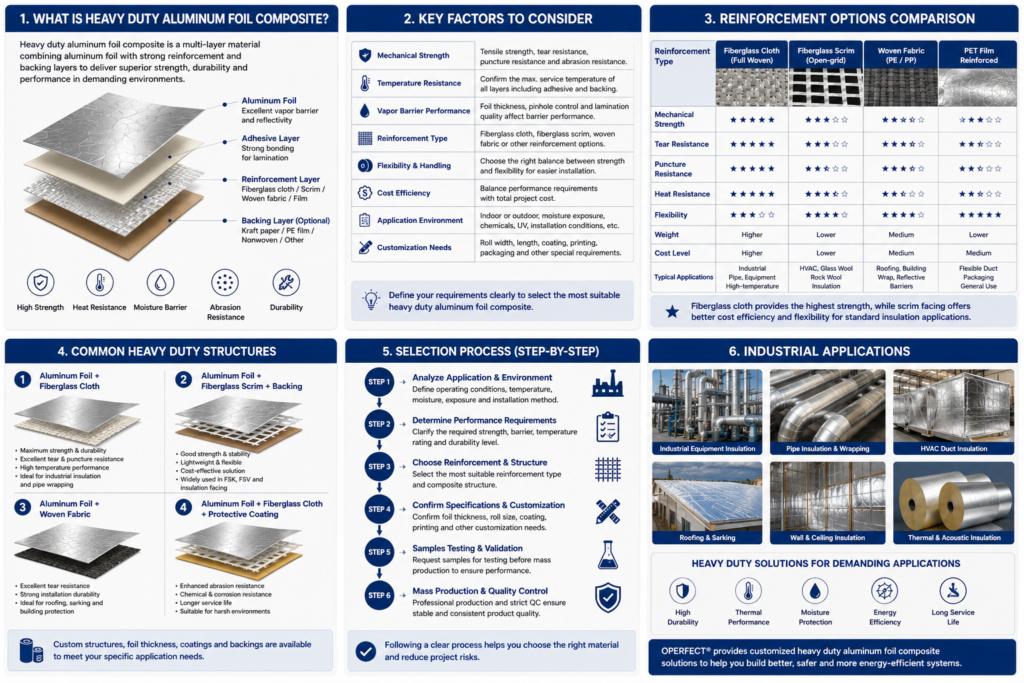
A heavy duty aluminum foil composite is a reinforced multi-layer material designed to provide greater durability than standard lightweight foil facing.
A typical structure may include:
Aluminum Foil
↓
Adhesive / Bonding Layer
↓
Heavy-Duty Reinforcement
↓
Optional Backing or Protective Layer
The reinforcement may be:
- Fiberglass cloth
- Fiberglass scrim
- PE or PP woven fabric
- PET film
- Nonwoven material
The final structure depends on the required balance between strength, flexibility, temperature resistance and cost.
Step 1: Define What “Heavy Duty” Means for Your Application
Before selecting the material, identify why extra strength is required.
Different projects may define heavy duty differently.
Mechanical Heavy Duty
Required when the material is exposed to:
- Pulling
- Tearing
- Puncture
- Repeated handling
- Abrasion
Suitable reinforcement:
→ Fiberglass cloth or heavy woven reinforcement
Thermal Heavy Duty
Required when the material is exposed to:
- Hot equipment
- Process piping
- Industrial machinery
- Elevated operating temperatures
Suitable reinforcement:
→ Fiberglass-based structures
Moisture Heavy Duty
Required when the system requires stronger vapor control or moisture resistance.
Important factors include:
- Aluminum foil thickness
- Low-permeability backing
- Lamination quality
- Seam sealing
Installation Heavy Duty
Required when the material must withstand:
- Construction-site handling
- Large-width installation
- Wrapping around equipment
- Outdoor exposure during installation
Suitable reinforcement may include:
- Woven fabric
- Fiberglass cloth
- Reinforced scrim
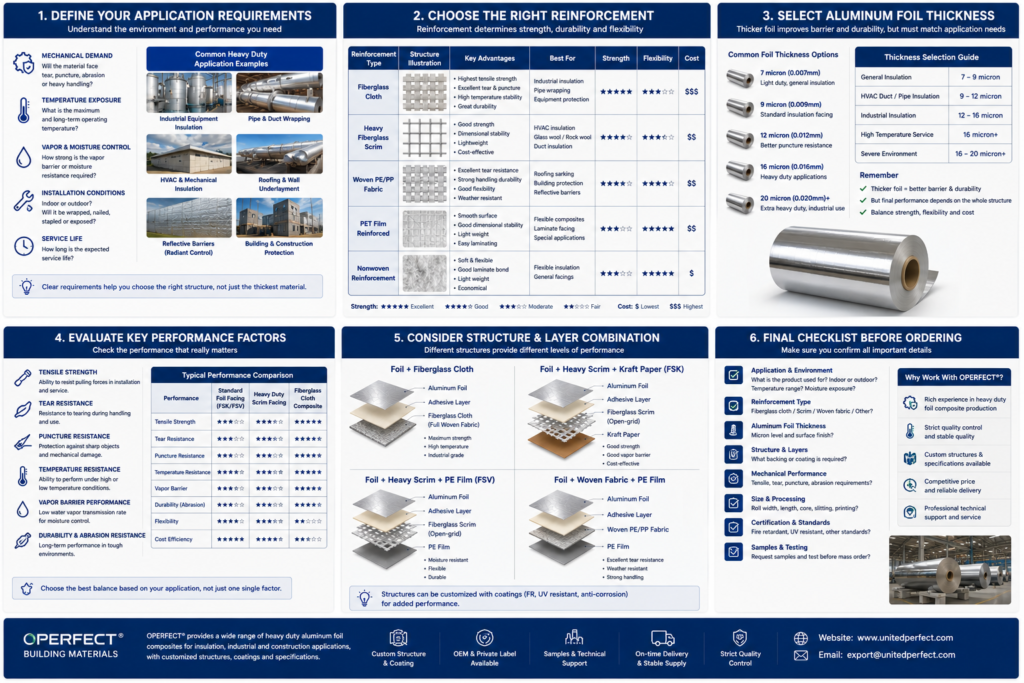
Step 2: Choose the Right Reinforcement
The reinforcement layer is one of the most important factors determining mechanical performance.
Fiberglass Cloth Reinforcement
Fiberglass cloth is a full woven fiberglass fabric.
It provides:
- High tensile strength
- Excellent tear resistance
- Excellent puncture resistance
- Strong dimensional stability
- High temperature stability
- Better abrasion resistance
Typical applications:
- Industrial insulation
- Pipe wrapping
- Equipment insulation
- Thermal protection
- Heavy-duty mechanical insulation
Best For:
Applications requiring maximum mechanical durability.
Fiberglass Scrim Reinforcement
Fiberglass scrim is an open-grid reinforcement.
It provides:
- Good tensile strength
- Good dimensional stability
- Lower weight
- Better flexibility
- Good cost efficiency
Typical applications:
- FSK
- FSV
- HVAC insulation
- Laine de verre
- Laine de roche
Best For:
Projects requiring reinforced insulation facing without the additional weight and cost of full fiberglass cloth.
Woven Fabric Reinforcement
PE or PP woven fabrics provide a dense synthetic reinforcement structure.
Advantages include:
- Excellent tear resistance
- Strong handling durability
- Good flexibility
- Better resistance to installation stress
Typical applications:
- Roofing sarking
- Building protection
- Industrial wrapping
- Reflective barriers
Best For:
Applications involving demanding handling, large areas or construction-site exposure.
Step 3: Select the Aluminum Foil Thickness
Foil thickness affects:
- Barrier integrity
- Puncture resistance
- Durability
- Processing characteristics
- Material cost
Thicker aluminum foil can provide stronger physical durability, but increasing foil thickness alone does not necessarily create a heavy-duty composite.
For example:
Heavy foil + weak backing
may still perform worse mechanically than:
Moderate foil + strong fiberglass cloth reinforcement
Therefore, foil thickness and reinforcement structure should be selected together.
Step 4: Consider Tear and Puncture Resistance
Heavy-duty applications often involve sharp edges, corners or repeated handling.
Important performance factors include:
Tear Resistance
Important for:
- Wrapping
- Large rolls
- Installation
- Industrial insulation
Puncture Resistance
Important for:
- Equipment insulation
- Construction environments
- Protective wrapping
Abrasion Resistance
Important when the facing may contact:
- Pipes
- Equipment
- Workers
- Tools
- Other building materials
For maximum mechanical protection, full woven fiberglass cloth usually provides stronger overall reinforcement than lightweight open scrim.
Step 5: Evaluate Temperature Requirements
Temperature performance should be evaluated for the complete composite—not aluminum foil alone.
Important layers include:
- Aluminum foil
- Reinforcement
- Adhesive
- Polymer backing
- Surface coating
Although aluminum and fiberglass can tolerate high temperatures, a polymer backing or adhesive may become the limiting component.
For high-temperature applications, buyers should confirm:
- Maximum service temperature
- Adhesive temperature resistance
- Backing material limits
- Long-term thermal aging performance
Step 6: Check Vapor Barrier Requirements
Aluminum foil provides excellent vapor resistance when continuous and undamaged.
However, final vapor-control performance also depends on:
- Foil thickness
- Pinholes
- Lamination quality
- Surface damage
- Seams
- Installation
For demanding vapor-control applications, buyers should evaluate the complete system rather than choosing material based only on surface appearance.
Step 7: Balance Strength and Flexibility
Higher strength does not always mean better performance.
Heavy woven composites may provide better mechanical protection but can also be:
- Heavier
- More rigid
- More difficult to wrap around complex surfaces
- More expensive
A flexible reinforced foil may be more practical for:
- Elbows
- Pipes
- Curved surfaces
- Flexible insulation blankets
The best material should provide enough strength without making installation unnecessarily difficult.
Heavy Duty Aluminum Foil Composite Comparison
| Reinforcement | Mechanical Strength | Flexibility | Temperature Stability | Weight | Typical Application |
|---|---|---|---|---|---|
| Fiberglass Cloth | Excellent | Moderate | Excellent | Higher | Industrial / pipe insulation |
| Fiberglass Scrim | Good | Good | Excellent | Low | HVAC / standard insulation |
| PE/PP Woven Fabric | Excellent | Good | Moderate | Medium | Roofing / building protection |
| PET Reinforcement | Good | Excellent | Good | Low | Flexible composite applications |
| Nonwoven | Moderate | Excellent | Depends on fiber | Low | Flexible insulation facing |
Common Heavy Duty Composite Structures
1. Aluminum Foil + Fiberglass Cloth
Recommended for:
- Industrial insulation
- Equipment protection
- Pipe wrapping
- Thermal protection
Key advantage:
High strength and long-term durability
2. Aluminum Foil + Heavy Fiberglass Scrim + Backing
Recommended for:
- HVAC insulation
- Laine de verre
- Laine de roche
- Heavy-duty insulation facing
Key advantage:
Balanced strength, weight and cost
3. Aluminum Foil + Woven Fabric
Recommended for:
- Roofing sarking
- Building envelope applications
- Heavy-duty reflective barriers
- Industrial wrapping
Key advantage:
Excellent tear and handling resistance
4. Aluminum Foil + Fiberglass Cloth + Protective Coating
Recommended for:
- Industrial environments
- Equipment protection
- Specialized thermal systems
Additional coatings may provide:
- Improved abrasion resistance
- Chemical resistance
- Surface durability
- Fire-performance enhancement
How to Choose the Right Heavy Duty Structure
Choose Aluminum Foil Fiberglass Cloth When:
You need:
✓ Maximum mechanical strength
✓ Excellent puncture and tear resistance
✓ Industrial durability
✓ Strong temperature stability
✓ Long-term protection
Choose Heavy Fiberglass Scrim Facing When:
You need:
✓ Good reinforcement
✓ Lower weight
✓ Better flexibility
✓ Cost-effective production
✓ Standard or upgraded insulation facing
Choose Aluminum Foil Woven Fabric When:
You need:
✓ Excellent tear resistance
✓ Strong installation durability
✓ Large-area building applications
✓ Roofing or protective wrapping
Buyer Checklist
Before ordering a heavy duty aluminum foil composite, confirm:
Reinforcement
- Fiberglass cloth?
- Fiberglass scrim?
- Woven fabric?
- Nonwoven?
Aluminum Foil
- Foil thickness
- Surface finish
- Barrier requirements
Mechanical Requirements
- Tensile strength
- Tear resistance
- Puncture resistance
- Abrasion resistance
Temperature
- Service temperature
- Short-term exposure
- Adhesive temperature capability
Environment
- Indoor or outdoor
- Moisture exposure
- Industrial environment
- Installation conditions
Processing
- Lamination method
- Cutting
- Slitting
- Wrapping requirements
Customization
- Roll width
- Roll length
- Coating
- Printing
- OEM / private label packaging
Common Buyer Mistakes
Mistake 1: Choosing Only by Foil Thickness
A thicker aluminum foil does not automatically mean a stronger composite.
The reinforcement layer may have a greater impact on tear and puncture resistance.
Mistake 2: Over-Specifying the Material
Using full fiberglass cloth for a standard HVAC application may add unnecessary cost and weight.
Mistake 3: Ignoring the Adhesive System
The composite is only as reliable as the bond between its layers.
Poor adhesive performance can cause:
- Delamination
- Wrinkling
- Failure at elevated temperature
Mistake 4: Ignoring Installation Conditions
A very strong but rigid material may be difficult to install around curved equipment or pipe systems.
FAQ
What is the strongest aluminum foil reinforcement?
For many insulation and industrial applications, full woven fiberglass cloth provides one of the strongest reinforcement options because it offers continuous fabric support.
Is thicker aluminum foil always better for heavy-duty use?
No.
The complete composite structure—including foil, reinforcement, adhesive and backing—determines overall performance.
Fiberglass cloth or woven PE fabric: which is better?
Fiberglass cloth is generally preferred for high-temperature and industrial insulation applications.
Woven PE or PP fabric is commonly preferred where tear resistance, flexibility and installation durability are more important.
Can heavy-duty aluminum foil composite be customized?
Yes.
Common customization options include:
- Foil thickness
- Fiberglass weight
- Weave structure
- Scrim specification
- Backing material
- Surface coating
- Roll width and length
- Printing
- OEM packaging
Conclusion
Choosing a heavy duty aluminum foil composite requires more than simply selecting thicker aluminum foil.
The correct structure should balance:
- Mechanical strength
- Tear and puncture resistance
- Temperature performance
- Vapor control
- Flexibility
- Weight
- Cost
For demanding industrial and thermal applications, aluminum foil fiberglass cloth provides excellent strength and durability.
For standard reinforced insulation applications, fiberglass scrim facing offers a practical balance of performance and cost.
For roofing, building protection and demanding installation environments, aluminum foil woven fabric can provide excellent tear resistance and handling durability.
OPERFECT® supplies customized heavy-duty aluminum foil composites with fiberglass cloth, fiberglass scrim, woven fabric and other reinforcement structures, with flexible foil thicknesses, roll specifications, coatings and OEM/private-label options.