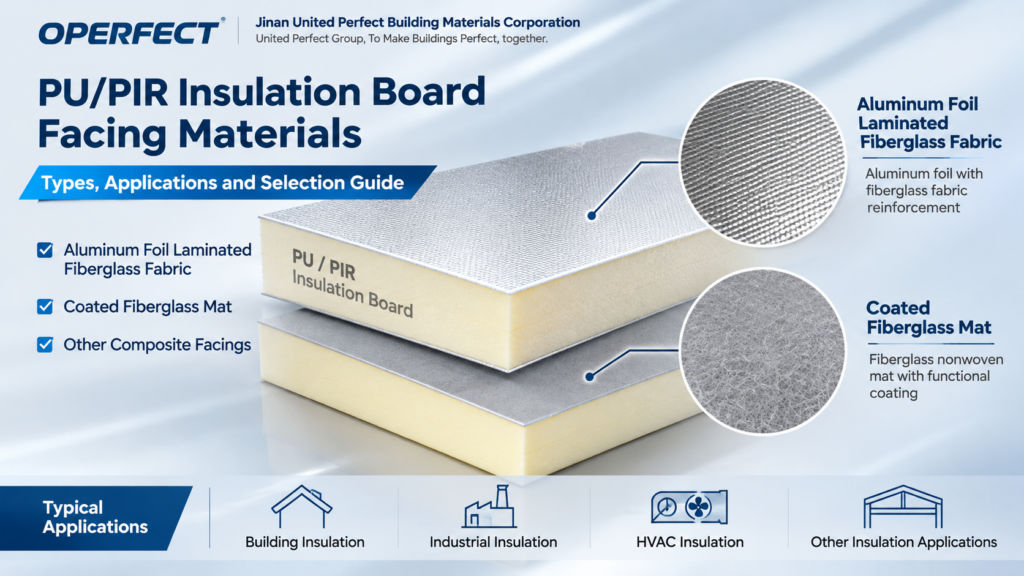
PU/PIR Insulation Board Facing Materials: Types, Applications and Selection Guide
How to Choose the Right Facing Materials for Polyurethane and Polyisocyanurate Insulation Boards
Introduction: Why Facing Materials Matter in PU/PIR Insulation Boards
When selecting materials for PU/PIR insulation board manufacturing, the foam core is only part of the equation.
The facing material also plays an important role in the finished board’s surface characteristics, dimensional stability, handling performance, and suitability for different applications.
For manufacturers of polyurethane (PUR/PU) and polyisocyanurate (PIR) insulation boards, selecting a suitable facing involves more than comparing material prices.
Different facers may offer different advantages in terms of:
- Surface protection and appearance
- Moisture and vapor resistance
- Mechanical reinforcement
- Compatibility with foam production processes
- Fire-performance requirements
- Processing efficiency and finished board cost
Two commonly considered facing solutions are Aluminum Foil Laminated Fiberglass Fabric and Estera de fibra de vidrio recubierta.
Understanding their differences can help manufacturers select materials that better match their production requirements and target markets.
1. What Are PU/PIR Insulation Board Facing Materials?
PU/PIR insulation boards are rigid foam insulation products used in building and industrial applications.
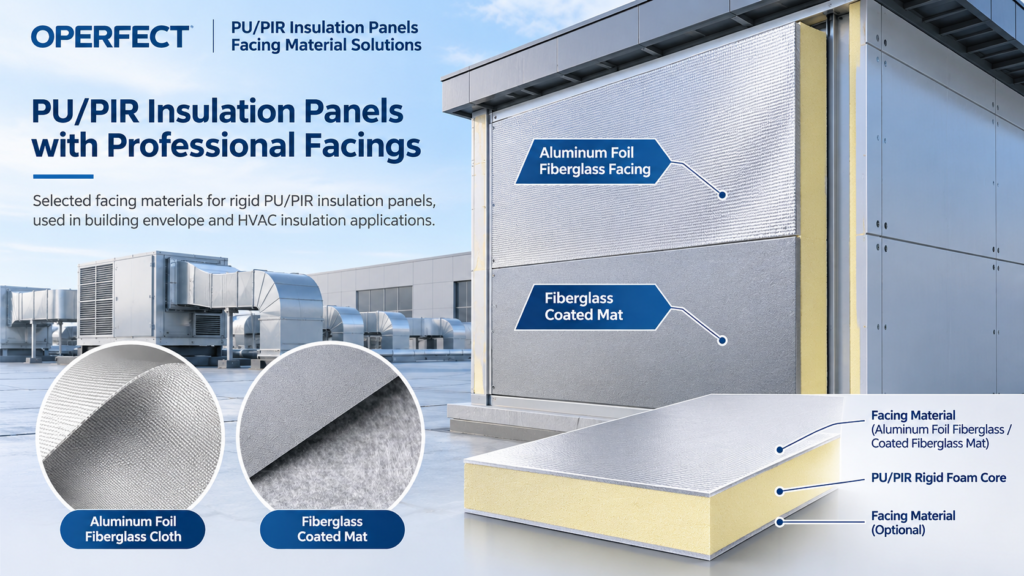
Depending on the product design, facing materials may be applied to one or both sides of the foam core.
They can serve several functions, including protecting the foam surface, providing reinforcement, influencing moisture or vapor transmission, and supporting the board’s intended application.
Common facing material categories include:
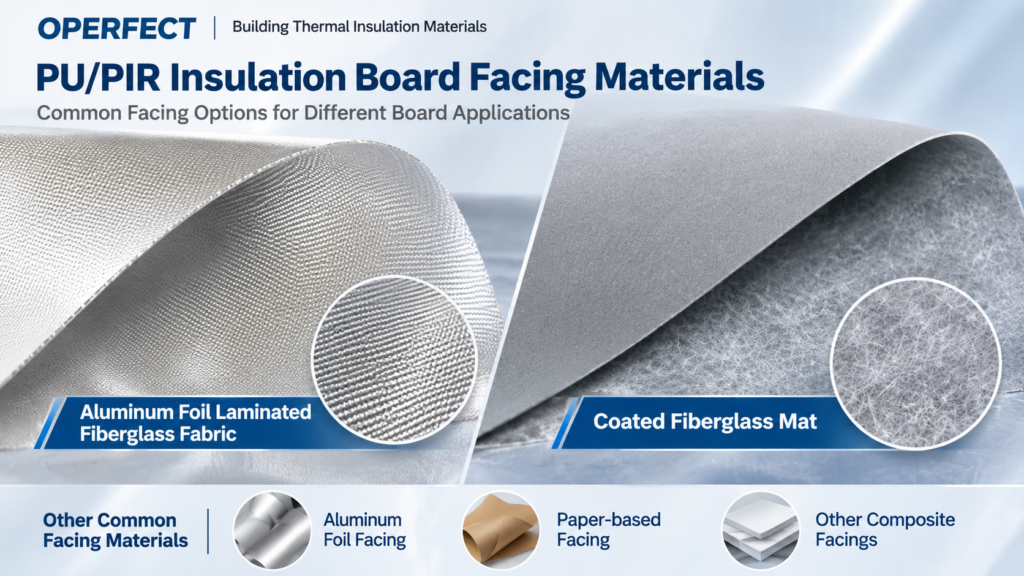
Aluminum Foil Facings
Aluminum foil and foil-based laminates are used where reflective surfaces, moisture resistance, or specific barrier properties are required.
Fiberglass-Reinforced Aluminum Foil Facings
These materials combine aluminum foil with fiberglass reinforcement to provide a composite facing with additional mechanical support.
Coated Fiberglass Mats
Fiberglass nonwoven mats with mineral-based or other functional coatings are used in selected PU/PIR board constructions, including certain roofing and building insulation applications.
Paper-Based and Other Composite Facings
Depending on the application, manufacturers may also consider reinforced paper, multilayer laminates, or other engineered facing structures.
Not all facing materials are interchangeable. Their suitability depends on the finished board’s performance requirements and the manufacturing process.
2. Aluminum Foil Laminated Fiberglass Fabric for PU/PIR Boards
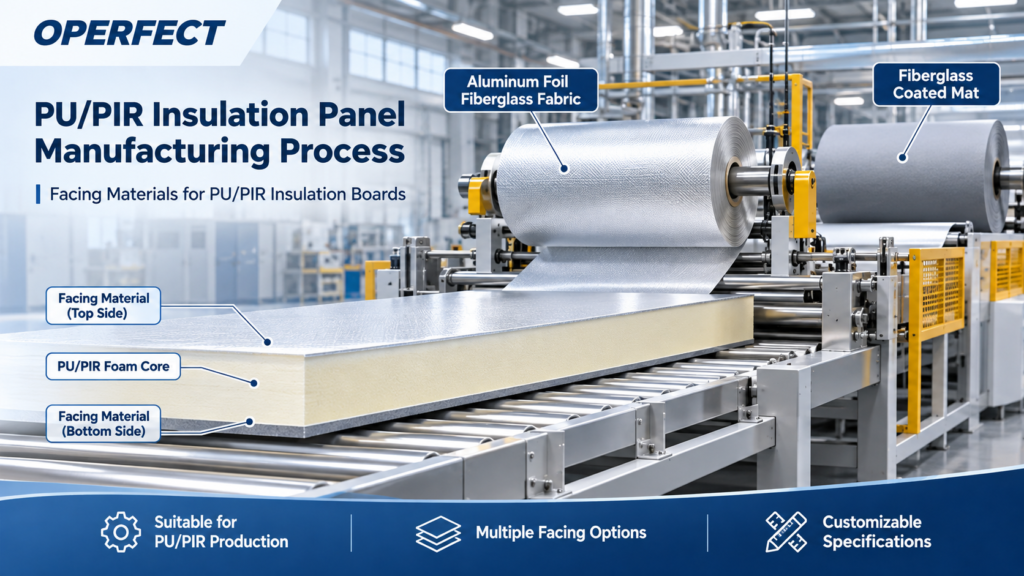
Aluminum Foil Laminated Fiberglass Fabric combines a metallic foil surface with fiberglass fabric reinforcement.
The specific construction can be customized according to the manufacturer’s requirements.
Key Characteristics
Reflective Surface
The aluminum foil provides a reflective metallic surface. Its contribution to the thermal performance of the finished assembly depends on the installation configuration, including whether an appropriate air space is present.
Moisture and Vapor Barrier Potential
The aluminum layer can contribute to barrier performance. Actual performance depends on foil continuity, laminate construction, joints, and installation conditions.
Mechanical Reinforcement
The fiberglass fabric supports the laminate’s mechanical strength and handling characteristics.
Customizable Construction
Foil thickness, fiberglass fabric construction, bonding method, roll dimensions, and other specifications may be evaluated according to the intended application.
Typical Applications
- Selected PUR/PIR rigid insulation board facings
- Industrial thermal insulation composites
- HVAC insulation-related applications
- Other engineered insulation facing systems
For PU/PIR board manufacturers, the key consideration is whether the facing structure is compatible with the foam formulation, production equipment, and finished product requirements.
3. Coated Fiberglass Mat for PU/PIR Insulation Boards
Coated Fiberglass Mat generally uses a fiberglass nonwoven substrate with a functional coating.
Depending on the product, the coating may contain mineral-based materials and other formulation components.
Key Characteristics
Engineered Surface Properties
Coating composition and application method influence surface appearance, texture, and interaction with other materials.
Dimensional and Handling Performance
The fiberglass substrate and coating construction influence the material’s dimensional stability, flexibility, and handling characteristics.
Compatibility with Board Manufacturing
Coated fiberglass mats may be used as facers in selected continuous or other PU/PIR board manufacturing processes, subject to process validation.
Specification Flexibility
Manufacturers may require different coating weights, total grammages, thicknesses, widths, roll lengths, and surface characteristics.
Typical Applications
- Selected PU/PIR insulation boards
- Certain roofing insulation board constructions
- Building insulation and composite panel applications
Coated fiberglass mat should be evaluated according to the intended board system, rather than selected solely on appearance or material cost.
4. Aluminum Foil Fiberglass Facing vs. Coated Fiberglass Mat
Both materials can be used in PU/PIR insulation board applications, but their structures and performance priorities differ.
| Selection Factor | Aluminum Foil Laminated Fiberglass Fabric | Estera de fibra de vidrio recubierta |
|---|---|---|
| Base Structure | Aluminum foil with fiberglass fabric reinforcement | Fiberglass nonwoven mat with functional coating |
| Surface | Metallic, reflective | Coated, often mineral-based |
| Barrier Performance | Can provide significant barrier properties depending on construction | Depends on coating formulation and tested properties |
| Mechanical Behavior | Influenced by fiberglass weave and lamination quality | Influenced by nonwoven substrate and coating |
| Manufacturing Compatibility | Requires evaluation of bonding and processing conditions | Requires evaluation of coating, bonding, and processing conditions |
| Cost | Depends on foil, fabric, and lamination specifications | Depends on substrate, coating formulation, and processing |
| Selection Priority | Reflective/barrier requirements and engineered composite performance | Coated surface characteristics and board-system requirements |
Important: Neither material should be considered universally superior.
A change from one facing material to another may affect the finished board’s performance, processing behavior, and compliance with applicable specifications.
5. Practical Application Scenario: Balancing Performance and Cost
Consider a PU/PIR insulation board manufacturer reviewing its facing material options.
The manufacturer currently uses an aluminum foil laminated fiberglass fabric that meets its established production requirements.
During a cost review, the purchasing and technical teams begin evaluating coated fiberglass mat as a possible alternative for a different board specification.
Before changing the material, several questions must be answered:
- Does the alternative facing meet the intended board’s performance requirements?
- Is it compatible with the existing foam formulation and production line?
- How does it affect surface characteristics and bonding?
- Are additional tests required for the finished board?
- Does the potential material cost saving justify the validation process?
This illustrative scenario reflects a common procurement challenge: balancing material cost with technical suitability.
A lower-priced facing is not necessarily a lower-cost solution if it causes production problems or fails to meet finished board requirements.
6. How to Select Facing Materials for PU/PIR Board Manufacturing
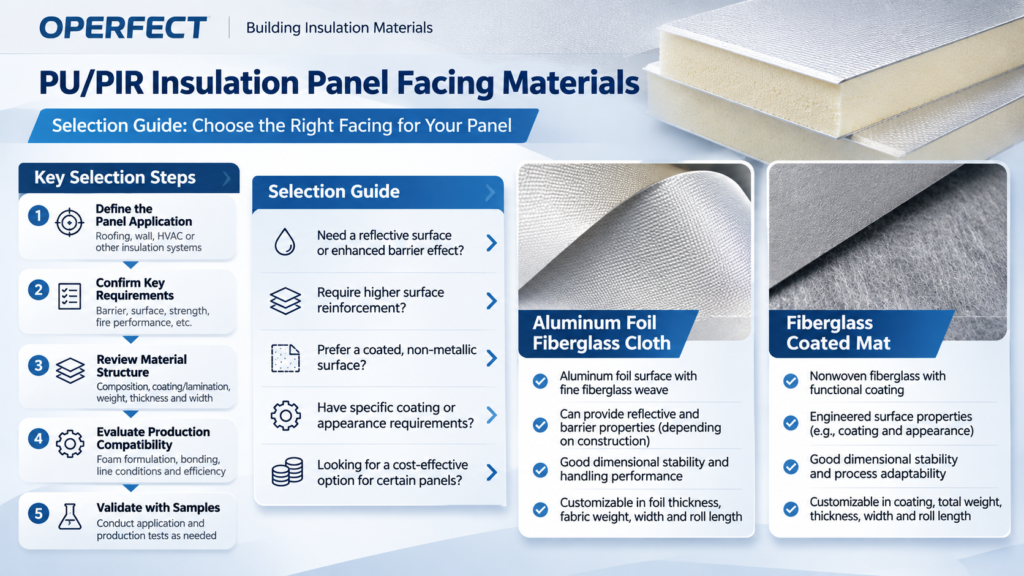
Step 1: Define the Finished Board Application
Identify whether the board is intended for roofing, walls, HVAC, industrial insulation, or another application.
Step 2: Confirm Required Performance
Determine which properties are critical, such as:
- Moisture and vapor resistance
- Surface strength and durability
- Dimensional stability
- Fire-performance requirements
- Compatibility with subsequent bonding or finishing processes
Step 3: Review the Facing Structure
Confirm the material composition, layer arrangement, coating or lamination method, thickness, grammage, and roll specifications.
Step 4: Evaluate Production Compatibility
Consider foam formulation, facing feeding and tension, bonding behavior, production speed, and handling conditions.
Step 5: Validate Samples Before Commercial Production
Where appropriate, conduct facing-level and finished-board testing under representative production conditions.
Testing requirements should follow the intended market, board design, and applicable standards.
7. Related Facing Material Solutions from OPERFECT
OPERFECT supplies industrial facing and composite materials for insulation-related applications.
Our relevant product portfolio includes:
Aluminum Foil Laminated Fiberglass Fabric
Customizable foil and fiberglass composite facings for selected PU/PIR and industrial insulation applications.
Estera de fibra de vidrio recubierta
Coated nonwoven fiberglass materials for selected rigid insulation board applications.
Other Fiberglass and Aluminum Foil Composite Materials
Additional materials may be evaluated according to customer samples, technical specifications, and intended use.
Rather than assuming one material fits every application, we encourage customers to compare available structures against their actual manufacturing and finished-board requirements.
Customization and Supply Support
Depending on the material and manufacturing feasibility, customization may include:
- Material construction and coating or lamination requirements
- Thickness and grammage
- Width and roll length
- Surface characteristics
- Packaging and export specifications
- Reference sample evaluation
Specific performance requirements should be confirmed through technical review and appropriate testing.
8. Frequently Asked Questions
Q1. What is the most common facing material for PU/PIR insulation boards?
There is no single facing material suitable for every PU/PIR board. Aluminum foil composites, coated fiberglass mats, reinforced paper, and other engineered facers are used depending on the board application and manufacturer requirements.
Q2. Can aluminum foil laminated fiberglass fabric be used for PUR/PIR boards?
Yes, suitable constructions can be used as facings for selected PUR/PIR insulation boards. Compatibility with the production process and finished board requirements must be confirmed.
Q3. Can coated fiberglass mat replace aluminum foil fiberglass facing?
It may be considered for certain board specifications, but it is not a direct universal replacement. Barrier properties, surface performance, bonding, fire requirements, and production compatibility must be evaluated.
Q4. Is coated fiberglass mat always cheaper than foil fiberglass facing?
Not necessarily. Pricing depends on material construction, coating formulation, specifications, quantity, and manufacturing requirements.
Q5. Does aluminum foil facing improve insulation performance?
Aluminum foil provides a low-emissivity reflective surface. Its effect on assembly thermal performance depends on the system design, especially the presence and arrangement of air spaces.
Q6. Can facing materials be customized for existing PU/PIR production lines?
Depending on manufacturing feasibility, material construction, dimensions, and selected properties can be evaluated using customer specifications or reference samples.
Q7. What information should a buyer provide when requesting a quotation?
Ideally, provide the intended application, existing material structure or sample, width, roll length, thickness, grammage, required performance, and expected purchasing requirements.
Q8. Should finished boards be tested when changing facing materials?
Yes. A facing change may affect the finished board’s behavior or compliance. Appropriate testing and validation should be determined by the manufacturer and applicable requirements.
9. Work with OPERFECT on PU/PIR Facing Material Selection
Choosing the right facing material requires a balance of technical performance, manufacturing compatibility, and commercial considerations.
OPERFECT supports international buyers and insulation manufacturers with established fiberglass and aluminum foil composite material supply resources.
Whether you are sourcing aluminum foil laminated fiberglass fabric, coated fiberglass mat, or evaluating alternative facing constructions, our team can discuss your requirements and potential material options.
Have an existing facing sample or technical specification?
Contact us to discuss a suitable material solution for your PU/PIR insulation board application.
OPERFECT | Jinan United Perfect Building Materials Corporation
United Perfect Group, To Make Buildings Perfect, together.
Global Business Director: Mr. Du
WhatsApp/WeChat: +86 134 2613 0536
Correo electrónico: export@unitedperfect.com
Official Website: www.unitedperfect.com