Common Mistakes When Selecting Insulation Facing Materials
How to Avoid Costly Mistakes When Buying Aluminum Foil Composite Products
Introduction
Selecting insulation facing materials may seem simple.
However, different insulation systems require different facing structures, performance levels, and manufacturing specifications.
Choosing a material based only on price or appearance can create problems later in production, installation, and long-term application.
Common purchasing mistakes include:
- Choosing the wrong product structure
- Comparing suppliers only by price
- Ignoring application requirements
- Skipping sample approval
- Failing to confirm specifications
- Overlooking lamination quality
- Ignoring packaging and transportation
- Choosing a supplier without sufficient technical support
A professional purchasing process should evaluate application, performance, quality, cost, and supply reliability together.
OPERFECT helps global customers select and customize aluminum foil composite materials for different thermal protection applications.
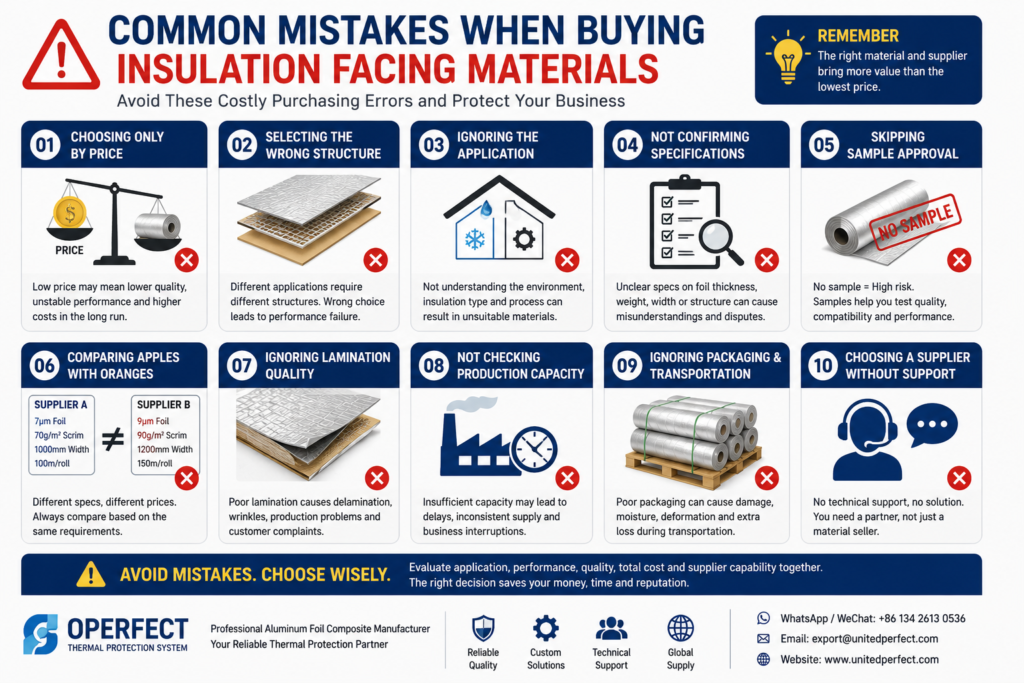
1. Mistake: Choosing a Product Only by Price
Price is important, but it should not be the only purchasing factor.
Two aluminum foil composite products may look similar while having significant differences in:
- Aluminum foil thickness
- Reinforcement material
- Adhesive system
- Lamination strength
- Total weight
- Roll specifications
- Production consistency
A lower initial price may create higher costs later through:
- Production problems
- Material waste
- Installation difficulties
- Customer complaints
- Replacement costs
Better Approach
Compare:
Performance + Quality + Service + Total Cost
rather than price alone.
2. Mistake: Selecting the Wrong Product Structure
Different applications require different structures.
For example:
FSK Facing
Typical structure:
Aluminum Foil + Fiberglass Scrim + Kraft Paper
Common applications:
- Lana de vidrio
- HVAC insulation
- Building insulation
FSV Facing
Typical structure:
Aluminum Foil + Fiberglass Scrim + Protective Film
Suitable for applications where improved moisture resistance and surface protection are important.
Heat Sealing Foil
Typical structure:
Aluminum Foil + Reinforcement + Heat-Sealing Layer
Common applications:
- PIR/PUR panels
- Cold room panels
- Insulated panels
Aluminum Foil Fiberglass Cloth
Typical structure:
Aluminum Foil + Fiberglass Cloth
Suitable for applications requiring higher mechanical strength and durable surface protection.
Better Approach
Before selecting a product, define:
Application → Required Performance → Material Structure
Do not select the structure first and try to find an application afterward.
3. Mistake: Ignoring the Final Application
The same facing material may not be suitable for every insulation system.
Before purchasing, confirm:
- What insulation material will it cover?
- Where will it be installed?
- What environmental conditions will it face?
- What manufacturing process will be used?
- What performance is required?
For example:
HVAC
Important considerations may include:
- Vapor control
- Surface durability
- Easy installation
- Appearance
Glass Wool / Rock Wool
Important considerations may include:
- Lamination stability
- Production compatibility
- Dimensional consistency
PIR/PUR Panels
Important considerations may include:
- Heat-sealing performance
- Bonding
- Production efficiency
Industrial Insulation
Important considerations may include:
- Mechanical strength
- Durability
- Surface protection
4. Mistake: Not Confirming Technical Specifications
A product name is not a complete specification.
Before ordering, buyers should confirm:
Aluminum Foil
- Foil thickness
- Alloy or material requirements
- Surface condition
Reinforcement
- Fiberglass scrim
- Fiberglass cloth
- Reinforcement weight
Composite Structure
- Number of layers
- Material sequence
- Adhesive or bonding system
Finished Product
- Total thickness
- Finished weight
- Width
- Roll length
- Core size
A clear technical specification prevents misunderstandings between buyer and supplier.
5. Mistake: Skipping Sample Approval
Large-volume production should not begin before the product has been properly confirmed.
Samples allow buyers to evaluate:
- Appearance
- Structure
- Thickness
- Lamination
- Handling
- Application compatibility
- Production performance
For industrial customers, sample testing is particularly important because the material may need to run through an existing production line.
Better Approach
Use a simple process:
Sample → Testing → Approval → Mass Production
This small step can significantly reduce purchasing risk.
6. Mistake: Comparing Suppliers Using Different Specifications
This is a common purchasing problem.
Supplier A may quote:
- 7-micron aluminum foil
- Standard reinforcement
- Standard roll length
Supplier B may quote:
- 9-micron aluminum foil
- Heavier reinforcement
- Customized roll length
Comparing only the final price does not provide a meaningful comparison.
Better Approach
Create a standardized RFQ.
Every supplier should quote against the same:
- Structure
- Foil thickness
- Reinforcement
- Width
- Roll length
- Packaging
- Quantity
- Delivery terms
Only then can buyers make a fair comparison.
7. Mistake: Ignoring Lamination Quality
Aluminum foil facing is a composite material.
The performance of the finished product depends not only on individual materials but also on how those layers are combined.
Poor lamination may lead to:
- Delamination
- Wrinkles
- Uneven surfaces
- Production difficulties
- Reduced product reliability
Better Approach
Ask suppliers about:
- Lamination process
- Bonding quality
- Production inspection
- Finished roll inspection
A professional supplier should be able to explain how quality is controlled throughout production.
8. Mistake: Ordering Before Confirming Production Capacity
A supplier may provide an attractive sample but struggle with a large production order.
Before placing a major order, ask:
- What is the production capacity?
- What is the normal lead time?
- Can repeat orders be supported?
- How are urgent orders handled?
- Can capacity increase with our business?
This is especially important for distributors and insulation manufacturers who need stable supply throughout the year.
Better Approach
Evaluate the supplier’s ability to support both:
Today’s order + Tomorrow’s growth
9. Mistake: Ignoring Packaging and Transportation
Insulation facing materials may travel thousands of kilometers before reaching the final customer.
Packaging therefore matters.
Buyers should confirm:
- Roll protection
- Moisture protection
- Pallet requirements
- Core protection
- Container loading
- Labeling
- Export documentation
A good product can still arrive in poor condition if transportation preparation is inadequate.
10. Mistake: Choosing a Supplier Without Technical Support
A supplier should not simply ask:
“What quantity do you need?”
A professional supplier should also ask:
- What is the application?
- What insulation material are you using?
- What performance do you require?
- What production process do you use?
- What market are you selling into?
This difference separates a material seller from a technical supply partner.
11. A Better Way to Select Insulation Facing Materials
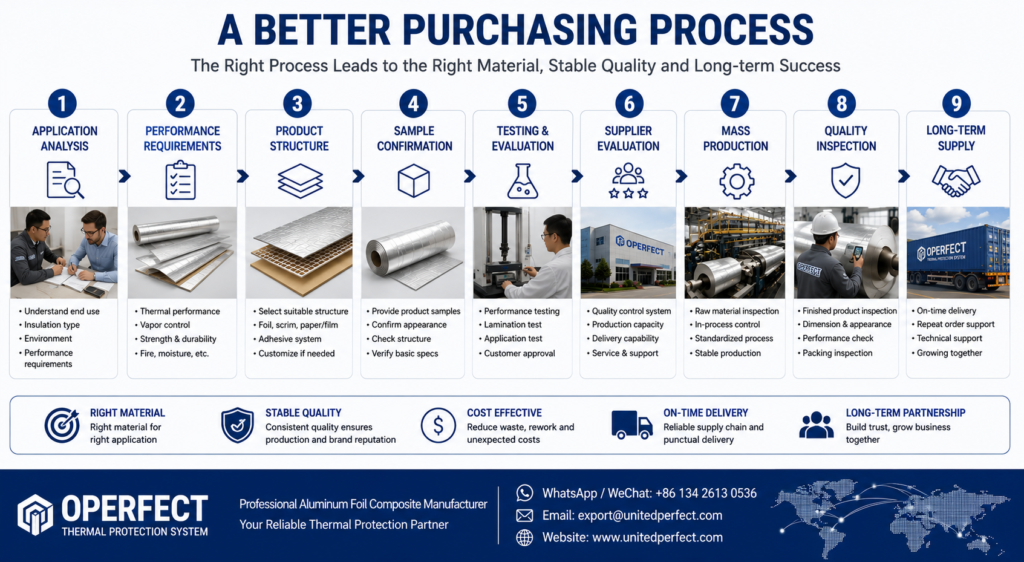
Instead of following:
Price → Order → Problem → Replacement
use:
Aplicación
↓
Performance Requirements
↓
Product Structure
↓
Sample
↓
Testing
↓
Supplier Evaluation
↓
Mass Production
↓
Quality Inspection
↓
Long-Term Supply
This process reduces purchasing risk and improves long-term product consistency.
12. Why Choose OPERFECT?
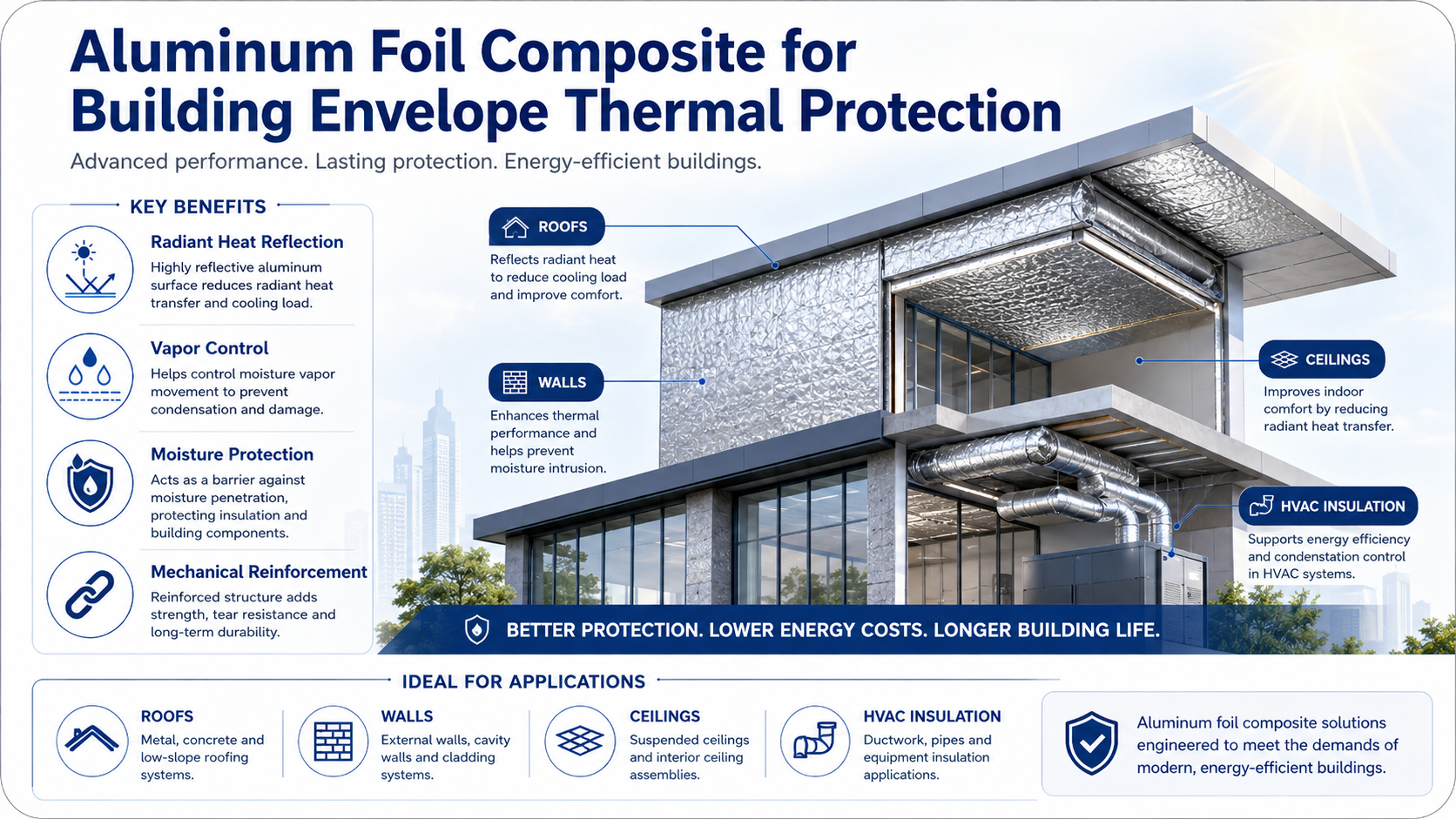
OPERFECT provides a complete aluminum foil composite portfolio for different thermal protection applications.
Standard Facing
- FSK
- FSV
Reinforced Facing
- Aluminum Foil Fiberglass Scrim
- Aluminum Foil Fiberglass Cloth
Premium Composite
- Heat Sealing Foil
- DFC
- PET/AL/PET
OPERFECT also supports:
- Custom structures
- Customized foil thickness
- Customized width
- Customized roll length
- Printing
- OEM manufacturing
- Private label production
Global Market Experience
OPERFECT supports customers in:
- Middle East
- India
- Southeast Asia
- North America
- Europe
Our customers include:
- Insulation manufacturers
- HVAC companies
- Importers
- Distributors
- Building material suppliers
- Private label brands
Conclusion
Selecting insulation facing materials is not simply a matter of finding the lowest price.
The right decision should consider:
Application + Performance + Structure + Quality + Cost + Supply Reliability
Avoiding common purchasing mistakes can help buyers reduce waste, improve production stability, and build a more reliable supply chain.
The right supplier should provide more than materials.
It should provide technical knowledge, manufacturing capability, customization flexibility, quality control, and long-term support.
OPERFECT works with global customers to develop practical thermal protection material solutions for different insulation applications.
Contact OPERFECT
United Perfect Group,To Make Buildings Perfect, together.
Global Business Director: Mr. Du
WhatsApp / WeChat: +86 134 2613 0536
Correo electrónico: export@unitedperfect.com
Página web: www.unitedperfect.com