Learn the differences between aluminum foil with fiberglass scrim and aluminum foil with woven scrim, including structure, strength, applications and selection guidance.
Introduction
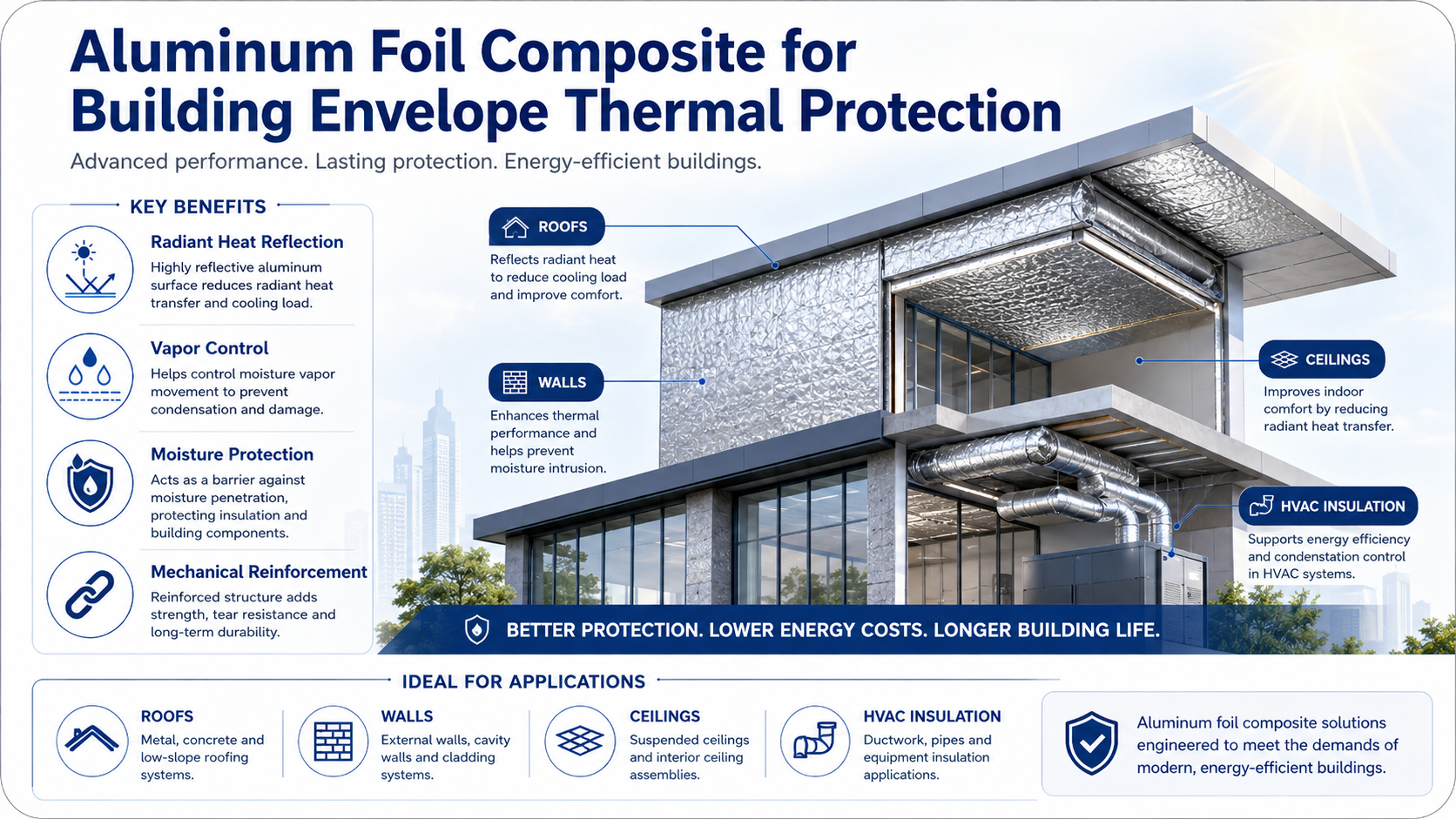
Aluminum foil composite materials are widely used in insulation, roofing, building envelope and industrial protection applications.
To improve the strength and durability of aluminum foil, different reinforcement layers can be laminated behind the foil surface.
Two common reinforcement structures are:
- Aluminum Foil + Fiberglass Scrim
- Aluminum Foil + Woven Scrim
Although both use aluminum foil as the functional barrier layer, their reinforcement structures create different performance characteristics and application advantages.
Understanding the difference helps buyers select the right material for insulation systems, roofing applications and building protection.
Structure Comparison
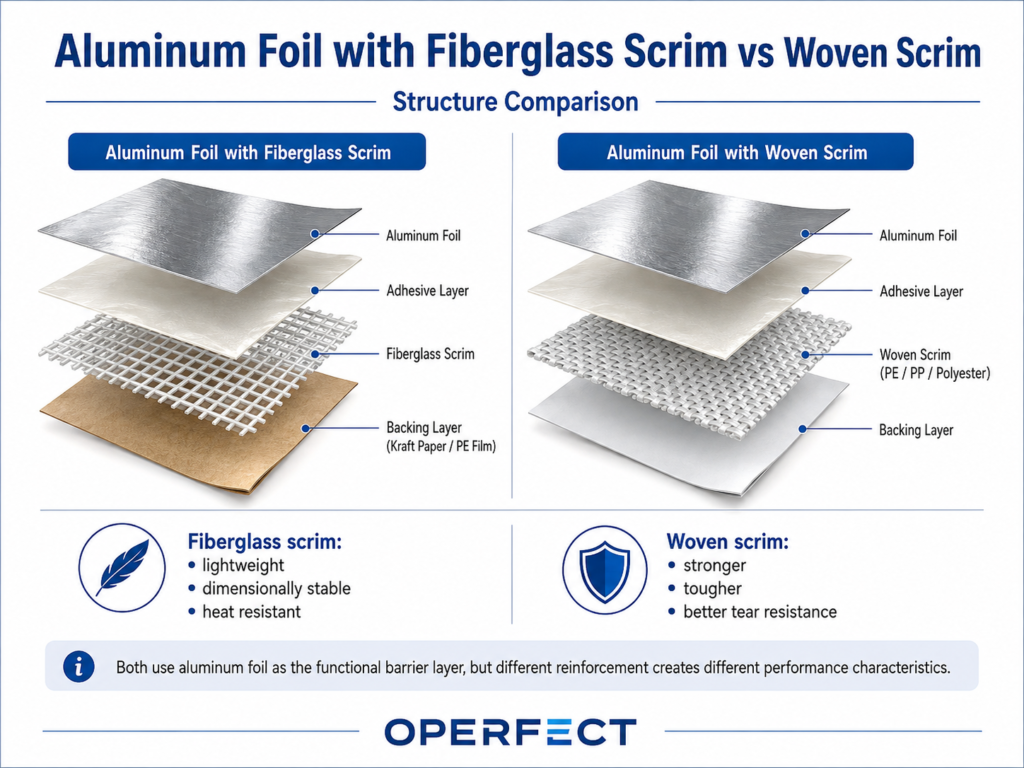
Aluminum Foil with Fiberglass Scrim
Typical structure:
Aluminum Foil + Adhesive + Fiberglass Scrim + Backing Layer
The fiberglass scrim is an open-grid reinforcement made from fiberglass yarn.
Common structures include:
- Aluminum foil + fiberglass scrim
- Aluminum foil + fiberglass scrim + kraft paper
- Aluminum foil + fiberglass scrim + PE film
- Aluminum foil + fiberglass scrim + woven backing
The fiberglass reinforcement provides strength while maintaining a lightweight structure.
Aluminum Foil with Woven Scrim
Typical structure:
Aluminum Foil + Adhesive + Woven Fabric
The woven layer is usually made from:
- PE woven fabric
- PP woven fabric
- Polyester woven fabric
- Other synthetic woven materials
The woven backing creates a stronger and more durable composite suitable for more demanding environments.
Difference Between Fiberglass Scrim and Woven Scrim
1. Reinforcement Structure
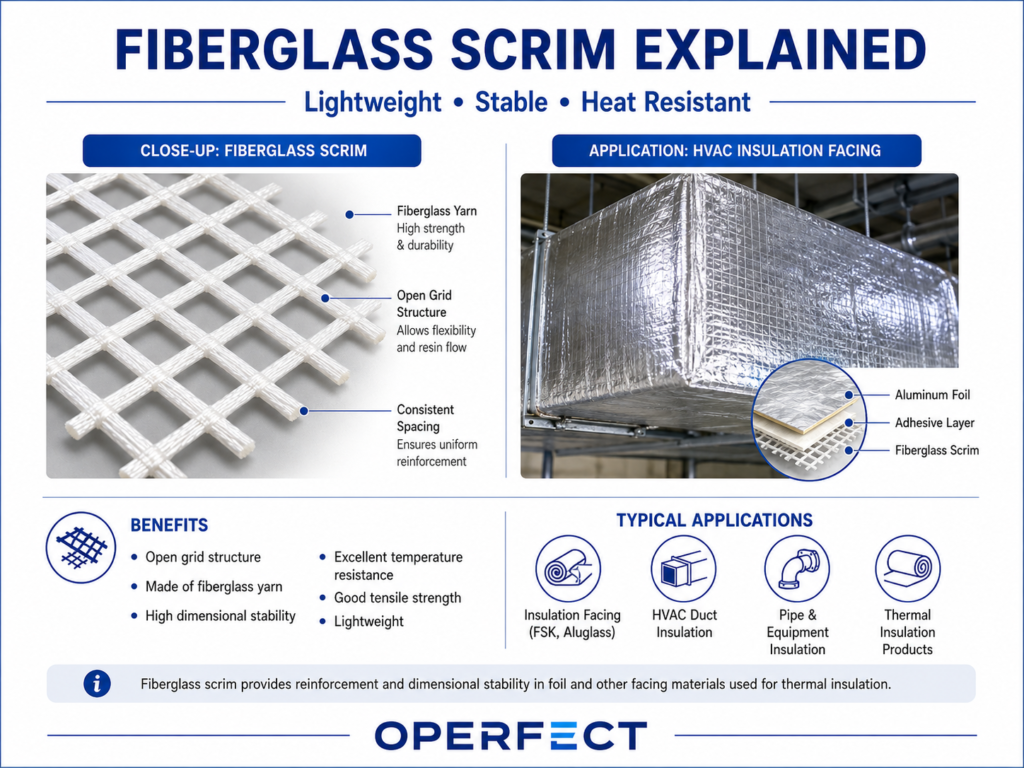
Fiberglass Scrim
Fiberglass scrim is a mesh reinforcement made from fiberglass yarn.
Characteristics:
- Lightweight
- Open grid structure
- High dimensional stability
- Good tensile strength
- Excellent temperature resistance
It is commonly used where reinforcement is needed without significantly increasing thickness or weight.
Woven Scrim
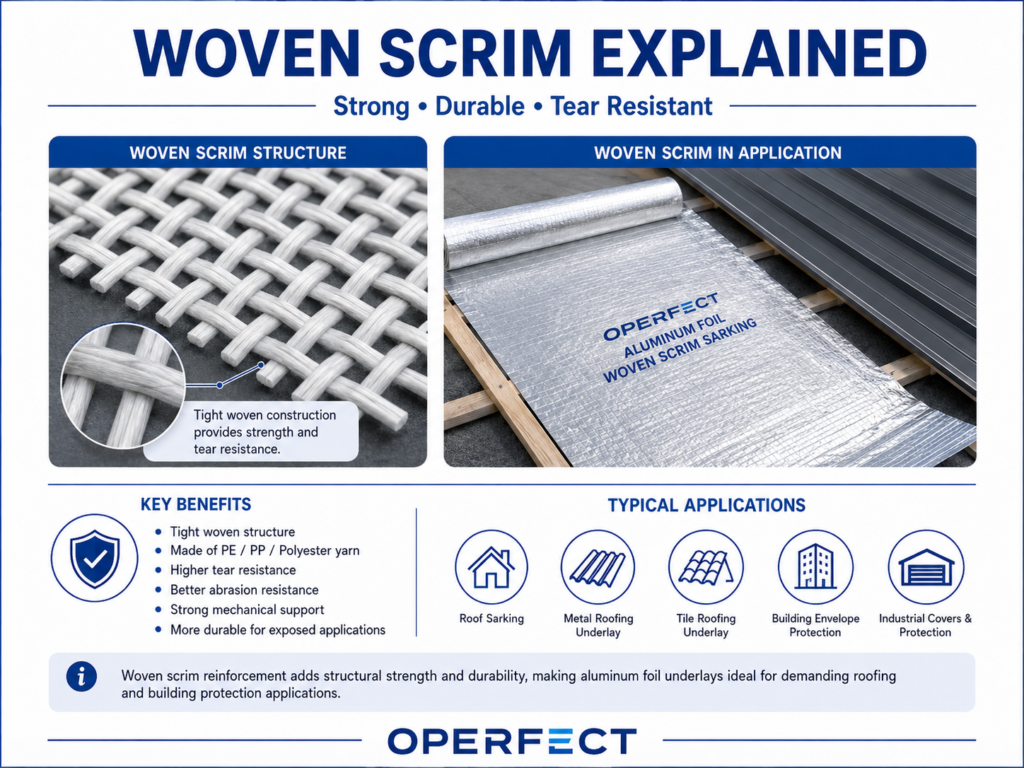
Woven scrim is produced by weaving yarns together to create a fabric structure.
Characteristics:
- Higher fabric density
- Stronger mechanical support
- Better tear resistance
- Better abrasion resistance
- More suitable for exposed applications
The woven structure provides a more protective backing.
Mechanical Performance Comparison
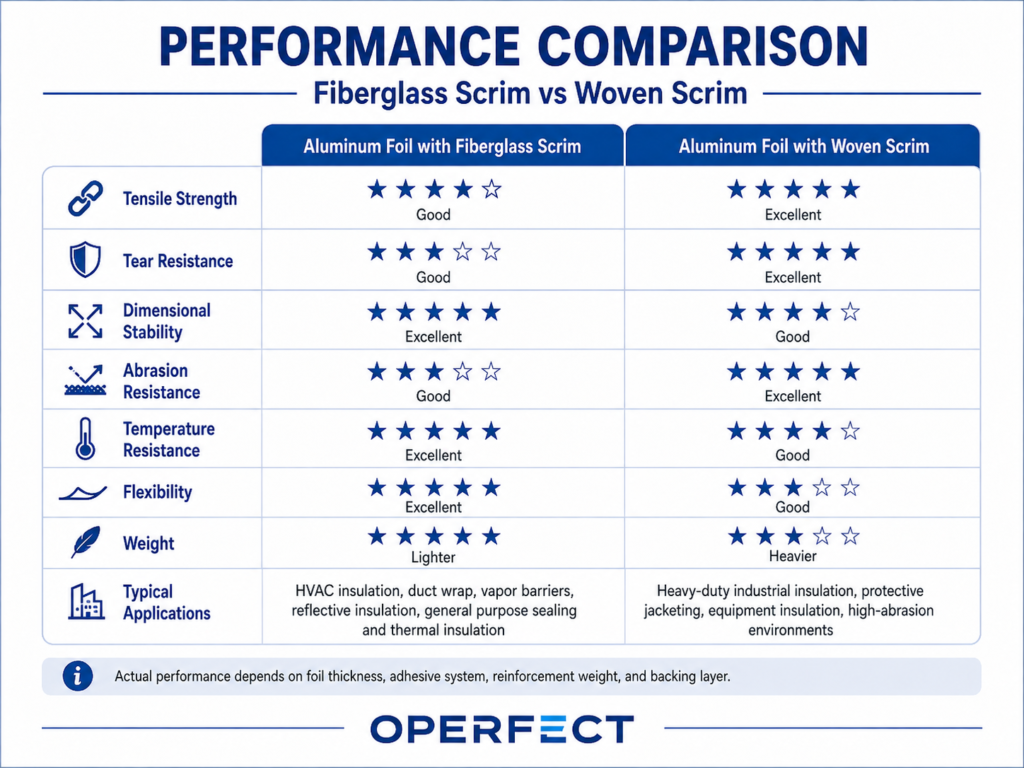
Performance | Fiberglass Scrim | Woven Scrim |
|---|---|---|
| Tensile Strength | High | Higher |
| Tear Resistance | Good | Excellent |
| Dimensional Stability | Excellent | Good |
| Abrasion Resistance | Moderate | Excellent |
| Weight | Lower | Higher |
| Flexibility | Good | Moderate |
| Durability | Good | Excellent |
Temperature Resistance
Fiberglass Scrim
Fiberglass provides excellent temperature stability.
Advantages:
- Maintains strength at elevated temperatures
- Low thermal expansion
- Suitable for insulation applications
Common uses:
- HVAC insulation
- Industrial insulation
- Heat-resistant applications
Woven Scrim
Synthetic woven fabrics provide good durability but their temperature performance depends on the polymer type.
For example:
- PE woven fabric provides flexibility and cost efficiency
- PP woven fabric provides strength and moisture resistance
- Polyester woven fabric provides higher temperature stability
The selected woven material should match the application requirements.
Application Differences
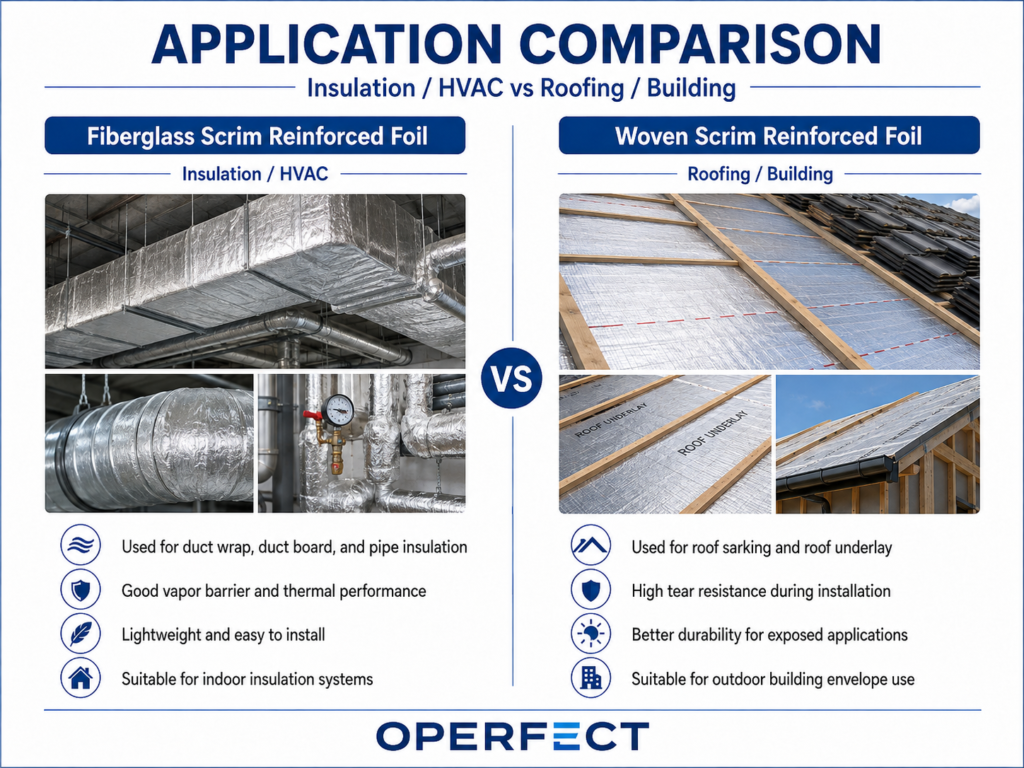
Aluminum Foil with Fiberglass Scrim Applications
1. Insulation Facing
Fiberglass scrim reinforced foil is widely used for:
- Glass wool insulation
- Rock wool insulation
- HVAC insulation
- Thermal insulation boards
The structure provides:
- Vapor control
- Reflective surface
- Reinforced handling strength
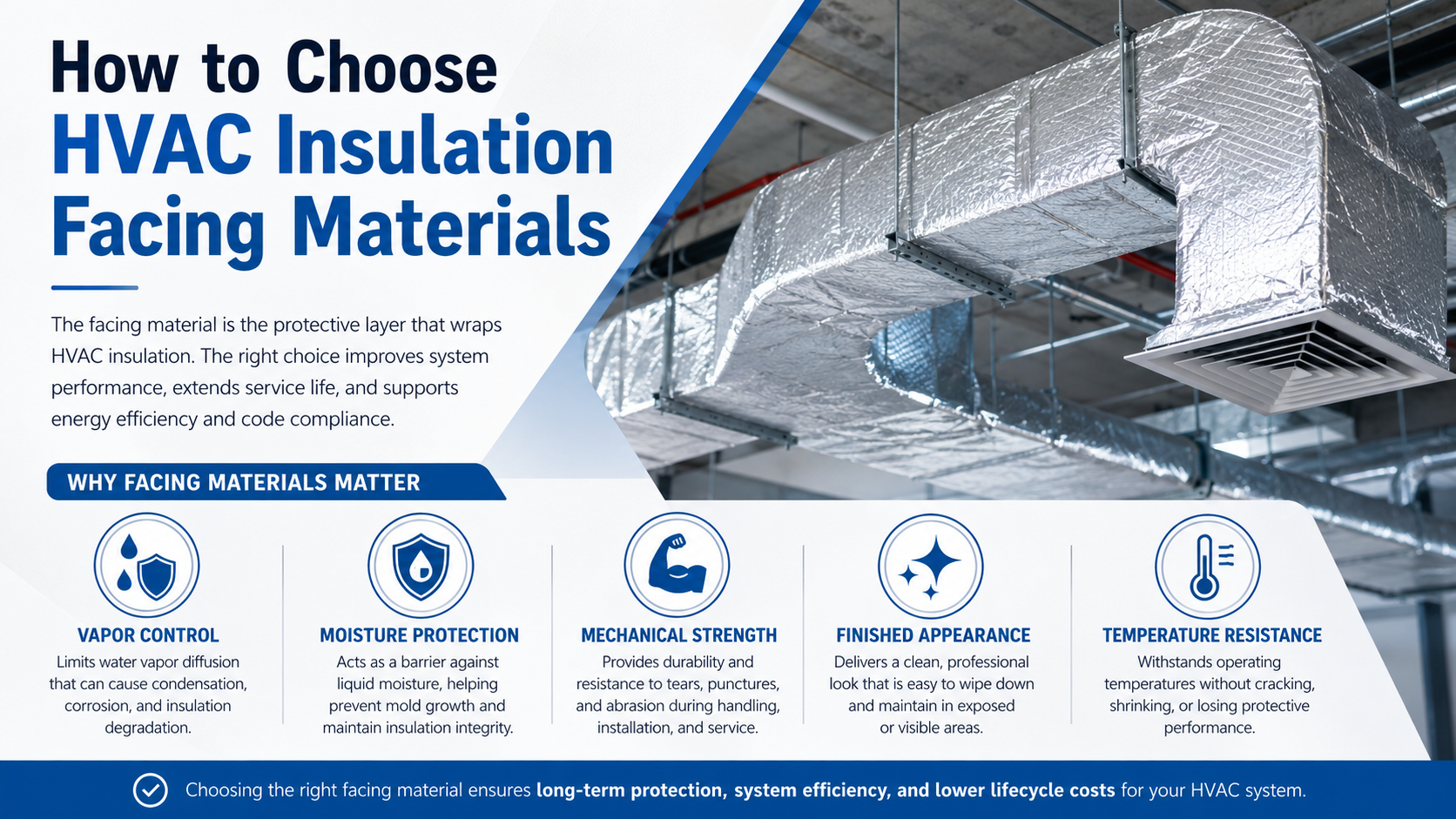
2. HVAC Duct Insulation
Common applications include:
- Duct wrap
- Duct board
- Mechanical insulation
Advantages:
- Lightweight installation
- Good moisture resistance
- Compatible with foil tape sealing
3. Industrial Thermal Insulation
Used for:
- Equipment insulation
- Pipe insulation
- Industrial thermal systems
The fiberglass reinforcement improves durability in high-temperature environments.
Aluminum Foil with Woven Scrim Applications
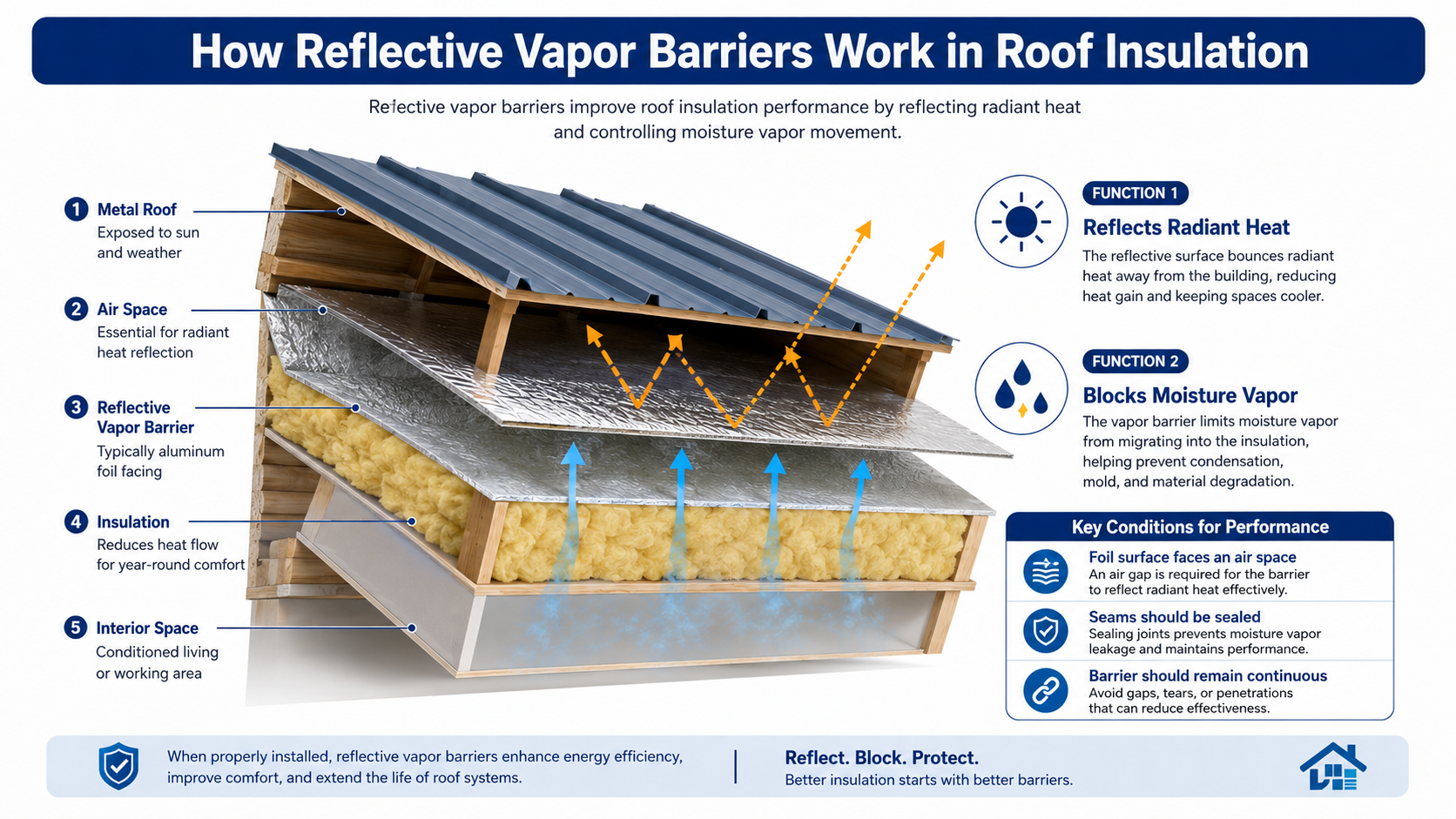
1. Roofing Sarking
One of the most common applications is roofing underlay/sarking.
Especially popular in:
- Australia
- New Zealand
- Southeast Asia
Applications include:
- Metal roofing
- Tile roofing
- Residential roofing
- Commercial roofing
The woven backing provides strength during roof installation.
2. Building Envelope Protection
Used in:
- Reflective barriers
- Wall systems
- Roof insulation systems
Benefits include:
- High tear resistance
- Better weather handling
- Improved durability
3. Industrial Protective Covers
The stronger woven structure makes it suitable for:
- Protective wrapping
- Equipment covers
- Heavy-duty insulation systems
Aluminum Foil Fiberglass Scrim vs Woven Scrim: How to Choose?
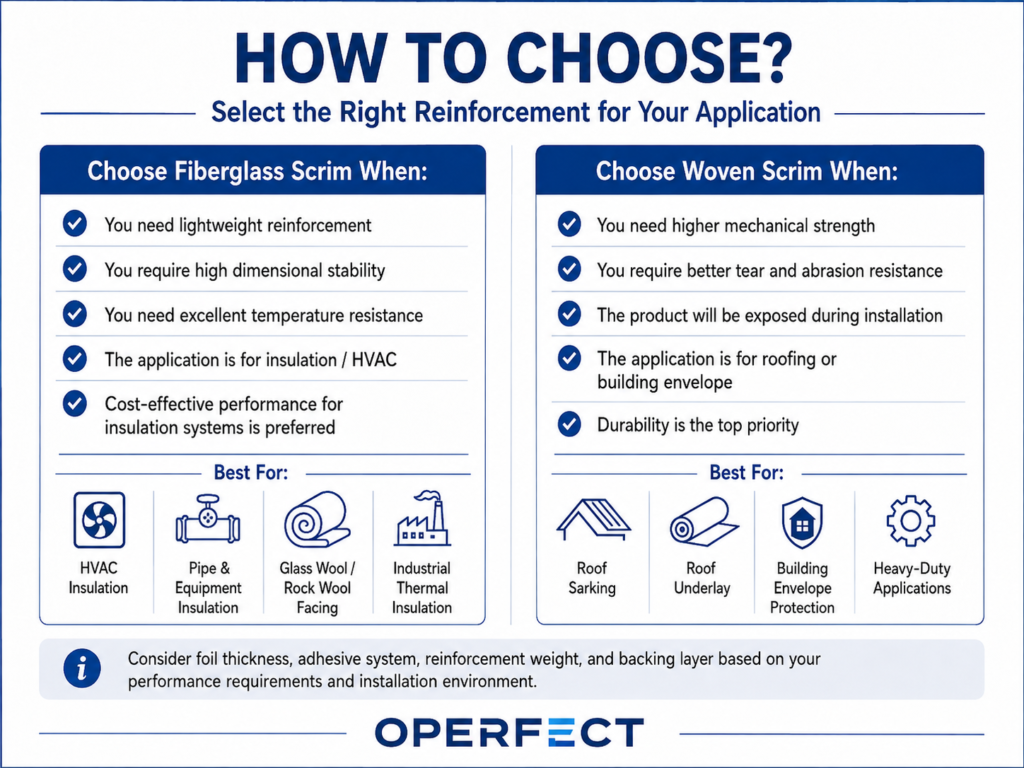
Choose Fiberglass Scrim When:
You need:
✓ Lightweight reinforcement
✓ Good thermal stability
✓ Insulation-facing applications
✓ HVAC compatibility
✓ Cost-effective performance
Typical products:
- FSK facing
- Aluminum foil fiberglass scrim
- HVAC insulation facing
Choose Woven Scrim When:
You need:
✓ Higher mechanical strength
✓ Better tear resistance
✓ More durable surface
✓ Exposure during installation
✓ Roofing applications
Typical products:
- Aluminum foil woven fabric
- Roof sarking
- Heavy-duty reflective barriers
Factors Affecting Final Performance
The reinforcement type is only one factor.
The final performance also depends on:
Aluminum Foil Thickness
Thicker foil generally provides:
- Better durability
- Better puncture resistance
- Improved barrier performance
Adhesive System
The bonding layer affects:
- Lamination strength
- Aging resistance
- Flexibility
- Delamination resistance
Reinforcement Weight
Higher reinforcement weight generally improves:
- Tensile strength
- Tear resistance
- Handling performance
Surface Treatment
Additional treatments may provide:
- Better printing performance
- Improved weather resistance
- Enhanced bonding
Quality Testing
Important tests include:
Mechanical Tests
- Tensile strength
- Tear strength
- Peel strength
- Puncture resistance
Barrier Tests
- Water vapor transmission rate
- Moisture resistance
Durability Tests
- Aging resistance
- Temperature resistance
- Lamination stability
Common Buyer Questions
Is fiberglass scrim stronger than woven scrim?
Not necessarily.
Fiberglass scrim provides excellent dimensional stability and temperature resistance.
Woven scrim generally provides higher tear resistance and mechanical durability.
The better choice depends on the application.
Can fiberglass scrim be used for roofing?
Fiberglass scrim can provide reinforcement, but roofing applications often require higher mechanical strength and durability.
For exposed roofing installation, woven scrim structures are commonly preferred.
Is woven scrim only used for roofing?
No.
Woven scrim can also be used for:
- Industrial insulation
- Protective covers
- Heavy-duty barriers
- Building materials
Conclusion
Aluminum foil with fiberglass scrim and aluminum foil with woven scrim are both reinforced foil composite materials, but they are designed for different performance requirements.
Fiberglass scrim reinforced foil provides excellent dimensional stability, temperature resistance and lightweight reinforcement, making it ideal for insulation and HVAC applications.
Woven scrim reinforced foil provides higher mechanical durability and tear resistance, making it suitable for roofing sarking, building protection and heavy-duty applications.
OPERFECT® supplies customized aluminum foil composite materials with fiberglass scrim, woven scrim, PE film, kraft paper and other reinforcement structures for insulation, roofing and building-envelope applications.