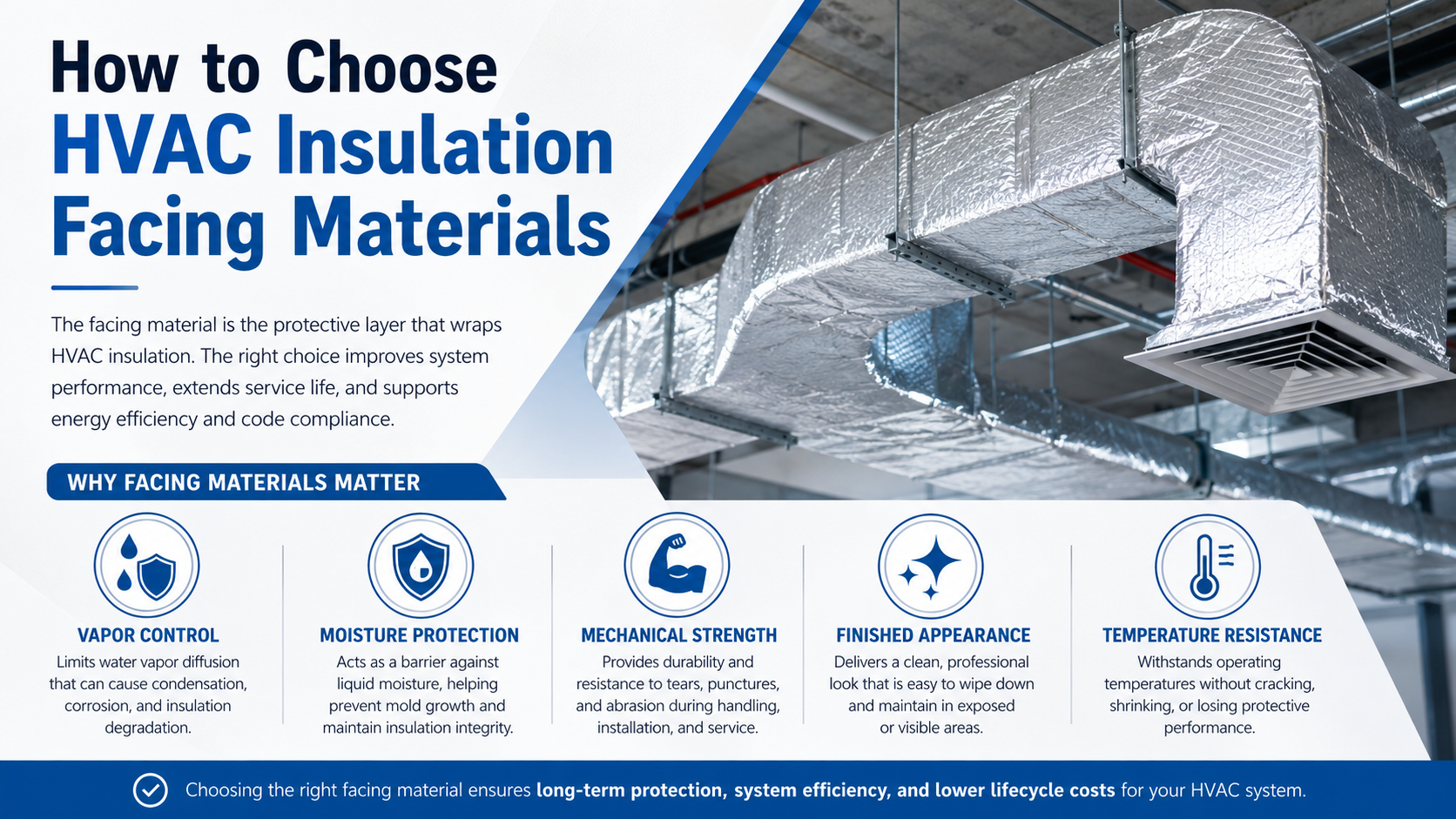
Compare FSK, FSV, WMP/WPSK, DFC, aluminum foil fiberglass cloth and other facing materials for rock wool production. Learn how to choose based on vapor control, strength, appearance, moisture resistance and application.
Introduction
For rock wool manufacturers, choosing the right facing material is an important part of product design.
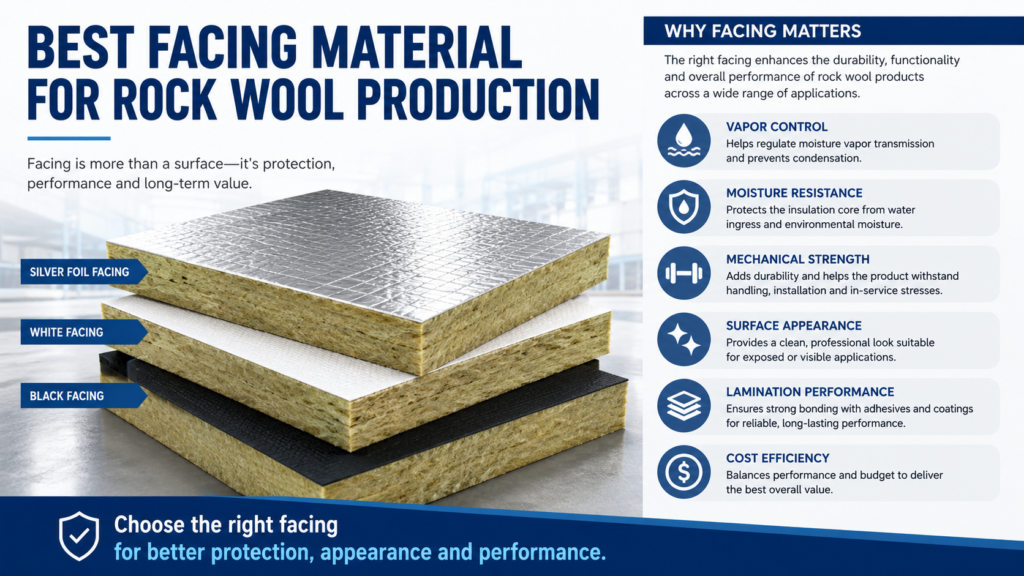
The facing affects:
- Vapor control
- Moisture resistance
- Surface protection
- Mechanical strength
- Product appearance
- Handling and installation
- Lamination performance
- Final product positioning
Different rock wool products require different facing structures.
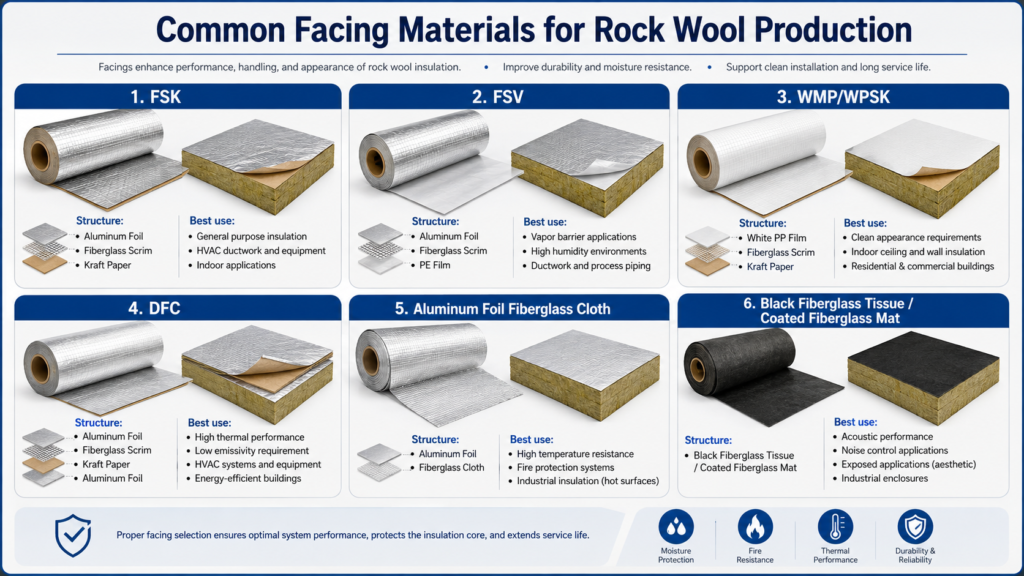
Common facing options include:
- FSK
- FSV
- WMP / WPSK
- DFC
- Aluminum foil fiberglass cloth
- Coated fiberglass mat or tissue
- Other customized composite facings
There is no single facing that is best for every rock wool product.
The correct choice depends on the application, environment, production process and target market.
What Should Rock Wool Manufacturers Consider?
Before selecting a facing, define the performance requirements of the finished product.
1. Final Application
Rock wool is commonly used in:
- HVAC systems
- Industrial insulation
- Building walls
- Roof systems
- Mechanical equipment
- Acoustic panels
- Fire-resistant insulation systems
The facing should match the final application rather than simply following a standard structure.
2. Vapor Barrier Requirements
If vapor control is important, aluminum foil-based facings are usually preferred.
Typical applications include:
- HVAC insulation
- Cold environments
- Mechanical systems
- Industrial insulation
A continuous aluminum foil layer can provide excellent resistance to vapor transmission when properly laminated and sealed.
3. Mechanical Strength
Rock wool boards and blankets may experience:
- Cutting
- Lamination
- Packaging
- Transportation
- Installation
- Mechanical stress
Reinforced facings can improve:
- Tensile strength
- Tear resistance
- Dimensional stability
- Surface durability
For heavy-duty applications, stronger reinforcements such as fiberglass cloth may be more suitable.
4. Moisture Resistance
The facing should match the humidity and condensation conditions of the application.
Important options include:
- Kraft-backed foil
- PE-backed foil
- Double foil structures
- Fiberglass-based composites
Higher moisture resistance is especially important for:
- HVAC systems
- Industrial environments
- High-humidity areas
5. Surface Appearance
For visible rock wool insulation, the surface appearance may be important.
Common choices include:
- Silver foil
- White PP facing
- Black fiberglass tissue
- Coated fiberglass mat
The facing can affect both the technical performance and final visual appearance of the product.
Option 1: FSK Facing
FSK stands for:
Foil Scrim Kraft
Typical structure:
Aluminum Foil
↓
Fiberglass Scrim
↓
Kraft Paper
FSK is a widely used facing for rock wool insulation.
Main Advantages
FSK provides:
- Excellent vapor barrier performance
- Good mechanical reinforcement
- Good dimensional stability
- Reliable processing performance
- Cost efficiency
Typical Applications
Suitable for:
- Rock wool boards
- Rock wool blankets
- HVAC insulation
- Building insulation
- General thermal insulation
Best For
Manufacturers requiring a reliable and economical standard foil facing.
Option 2: FSV Facing
Typical structure:
Aluminum Foil
↓
Fiberglass Scrim
↓
PE Film
FSV replaces the kraft paper backing with PE film.
Main Advantages
- Better moisture resistance
- Good vapor control
- Higher flexibility
- Better surface protection
- Good reinforcement
Typical Applications
Suitable for:
- HVAC insulation
- High-humidity environments
- Industrial rock wool
- Moisture-sensitive applications
Best For
Rock wool products requiring improved resistance to humidity and moisture exposure.
Option 3: WMP / WPSK White Facing
Typical structure:
White PP Film
↓
Fiberglass Scrim
↓
Kraft Paper
WPSK provides a clean white surface instead of a metallic foil appearance.
Advantages
- Clean white appearance
- Good reinforcement
- Good handling
- Suitable for visible installations
Typical Applications
Recommended for:
- Commercial buildings
- Mechanical rooms
- Ceiling insulation
- Visible wall and duct insulation
- Interior applications
Best For
Manufacturers targeting projects where appearance matters.
Option 4: DFC Double Foil Facing
Typical structure:
Aluminum Foil
↓
Fiberglass Scrim
↓
Kraft Paper
↓
Additional Aluminum Foil
DFC is essentially an FSK structure with an additional foil layer.
Advantages
- Aluminum foil on both sides
- Premium metallic appearance
- Additional surface protection
- Strong vapor barrier structure
- Double reflective surfaces
Typical Applications
Suitable for:
- Premium rock wool boards
- Reflective insulation systems
- High-end mechanical insulation
- Visible technical insulation
Best For
Manufacturers producing premium or higher-value rock wool products.
Option 5: Aluminum Foil Fiberglass Cloth
Typical structure:
Aluminum Foil + Fiberglass Cloth
Fiberglass cloth is a full woven reinforcement rather than an open-grid scrim.
Advantages
- Excellent tensile strength
- Excellent tear resistance
- Better puncture resistance
- Strong abrasion resistance
- Excellent temperature stability
Typical Applications
Suitable for:
- Industrial rock wool insulation
- Pipe insulation
- Equipment insulation
- Mechanical systems
- High-temperature applications
Best For
Heavy-duty or industrial rock wool products.
Option 6: Black Fiberglass Tissue
Black fiberglass tissue can be laminated onto rock wool as a surface facing.
Unlike foil-based facings, it is mainly selected for:
- Surface appearance
- Fiber containment
- Acoustic applications
- Decorative insulation systems
Advantages
- Black finished appearance
- Good compatibility with rock wool
- Lightweight
- Suitable for acoustic products
- Helps cover exposed fibers
Typical Applications
Commonly used for:
- Acoustic ceiling panels
- Sound absorption products
- HVAC acoustic insulation
- Black-faced rock wool boards
- Decorative insulation panels
Best For
Rock wool products used in visible acoustic or architectural applications.
Option 7: Coated Fiberglass Mat
Coated fiberglass mat provides a finished decorative or functional surface.
It can be available in different colors and coating systems.
Advantages
- Clean finished appearance
- Good dimensional stability
- Better surface durability
- Suitable for decorative and acoustic applications
Typical Applications
Used for:
- Ceiling panels
- Acoustic wall panels
- Rock wool boards
- Decorative insulation systems
Best For
Manufacturers producing finished acoustic or architectural rock wool products.
Rock Wool Facing Comparison
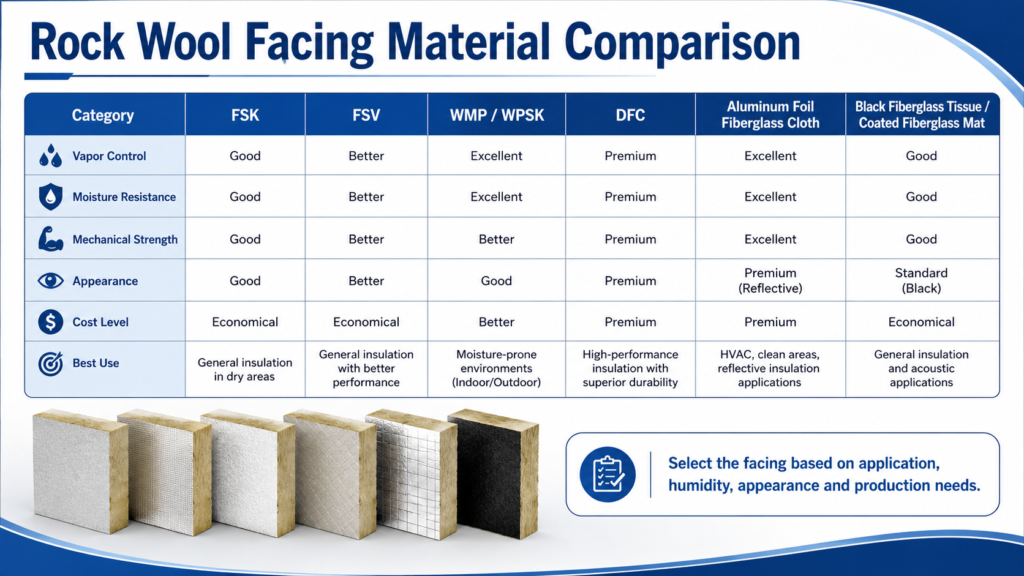
| Facing Type | Vapor Control | Moisture Resistance | Strength | Appearance | Cost Level | Best Use |
|---|---|---|---|---|---|---|
| FSK | Excellent | Good | Good | Silver / Kraft | Economical | Standard insulation |
| FSV | Excellent | Better | Good | Silver / PE | Medium | Humid environments |
| WMP / WPSK | Good | Good | Good | White | Medium | Visible applications |
| DFC | Excellent | Excellent | Good | Double foil | Higher | Premium products |
| Foil + Fiberglass Cloth | Excellent | Excellent | Excellent | Industrial foil | Higher | Heavy-duty use |
| Black Fiberglass Tissue | Limited | Limited | Moderate | Black | Medium | Acoustic / decorative |
| Coated Fiberglass Mat | Depends on coating | Good | Good | Colored / finished | Medium–High | Acoustic / architectural |
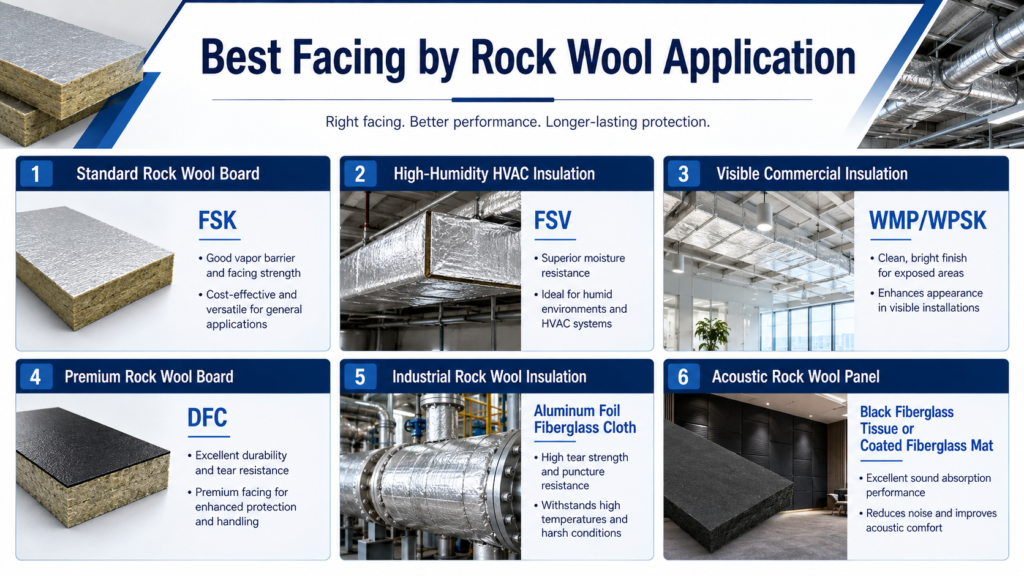
Best Facing by Rock Wool Application
Standard Rock Wool Board
Recommended:
FSK
Why:
- Reliable
- Cost-effective
- Good reinforcement
- Excellent vapor control
High-Humidity HVAC Rock Wool
Recommended:
FSV
Why:
- Better moisture resistance
- PE backing
- Flexible and durable
Visible Commercial Rock Wool
Recommended:
WMP / WPSK
Why:
- Clean white appearance
- Professional finish
- Good reinforcement
Premium Rock Wool Board
Recommended:
DFC
Why:
- Double foil appearance
- Premium positioning
- Strong surface protection
Industrial Rock Wool Insulation
Recommended:
Aluminum Foil Fiberglass Cloth
Why:
- Higher mechanical strength
- Better puncture resistance
- Better durability
Acoustic Rock Wool Panel
Recommended:
Black Fiberglass Tissue or Coated Fiberglass Mat
Why:
- Better appearance
- Suitable for exposed applications
- Compatible with acoustic panel manufacturing
How to Choose Step by Step
Step 1: Identify the Final Application
Is the rock wool used for:
- HVAC?
- Wall insulation?
- Industrial equipment?
- Acoustic panels?
- Ceiling systems?
- Roof insulation?
Step 2: Define Vapor and Moisture Requirements
For strong vapor control:
→ FSK / FSV / DFC
For high humidity:
→ FSV
For applications where vapor control is not the main requirement:
→ Fiberglass tissue or coated mat may be suitable.
Step 3: Decide Whether Appearance Matters
For silver surface:
→ FSK / FSV
For white surface:
→ WMP / WPSK
For black surface:
→ Black Fiberglass Tissue
For colored or finished decorative surface:
→ Coated Fiberglass Mat
Step 4: Determine Mechanical Requirements
For standard use:
→ Fiberglass scrim facing
For heavy-duty industrial use:
→ Fiberglass cloth
Step 5: Confirm Production Compatibility
Check:
- Adhesive system
- Roll width
- Roll length
- Core size
- Lamination temperature
- Production speed
- Cutting and slitting performance
Step 6: Confirm Fire and Application Requirements
Rock wool is often selected for fire-resistant systems.
Therefore, the facing should also be evaluated for:
- Fire-retardant requirements
- Smoke requirements
- Project standards
- Certification requirements
The complete facing structure—not just the surface layer—should be considered.
Important Specifications to Confirm Before Ordering
Rock wool manufacturers should confirm:
- Aluminum foil thickness
- Scrim specification
- Kraft paper weight
- PE / PP film thickness
- Fiberglass tissue weight
- Coating type
- Roll width
- Roll length
- Tensile strength
- Tear strength
- Peel strength
- Water vapor transmission requirements
- Surface color
- Fire-retardant requirements
- Printing
- Packaging
Common Buyer Mistakes
Choosing by Appearance Only
A silver or white surface does not tell you enough about the internal structure.
Always confirm:
- Reinforcement
- Backing
- Foil thickness
- Bonding method
Ignoring Fire Performance
A rock wool board may have excellent fire properties, but the facing can affect the performance of the complete finished product.
Over-Specifying Heavy-Duty Facing
Using fiberglass cloth where standard scrim is sufficient can add unnecessary cost.
Ignoring Lamination Compatibility
The facing must work reliably with the rock wool production process.
FAQ
What is the most common foil facing for rock wool?
FSK is one of the most widely used options because it provides a good balance of vapor control, reinforcement and cost.
Which facing is better for humid environments?
FSV is generally preferred when improved moisture resistance is required.
Which facing is best for acoustic rock wool panels?
Black fiberglass tissue or coated fiberglass mat is commonly selected for acoustic and decorative applications.
Which facing is best for industrial rock wool insulation?
Aluminum foil fiberglass cloth provides stronger mechanical performance for heavy-duty applications.
Can rock wool facing be customized?
Yes.
Common customization options include:
- Surface material
- Foil thickness
- Scrim specification
- Film thickness
- Fiberglass tissue weight
- Coating
- Color
- Roll size
- Printing
- OEM packaging
Conclusion
The best facing material for rock wool production depends on the final application.
For standard insulation, FSK provides a reliable balance of performance and cost.
For higher moisture resistance, FSV is a better option.
For clean white visible surfaces, WMP / WPSK is suitable.
For premium double-sided foil products, DFC provides a higher-end solution.
For industrial and heavy-duty insulation, aluminum foil fiberglass cloth provides stronger mechanical performance.
For acoustic and decorative rock wool products, black fiberglass tissue and coated fiberglass mat provide more suitable surface solutions.
OPERFECT® supplies customized facing materials for rock wool manufacturers, including FSK, FSV, WMP/WPSK, DFC, aluminum foil fiberglass cloth, fiberglass tissue and coated fiberglass mat, with customized structures, roll specifications, surface treatments and OEM/private-label solutions.