Compare FSK and FSV insulation facings, including kraft paper vs PE backing, structure, moisture resistance, applications and selection guidance.
Introduction
When choosing aluminum foil facing materials for insulation products, FSK and FSV are two widely used options.
Both materials provide:
- Aluminum foil vapor barrier protection
- Fiberglass scrim reinforcement
- Improved insulation durability
- Better handling performance
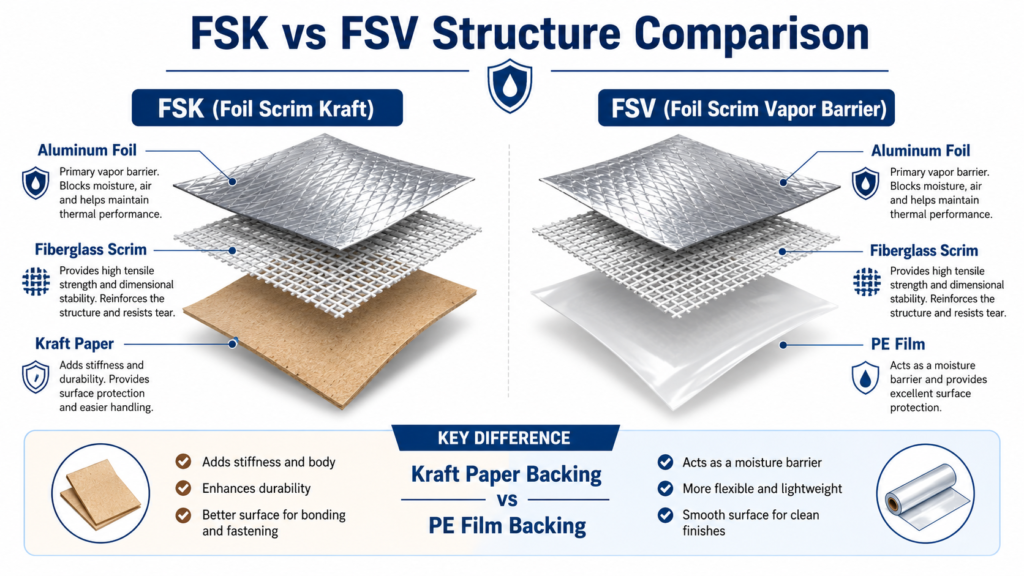
The main difference between them is the backing layer:
FSK uses kraft paper backing.
FSV uses PE film backing.
This difference affects:
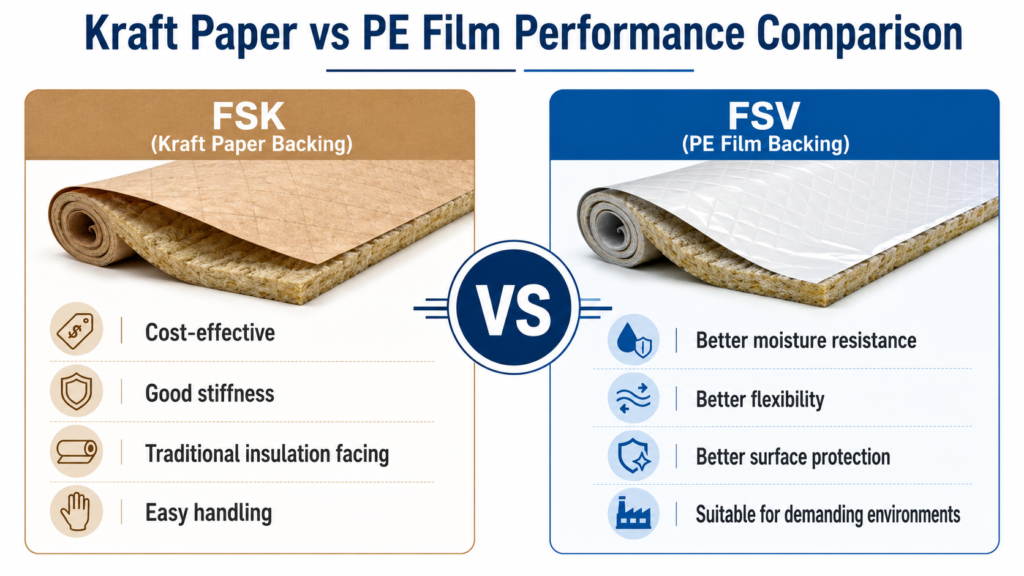
- Moisture resistance
- Flexibility
- Surface protection
- Application suitability
- Product positioning
Choosing between FSK and FSV depends on the insulation environment, performance requirements and cost expectations.
What Is FSK Facing?
FSK stands for:
Foil Scrim Kraft
The typical structure is:
Aluminum Foil
↓
Fiberglass Scrim
↓
Kraft Paper
FSK is one of the most commonly used insulation facing materials worldwide.
It provides a balanced combination of:
- Vapor control
- Reinforcement
- Cost efficiency
- Manufacturing compatibility
Aluminum Foil Layer
The aluminum foil provides the main barrier function.
Vapor Barrier Performance
The foil layer helps reduce moisture vapor transmission and protects insulation materials from moisture exposure.
Radiant Heat Reflection
The reflective foil surface can help reduce radiant heat transfer when installed with proper air space conditions.
Protective Surface
The aluminum surface provides:
- Clean appearance
- Compatibility with foil tape sealing
- Protection during installation
Fiberglass Scrim Layer
The fiberglass scrim reinforces the facing structure.
It improves:
- Tensile strength
- Tear resistance
- Dimensional stability
- Processing performance
The scrim helps prevent damage during:
- Lamination
- Cutting
- Transportation
- Installation
Kraft Paper Layer
The kraft paper backing provides:
- Structural support
- Stiffness
- Easy handling
- Good compatibility with insulation manufacturing
It is a traditional and cost-effective backing material widely accepted in insulation production.
What Is FSV Facing?
FSV stands for:
Foil Scrim Vapor Barrier
The typical structure is:
Aluminum Foil
↓
Fiberglass Scrim
↓
PE Film
FSV replaces the kraft paper backing layer with a polyethylene (PE) film vapor-control layer.
This creates a more moisture-resistant and flexible facing solution.
Aluminum Foil Layer
Similar to FSK, the aluminum foil provides:
- Vapor barrier performance
- Reflective properties
- Surface protection
Fiberglass Scrim Layer
The scrim provides reinforcement:
- High tensile strength
- Tear resistance
- Dimensional stability
PE Film Layer
The PE backing provides additional protection.
Advantages include:
Better Moisture Resistance
Compared with kraft paper, PE film provides better resistance against:
- Humidity
- Water exposure
- Moisture absorption
Improved Surface Protection
PE film helps protect the facing from:
- Dirt
- Moisture
- Handling damage
Better Flexibility
PE film generally provides:
- Softer handling
- Better bending performance
- Reduced cracking risk
FSK vs FSV Structure Comparison
| Feature | FSK | FSV |
|---|---|---|
| Full Name | Foil Scrim Kraft | Foil Scrim Vapor Barrier |
| Structure | Foil + Scrim + Kraft | Foil + Scrim + PE Film |
| Reinforcement | Fiberglass Scrim | Fiberglass Scrim |
| Backing Material | Kraft Paper | PE Film |
| Vapor Resistance | Excellent | Excellent |
| Moisture Resistance | Good | Better |
| Flexibility | Moderate | Higher |
| Surface Protection | Good | Better |
| Cost Level | More economical | Higher |
| Typical Positioning | Standard insulation facing | Enhanced vapor barrier facing |
Performance Comparison
1. Moisture Resistance
FSK
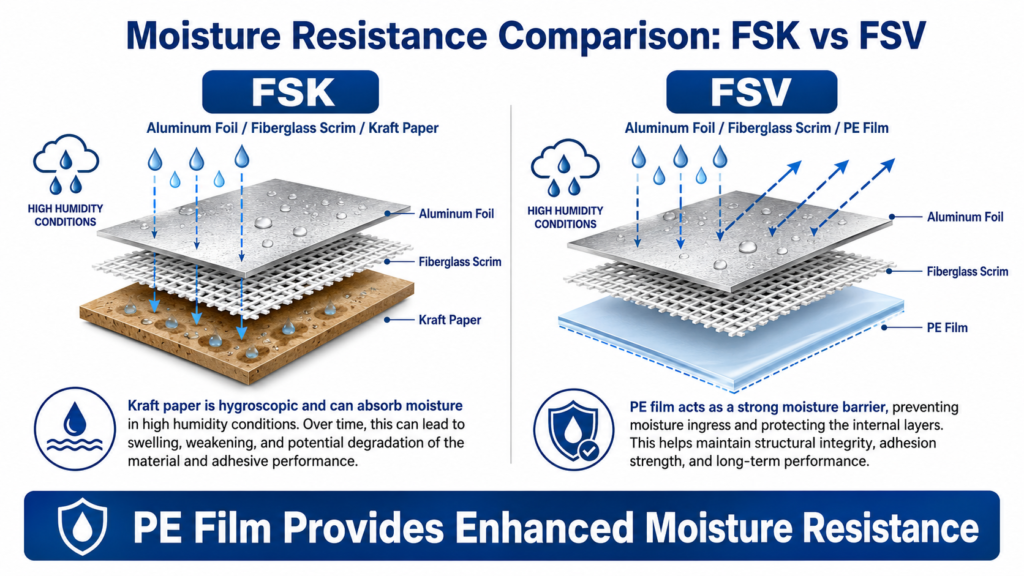
Kraft paper provides structural support but can absorb moisture if exposed to high humidity or water.
Suitable for:
- Standard indoor insulation
- Controlled environments
- General HVAC applications
FSV
PE film provides improved resistance against moisture exposure.
Suitable for:
- High humidity environments
- Vapor-sensitive applications
- More demanding insulation systems
2. Flexibility and Handling
FSK
Advantages:
- Good stiffness
- Easy processing
- Traditional insulation production compatibility
The kraft layer provides a firm backing.
FSV
Advantages:
- More flexible structure
- Better bending performance
- Better resistance to moisture-related deformation
Suitable for applications requiring flexible installation.
3. Durability
Both materials benefit from fiberglass scrim reinforcement.
However:
FSV provides additional protection because the PE backing is less affected by moisture compared with kraft paper.
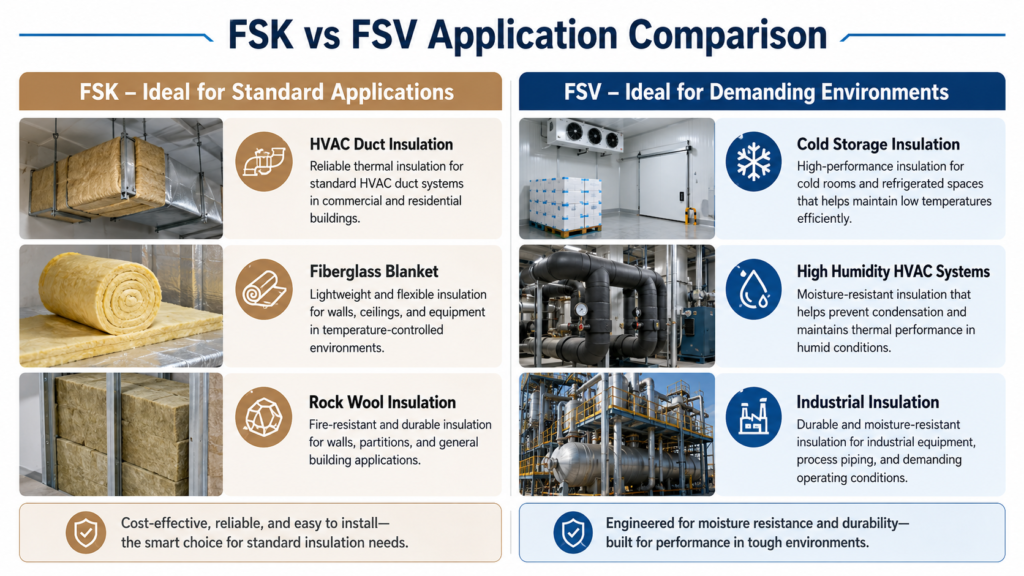
FSK vs FSV Application Comparison
| Application | Recommended Facing |
|---|---|
| Standard HVAC insulation | FSK |
| Fiberglass blanket | FSK / FSV |
| Rock wool insulation | FSK / FSV |
| High humidity area | FSV |
| Cold storage insulation | FSV |
| Industrial insulation | FSV |
| Cost-sensitive projects | FSK |
Common Applications of FSK
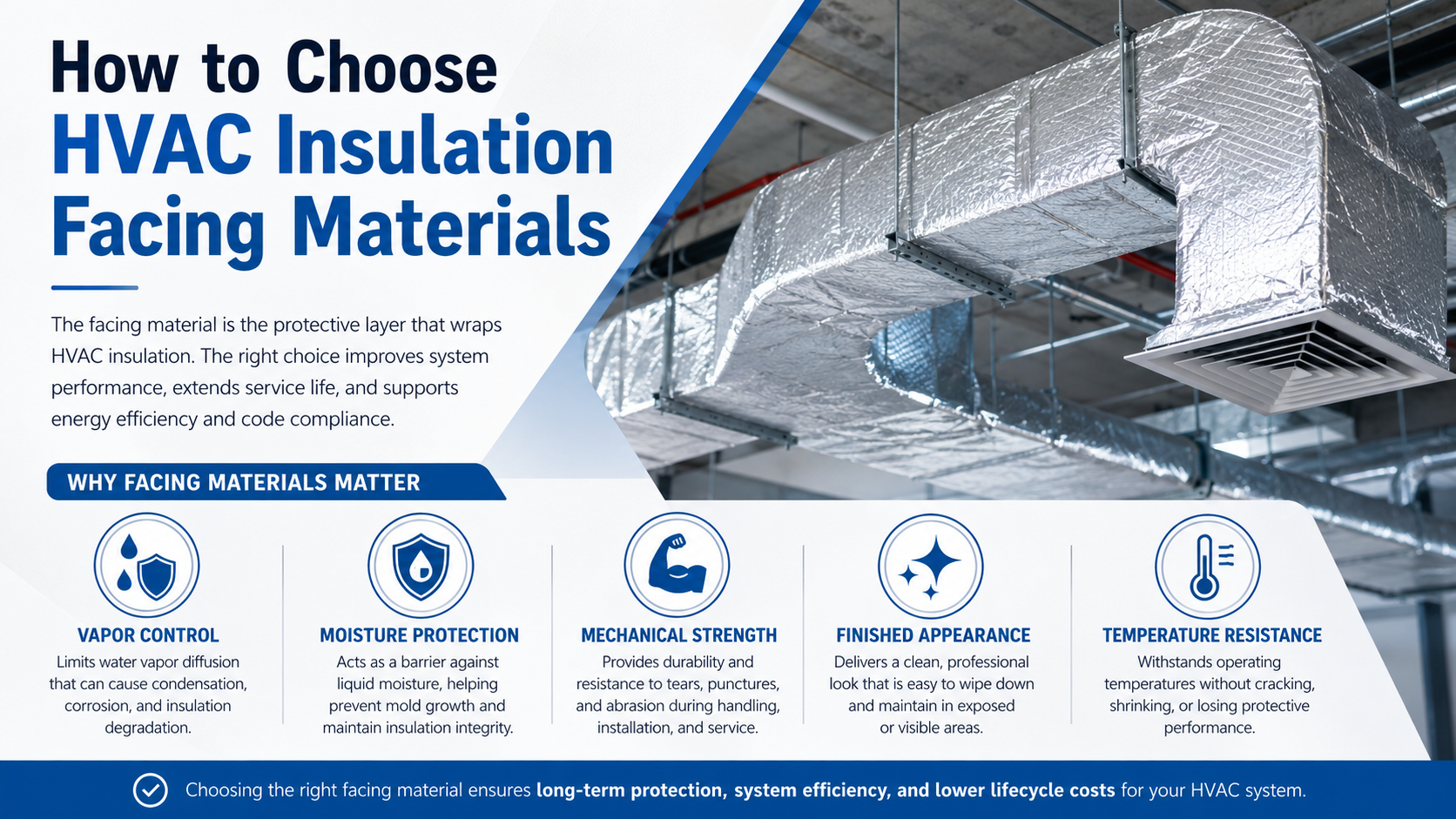
HVAC Duct Insulation
FSK is widely used for:
- Duct wrap
- Flexible duct insulation
- Mechanical insulation
Advantages:
- Reliable vapor barrier
- Good strength
- Cost-effective
Fiberglass Insulation Products
Used for:
- Fiberglass rolls
- Fiberglass blankets
- Insulation boards
Rock Wool Insulation
Suitable for:
- Commercial buildings
- Industrial insulation
- General thermal insulation
Common Applications of FSV
High-Humidity HVAC Systems
FSV is suitable for systems exposed to:
- Humidity
- Condensation risk
- Moisture variation
Cold Storage Applications
Cold environments require stronger moisture control.
FSV helps provide:
- Better vapor protection
- Improved durability
- Reduced moisture risk
Industrial Insulation
Used in:
- Factories
- Processing facilities
- Mechanical systems
Where environmental conditions are more demanding.
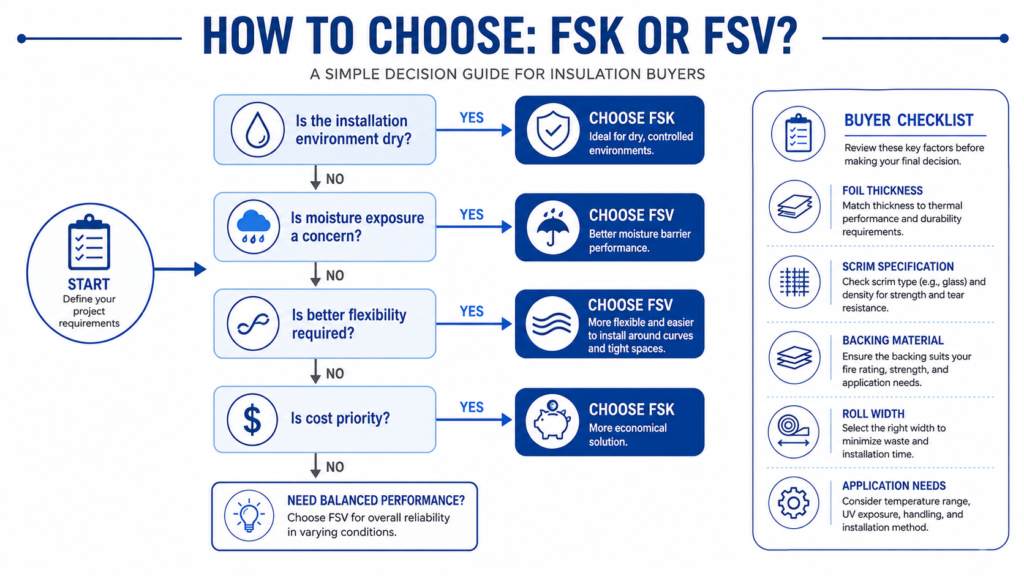
How to Choose Between FSK and FSV?
Choose FSK When:
You need:
✓ Cost-effective insulation facing
✓ Standard vapor barrier performance
✓ Traditional insulation applications
✓ Large-volume production
Typical applications:
- HVAC insulation
- Fiberglass insulation
- Rock wool insulation
Choose FSV When:
You need:
✓ Better moisture resistance
✓ PE film surface protection
✓ Higher flexibility
✓ More demanding environments
Typical applications:
- Cold storage
- Industrial insulation
- High-humidity HVAC systems
Buyer Checklist
Before selecting FSK or FSV, consider:
1. Is the installation environment dry?
If yes:
→ FSK may be sufficient
2. Is moisture exposure a concern?
If yes:
→ Choose FSV
3. Is cost the priority?
If yes:
→ FSK provides excellent value
4. Is better flexibility required?
If yes:
→ FSV is a better option
5. Does the customer need customized facing?
Consider:
- Aluminum foil thickness
- Scrim specification
- PE film thickness
- Kraft paper weight
- Roll width
- Printing requirements
- Private label packaging
FAQ
Is FSV waterproof?
FSV provides improved moisture resistance compared with kraft-backed FSK.
However, it is a vapor-control facing material, not a standalone waterproof membrane.
Is FSV stronger than FSK?
Both use fiberglass scrim reinforcement.
The mechanical strength depends mainly on:
- Scrim specification
- Material weight
- Lamination quality
FSV mainly improves moisture resistance and surface protection.
Can FSV replace FSK?
In many applications, yes.
However, FSK remains popular because it provides reliable performance at a more economical cost.
Conclusion
FSK and FSV are both effective aluminum foil insulation facing solutions.
FSK is a proven, economical choice for standard insulation applications where reliable vapor control and cost efficiency are important.
FSV upgrades the backing layer from kraft paper to PE film, providing improved moisture resistance, flexibility and surface protection for more demanding environments.
OPERFECT® supplies customized FSK and FSV insulation facings with different aluminum foil thicknesses, fiberglass scrim structures, kraft paper weights, PE film specifications, roll dimensions and OEM/private-label solutions.