Compare kraft paper, polyethylene film and PET film as backing and functional layers in aluminum foil composite materials.
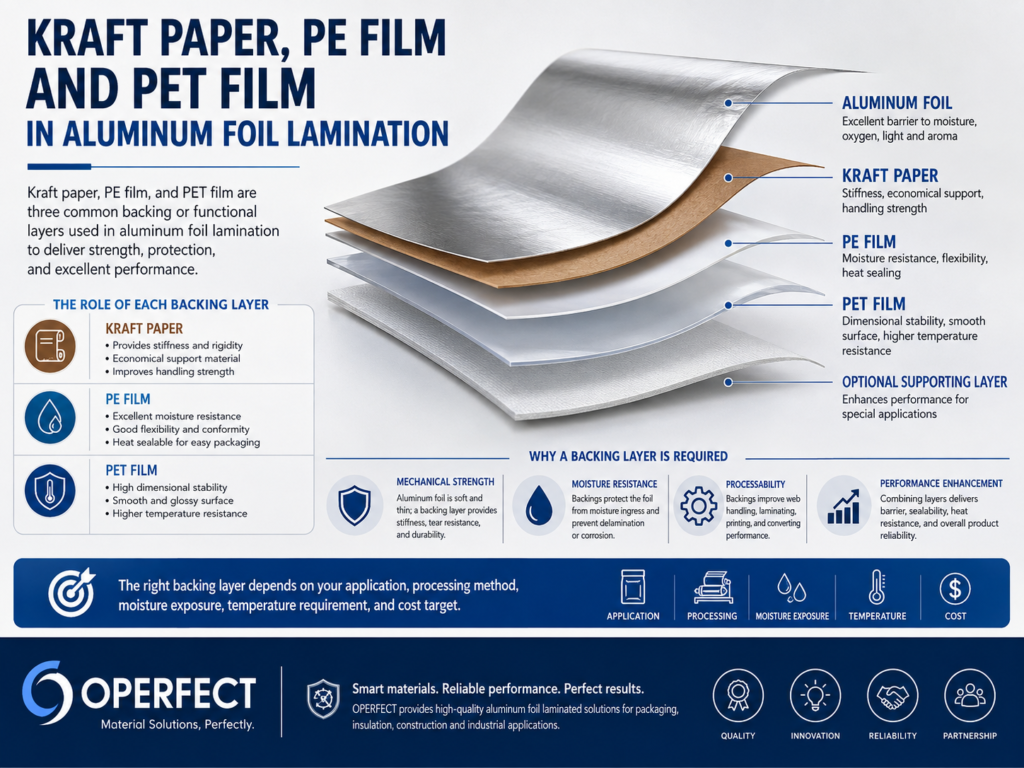
Kraft paper, polyethylene film and PET film are three common materials used in aluminum foil lamination.
Although all three can support an aluminum foil structure, they have different properties and perform different functions.
Kraft paper is valued for stiffness and cost efficiency. PE film is valued for flexibility, moisture resistance and heat-sealing capability. PET film is valued for dimensional stability, surface quality and higher temperature resistance.
The correct material should be selected according to application requirements rather than price or appearance alone.
Why a Backing Layer Is Required
Thin aluminum foil can provide thermal reflection and vapor resistance, but it normally requires support for practical production and installation.
A backing or intermediate layer can provide:
- Mechanical strength
- Dimensional stability
- Moisture resistance
- Heat-sealing performance
- Improved handling
- Adhesive compatibility
- Surface protection
- Printing performance
- Additional barrier properties
Kraft paper, PE and PET each provide a different balance of these characteristics.
Kraft Paper in Aluminum Foil Lamination
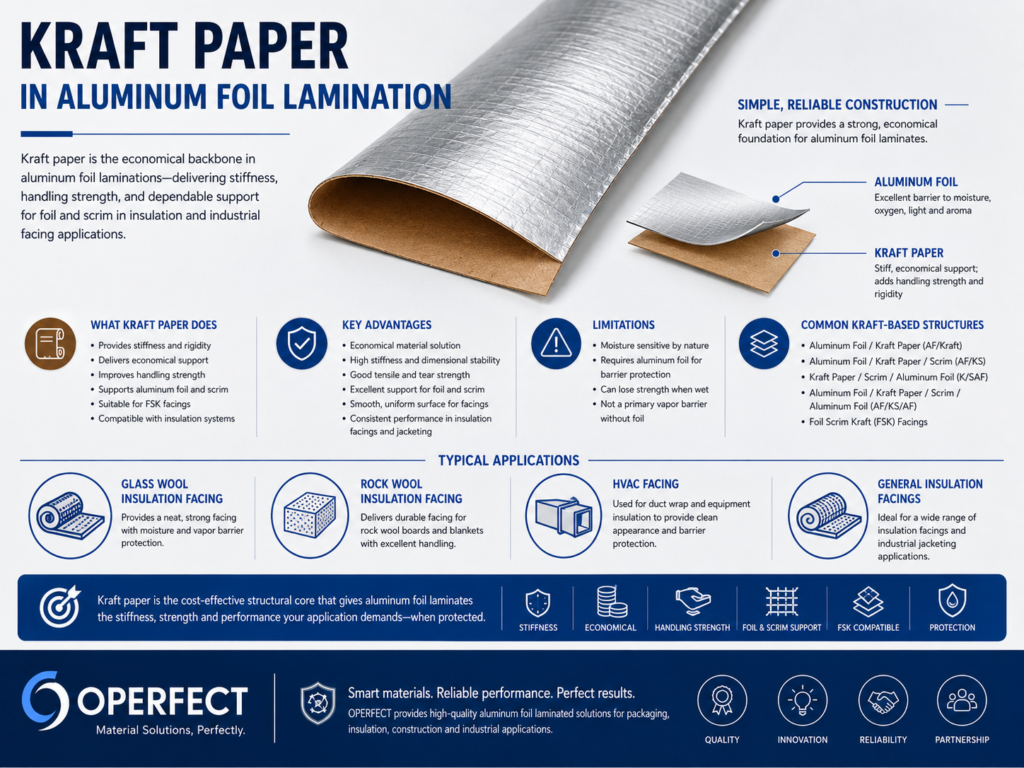
Kraft paper is made from wood pulp and is known for its strength, stiffness and converting performance.
It is commonly used in foil-kraft and foil-scrim-kraft insulation facings.
Main Advantages of Kraft Paper
Kraft paper provides:
- Good stiffness
- Economical reinforcement
- Easy converting
- Stable roll formation
- Suitable surface for adhesive bonding
- Good support for foil and scrim
- Familiar processing behavior for insulation manufacturers
Its stiffness can make the laminate easier to handle during lamination to glass wool or rock wool.
Limitations of Kraft Paper
Kraft paper can absorb moisture if it is not protected.
Potential limitations include:
- Sensitivity to high humidity
- Reduced strength when wet
- Possible dimensional change
- Combustibility
- Limited suitability for direct water exposure
For this reason, kraft paper is often combined with foil, polyethylene or coatings.
Common Kraft-Based Structures
Typical examples include:
- Aluminum foil + kraft paper
- Aluminum foil + scrim + kraft paper
- Aluminum foil + PE + kraft paper
- Aluminum foil + fiberglass scrim + kraft paper
The most widely recognized example is FSK facing.
PE Film in Aluminum Foil Lamination
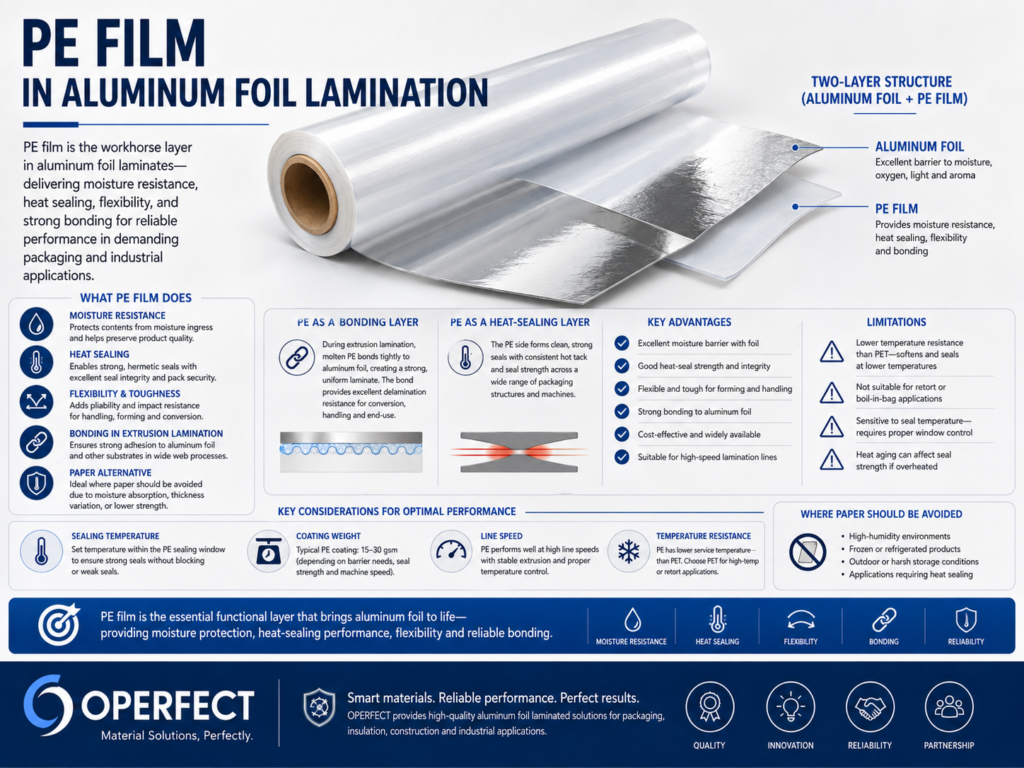
PE stands for polyethylene, a flexible thermoplastic polymer.
PE can be used as a film, extrusion-lamination layer, coating or heat-sealing surface.
Main Advantages of PE Film
PE may provide:
- Moisture resistance
- Flexibility
- Heat-sealing capability
- Smooth processing
- Good low-temperature flexibility
- Bonding between laminate layers
- Protection of moisture-sensitive materials
- Reduced dependence on paper backing
PE is especially useful when the laminate needs a polymer backing or sealing layer.
PE as a Bonding Layer
In extrusion lamination, molten polyethylene is applied between two materials and acts as both a bonding medium and continuous polymer layer.
For example, PE may bond aluminum foil to kraft paper, woven fabric or film.
The extrusion conditions must be controlled to achieve stable bond strength without damaging the substrates.
PE as a Heat-Sealing Layer
Some aluminum foil composites are designed to be heat sealed to insulation or another substrate.
In these structures, the PE side is activated by heat and pressure.
Heat-sealing performance depends on:
- PE grade
- Coating weight
- Sealing temperature
- Dwell time
- Pressure
- Insulation surface
- Production-line speed
Not every PE-backed foil automatically performs well as a heat-sealing facing. The complete structure should be tested on the intended production line.
Limitations of PE Film
Potential limitations include:
- Lower temperature resistance than PET
- Softening under excessive heat
- Possible stretching under tension
- Different fire behavior depending on formulation
- Surface-treatment requirements for printing or bonding
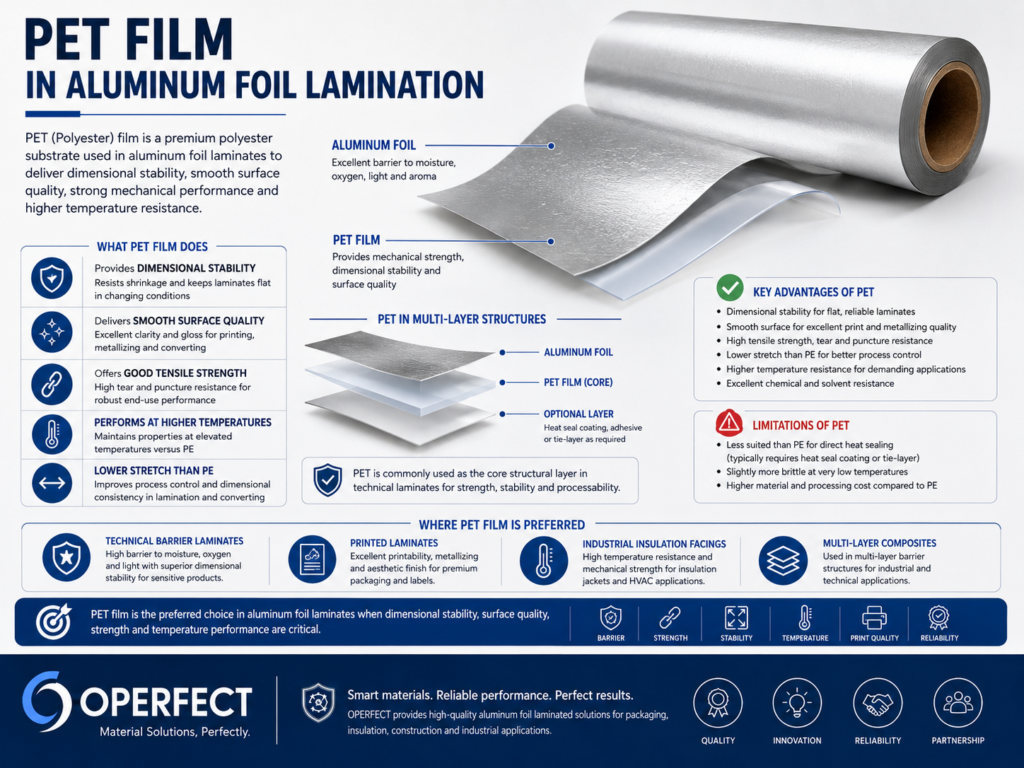
PET Film in Aluminum Foil Lamination
PET stands for polyethylene terephthalate.
It is a polyester film known for good tensile strength, smoothness and dimensional stability.
Main Advantages of PET Film
PET film may provide:
- High dimensional stability
- Smooth surface quality
- Good tensile strength
- Lower stretch than many PE films
- Good temperature resistance
- Suitability for printing and metallization
- Good resistance to oils and many chemicals
- Stable thickness at low basis weight
PET is commonly used in technical laminates where a thin but stable polymer layer is required.
PET in Multi-Layer Structures
PET may be laminated with:
- Aluminum foil
- Metallized film
- PE film
- Nonwoven fabric
- Reinforcing scrim
- Adhesive coatings
A structure may use PET for dimensional stability and PE for sealing, combining both materials in the same laminate.
Limitations of PET Film
PET is generally less suitable than PE as a low-temperature heat-sealing layer unless a special coating or sealing layer is added.
Other considerations include:
- Higher stiffness than some flexible PE films
- Higher material cost in certain structures
- Need for suitable adhesive selection
- Possible delamination if surface treatment is insufficient
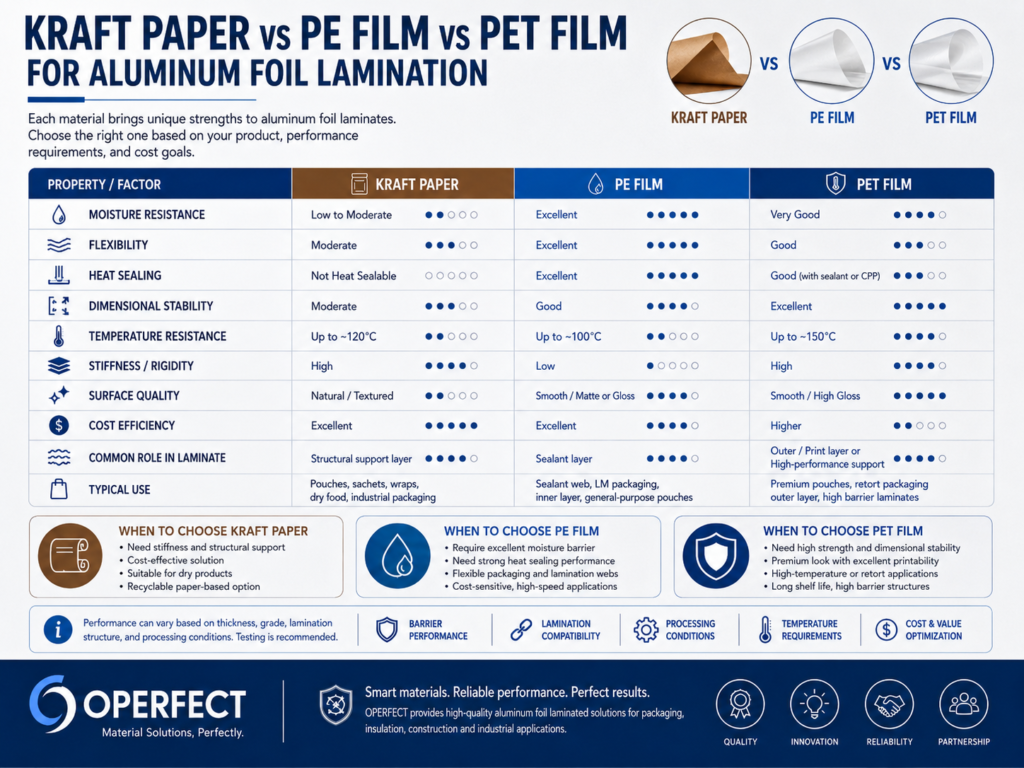
Kraft Paper vs PE Film vs PET Film
Moisture Resistance
Kraft paper has the lowest inherent moisture resistance.
PE and PET both resist moisture better than paper, although the complete barrier performance depends on thickness, bonding and laminate design.
Flexibility
PE is generally the most flexible.
PET is dimensionally stable but may feel firmer. Kraft paper adds stiffness but may crease.
Heat-Sealing Performance
PE is commonly selected for heat sealing.
Standard PET and kraft paper do not normally provide the same direct heat-sealing behavior without additional coatings or adhesive layers.
Dimensional Stability
PET offers very good dimensional stability.
Kraft paper also provides useful stiffness, while PE may stretch more under tension or heat.
Temperature Resistance
PET generally withstands higher temperatures than standard PE.
The practical temperature limit of a laminate also depends on adhesives and other layers.
Cost Efficiency
Kraft paper is commonly used for economical insulation facings.
PE and PET costs depend on film thickness, grade and processing method.
Fire Performance
None of these materials should be evaluated independently when fire performance is required.
The complete laminate must be tested because paper, polymer films, adhesives and coatings all affect the result.
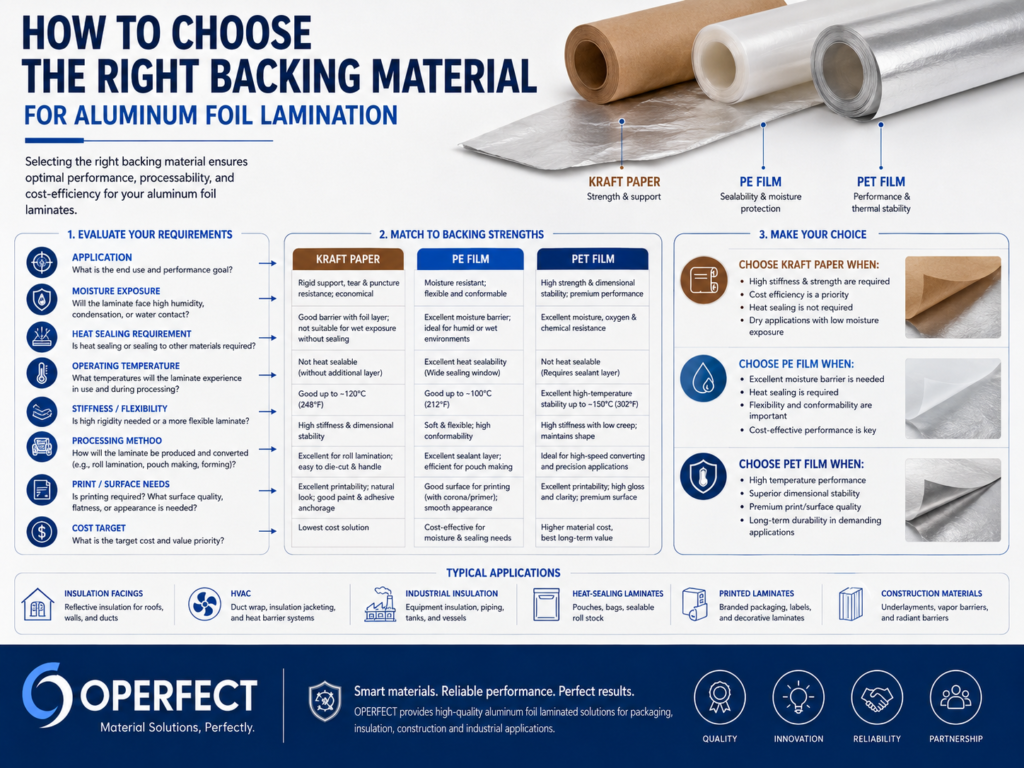
When to Choose Kraft Paper
Kraft paper may be suitable when:
- Economical reinforcement is required
- The product is used indoors
- The facing needs stiffness
- Moisture exposure is limited
- The manufacturer already uses FSK-type materials
- The facing will be laminated to glass wool or rock wool
When to Choose PE Film
PE film may be suitable when:
- Moisture resistance is important
- Heat sealing is required
- Flexibility is preferred
- Paper should be avoided
- A polymer bonding layer is needed
- The laminate must tolerate repeated folding or handling
When to Choose PET Film
PET film may be suitable when:
- Dimensional stability is important
- A smooth technical surface is required
- Higher processing temperature is expected
- Thin but strong film is preferred
- Printing or metallization is involved
- A multi-layer barrier laminate is being developed
Combining Multiple Materials
Kraft, PE and PET are not always competing options.
A single aluminum foil composite may use more than one of them.
For example:
- Foil + PE + kraft paper
- Foil + PET + PE
- Foil + scrim + PE film
- Foil + PET + nonwoven
- Foil + PE + woven fabric
The purpose of multi-layer engineering is to use each material only where it adds a required function.
Conclusion
Kraft paper, PE film and PET film provide different advantages in aluminum foil lamination.
Kraft paper provides stiffness and economical support. PE provides flexibility, moisture resistance and heat-sealing capability. PET provides dimensional stability, strength and higher temperature resistance.
Selecting the correct backing material requires consideration of application, production process, moisture exposure, temperature, mechanical strength and cost.
OPERFECT® supports customized aluminum foil laminate development using kraft paper, PE film, PET film, scrim, woven fabric, fiberglass cloth and nonwoven materials.