Compare aluminum foil fiberglass cloth and fiberglass scrim facing, including structure, strength, flexibility, temperature resistance and insulation applications.
Introduction
Aluminum foil fiberglass cloth and aluminum foil fiberglass scrim facing are both reinforced foil composite materials used in insulation and industrial applications.
They may look similar because both combine aluminum foil with fiberglass reinforcement, but the reinforcement structure is very different.
The key difference is:
Fiberglass cloth uses a full woven fiberglass fabric.
Fiberglass scrim uses an open-grid fiberglass reinforcement.
This difference affects:
- Mechanical strength
- Tear resistance
- Surface coverage
- Flexibility
- Temperature performance
- Weight
- Cost
- Application suitability
For insulation manufacturers, HVAC suppliers and industrial buyers, understanding these differences helps avoid over-specifying or under-specifying the facing material.
What Is Aluminum Foil Fiberglass Cloth?
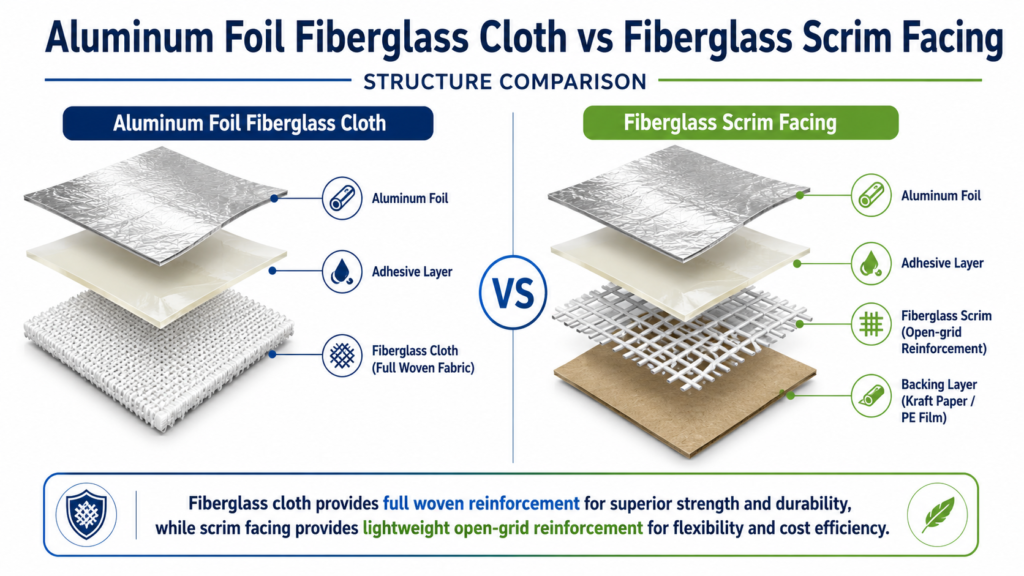
Aluminum foil fiberglass cloth is a composite material made by laminating aluminum foil to a woven fiberglass fabric.
A typical structure is:
Aluminum Foil
↓
Adhesive / Bonding Layer
↓
Fiberglass Cloth
Depending on the application, additional coatings or layers may also be added.
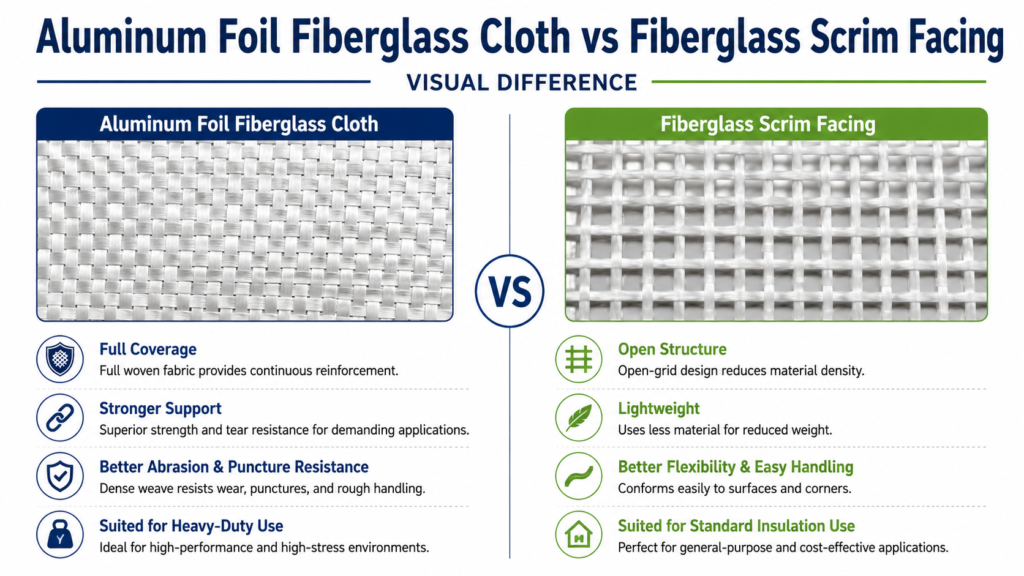
Fiberglass cloth is a continuous woven fabric rather than an open reinforcement mesh.
This gives the material a stronger and more durable backing.
What Is Fiberglass Scrim Facing?
Fiberglass scrim facing uses an open-grid fiberglass reinforcement laminated with aluminum foil and, in many structures, an additional backing material.
Typical structures include:
Aluminum Foil + Fiberglass Scrim + Kraft Paper
or:
Aluminum Foil + Fiberglass Scrim + PE Film
Common examples include:
- FSK
- FSV
- Other reinforced foil facings
The scrim strengthens the laminate while keeping the material relatively lightweight.
Structure Comparison
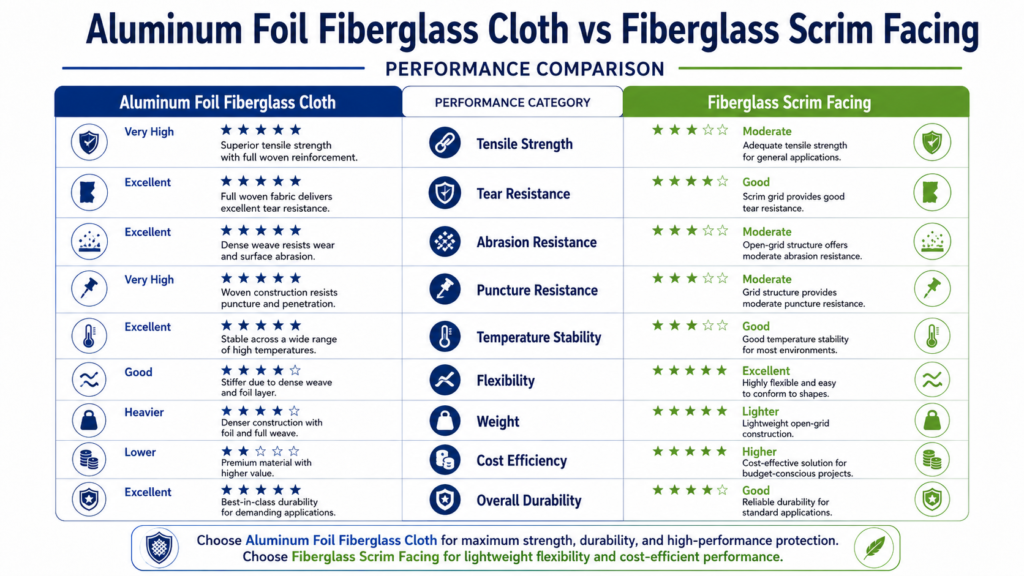
| Feature | Aluminum Foil Fiberglass Cloth | Fiberglass Scrim Facing |
|---|---|---|
| Reinforcement | Full woven fiberglass fabric | Open-grid fiberglass scrim |
| Surface Coverage | Continuous fabric | Partial / open mesh |
| Typical Backing | Fiberglass cloth itself | Kraft, PE film or other backing |
| Material Weight | Higher | Lower |
| Mechanical Strength | Higher | Good |
| Tear Resistance | Excellent | Good |
| Flexibility | Moderate | Higher |
| Cost | Higher | More economical |
Mechanical Strength
Aluminum Foil Fiberglass Cloth
The woven fiberglass fabric provides strong reinforcement in both directions.
Advantages include:
- High tensile strength
- Strong tear resistance
- Better puncture resistance
- Better abrasion resistance
- Good dimensional stability
It is suitable for applications where the facing may experience:
- Frequent handling
- Mechanical stress
- Wrapping
- Industrial service conditions
Fiberglass Scrim Facing
Fiberglass scrim provides effective reinforcement without creating a heavy composite.
Advantages include:
- Good tensile strength
- Improved tear resistance
- Lightweight construction
- Good dimensional stability
It is generally sufficient for standard insulation-facing applications.
Surface Coverage
One of the most important differences is the reinforcement coverage.
Fiberglass Cloth
The woven fabric forms a continuous backing layer.
This provides:
- Full surface support
- Better abrasion resistance
- Stronger mechanical protection
Fiberglass Scrim
Scrim has an open-grid structure.
This means:
- Less material
- Lower weight
- Lower cost
- Easier lamination with other backing layers
For many insulation applications, full fabric coverage is not necessary.
Temperature Resistance
Both fiberglass cloth and fiberglass scrim provide excellent thermal stability compared with many polymer reinforcement materials.
However, the complete temperature resistance of the composite depends on:
- Adhesive type
- Aluminum foil
- Additional backing materials
- Coatings
Aluminum Foil Fiberglass Cloth
Because fiberglass cloth itself provides a strong heat-resistant substrate, this material is commonly selected for:
- Industrial insulation
- High-temperature equipment
- Pipe wrapping
- Thermal protection
Fiberglass Scrim Facing
Scrim-reinforced foil is widely used in:
- HVAC insulation
- 玻璃棉
- 岩棉
- Building insulation
Its final temperature capability depends strongly on the kraft paper, PE film or other backing used in the structure.
Flexibility and Handling
Fiberglass Cloth
The continuous woven fabric produces a more substantial composite.
优势
- Durable
- Strong
- Stable
But it may feel:
- Heavier
- Less soft
- Less flexible than lightweight scrim facings
Fiberglass Scrim Facing
Because the scrim is lightweight and open, scrim-facing materials generally provide:
- Better flexibility
- Easier roll handling
- Easier cutting
- Easier installation
This is useful for large-volume insulation production.
Aluminum Foil Fiberglass Cloth vs Fiberglass Scrim Performance Comparison
| Performance | Fiberglass Cloth | Fiberglass Scrim |
|---|---|---|
| Tensile Strength | Excellent | Good |
| Tear Resistance | Excellent | Good |
| Abrasion Resistance | Excellent | Moderate |
| Dimensional Stability | Excellent | Excellent |
| Flexibility | Moderate | Good |
| Weight | Higher | Lower |
| Temperature Stability | Excellent | Excellent |
| Cost Efficiency | Moderate | Excellent |
| Heavy-Duty Suitability | Excellent | Moderate |
| Standard Insulation Use | Good | Excellent |
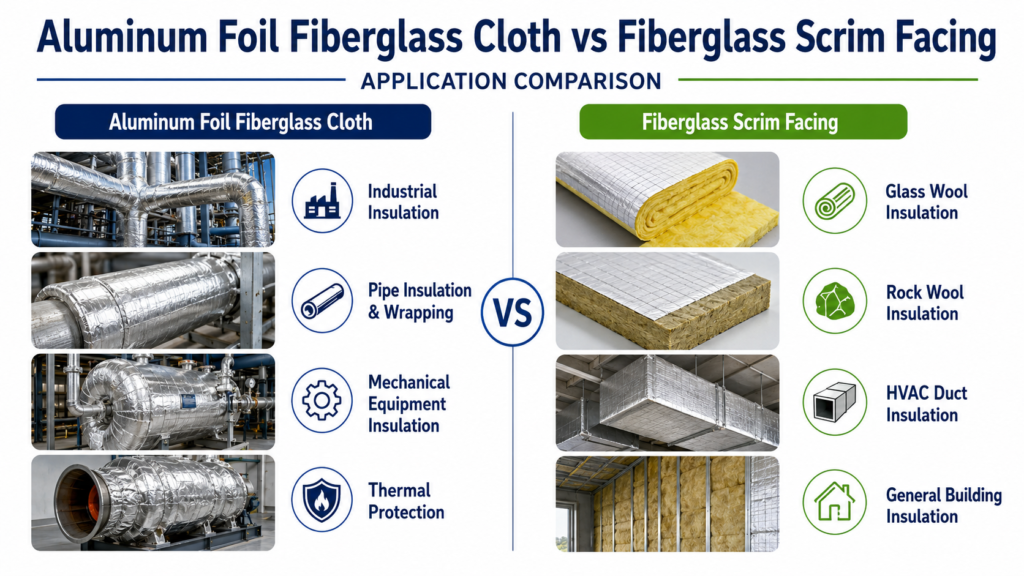
Common Applications of Aluminum Foil Fiberglass Cloth
Industrial Insulation
Used for:
- Equipment insulation
- Tanks
- Boilers
- Industrial thermal systems
The full woven fiberglass backing provides better mechanical durability.
Pipe Insulation and Wrapping
Suitable for:
- Pipe jackets
- Pipe wrapping
- Elbows
- Mechanical systems
Benefits include:
- High strength
- Better tear resistance
- Good thermal stability
HVAC and Mechanical Insulation
Used where a stronger facing is required for:
- Mechanical equipment
- Duct systems
- Industrial HVAC applications
Thermal Protection
Can be used in systems requiring:
- Heat resistance
- Reflective surface
- Durable reinforcement
Common Applications of Fiberglass Scrim Facing
Glass Wool Insulation
Widely used for:
- Fiberglass blankets
- 轧辊
- Boards
Examples include FSK and FSV facings.
Rock Wool Insulation
Used as a reinforced facing for:
- Thermal insulation
- Building insulation
- Industrial insulation
HVAC Duct Insulation
Fiberglass scrim facing is especially common in:
- Duct wrap
- Duct board
- Flexible duct insulation
General Building Insulation
Suitable for:
- 墙壁
- Ceilings
- Roof insulation
- Commercial building systems
Which One Should You Choose?
Choose Aluminum Foil Fiberglass Cloth When:
You need:
✓ Higher mechanical strength
✓ Better tear and puncture resistance
✓ Better abrasion resistance
✓ Industrial or heavy-duty applications
✓ Strong thermal stability
✓ Full fabric backing
Typical applications:
- Industrial insulation
- Pipe wrapping
- Equipment protection
- High-performance mechanical insulation
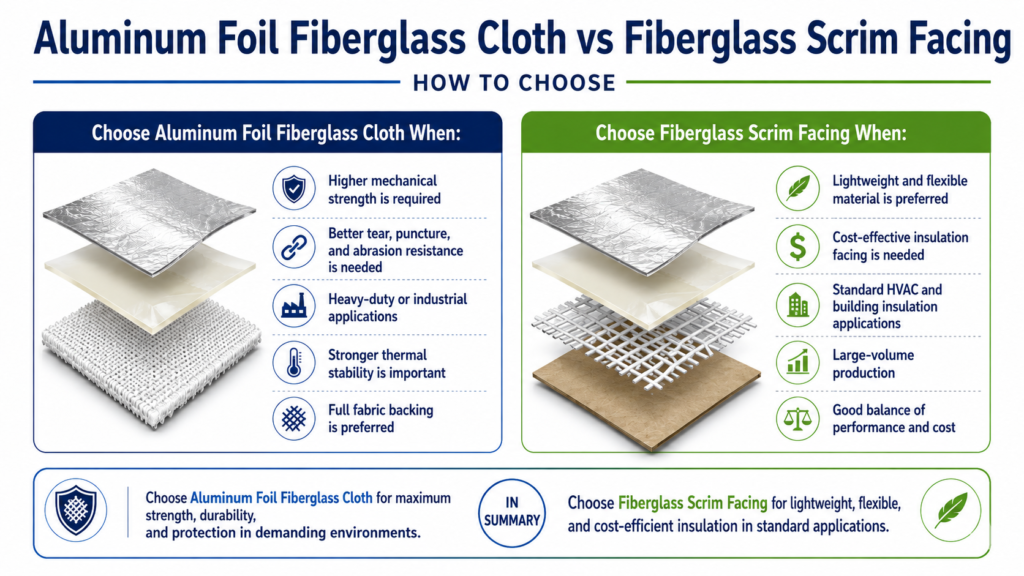
Choose Fiberglass Scrim Facing When:
You need:
✓ Lightweight reinforcement
✓ Cost-effective insulation facing
✓ Good flexibility
✓ Standard HVAC and building insulation
✓ Large-volume production
Typical applications:
- FSK
- FSV
- 玻璃棉
- 岩棉
- HVAC duct insulation
Buyer Checklist
Before ordering, confirm:
1. How much mechanical strength is required?
For heavy-duty service:
→ Fiberglass cloth
For standard insulation:
→ Fiberglass scrim
2. Is flexibility important?
If yes:
→ Fiberglass scrim facing is usually easier to handle.
3. Will the material be exposed to abrasion or repeated handling?
If yes:
→ Fiberglass cloth provides better durability.
4. Is cost a key consideration?
If yes:
→ Fiberglass scrim generally provides better cost efficiency.
5. What is the final application?
Consider:
- HVAC
- Building insulation
- Industrial equipment
- Pipe insulation
- High-temperature environments
FAQ
Is fiberglass cloth the same as fiberglass scrim?
No.
Fiberglass cloth is a continuous woven fabric.
Fiberglass scrim is an open-grid reinforcement structure.
Is fiberglass cloth always better?
No.
Fiberglass cloth provides higher strength, but many standard insulation applications do not require that level of reinforcement.
Fiberglass scrim can provide a better balance of performance, weight and cost.
Which one is better for HVAC insulation?
For standard HVAC duct insulation, fiberglass scrim facing such as FSK or FSV is commonly sufficient.
For heavy-duty or industrial mechanical insulation, fiberglass cloth may be more suitable.
Which one is more expensive?
Aluminum foil fiberglass cloth is generally more expensive because it uses a heavier, continuous woven fiberglass fabric.
Conclusion
Aluminum foil fiberglass cloth and fiberglass scrim facing both provide effective reinforcement for foil-based insulation materials, but they serve different performance levels.
Aluminum foil fiberglass cloth provides stronger mechanical performance, better abrasion resistance and greater durability for industrial and heavy-duty applications.
Fiberglass scrim facing provides lightweight reinforcement, good flexibility and better cost efficiency for standard insulation and HVAC applications.
OPERFECT® supplies customized aluminum foil fiberglass cloth, FSK, FSV and other reinforced foil facing materials with different foil thicknesses, fiberglass structures, roll dimensions and OEM/private-label options.