Learn how to choose the best reflective vapor barrier for roof insulation. Compare FSK, foil woven fabric, double foil facing, reinforced foil laminates and other reflective barriers for thermal reflection, vapor control, strength and roof applications.
Introduction
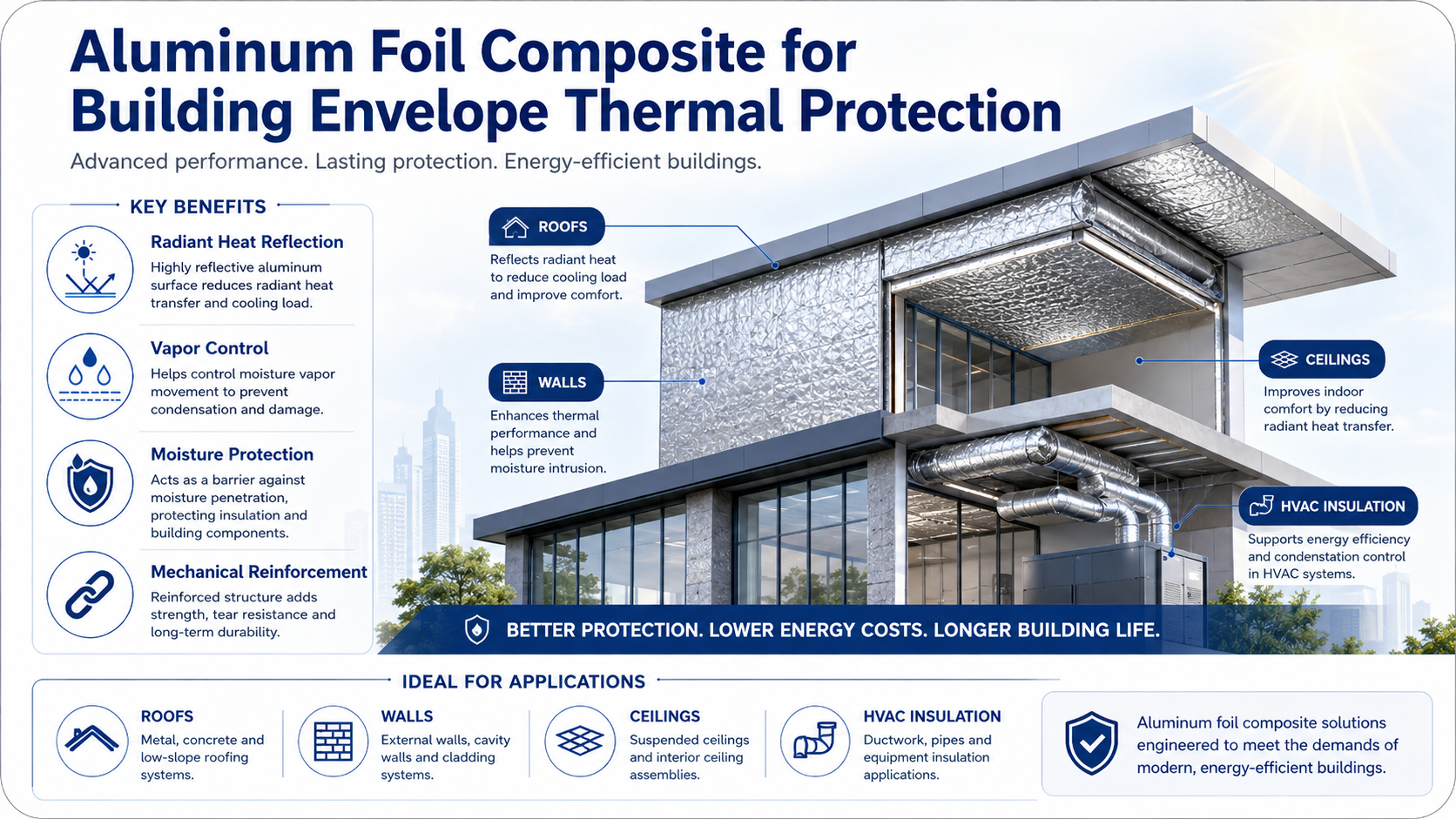
Reflective vapor barriers are widely used in roof insulation systems to help control moisture vapor and reduce radiant heat transfer.
They are especially important in applications such as:
- Metal roofing
- Warehouses
- Industrial buildings
- Commercial roofs
- Residential roof systems
- Roof sarking
- Insulated roof assemblies
However, not all reflective barriers provide the same level of performance.
The best choice depends on:
- Vapor barrier requirements
- Reflective performance
- Mechanical strength
- Tear resistance
- Roof structure
- Climate conditions
- Installation method
- Exposure conditions
- Cost
Common reflective vapor barrier materials include:
- FSK facing
- Тканый материал из алюминиевой фольги
- DFC double foil facing
- Aluminum foil fiberglass cloth
- Reinforced foil composites
- Foil + PE / PET structures
This guide explains how to choose the right reflective vapor barrier for roof insulation.
What Is a Reflective Vapor Barrier?
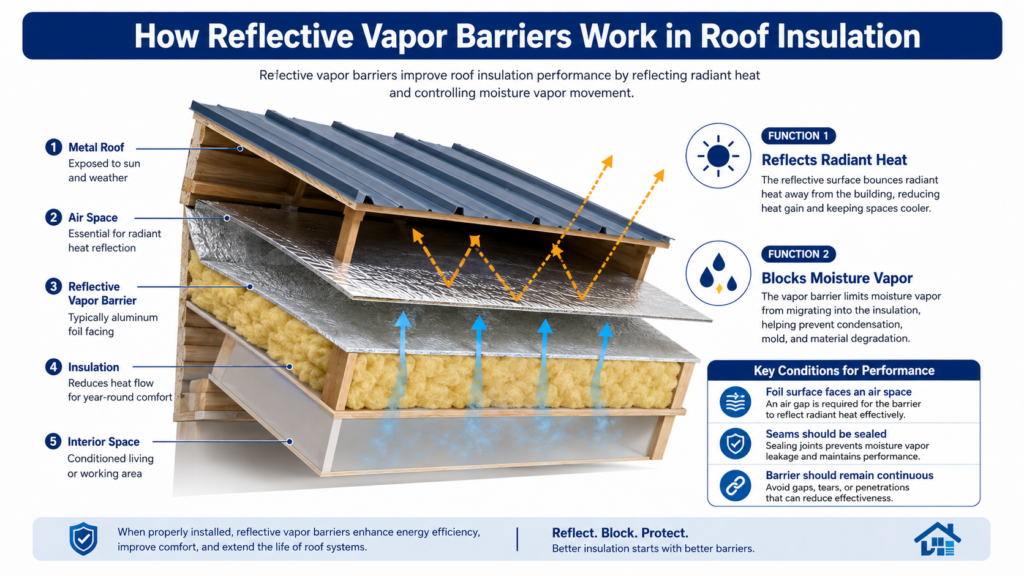
A reflective vapor barrier is a facing material designed to provide two main functions:
1. Vapor Control
The aluminum foil layer helps reduce water vapor transmission through the insulation system.
This can help protect roof insulation from:
- Condensation
- Moisture accumulation
- Performance loss
- Mold-related risks
2. Radiant Heat Reflection
The reflective foil surface can reduce radiant heat transfer when installed facing an air space.
This is especially useful in:
- Metal roofs
- Hot climates
- Industrial buildings
- Warehouses
The reflective layer does not replace bulk insulation, but it can complement the thermal insulation system.
Why Reflective Vapor Barriers Matter in Roof Insulation
Roof systems are exposed to major temperature differences.
Under metal roofing, solar radiation can create significant heat gain.
At the same time, moisture vapor from the interior may move toward colder surfaces and create condensation.
A suitable reflective vapor barrier helps address both problems.
Key benefits include:
- Vapor control
- Radiant heat reflection
- Moisture protection
- Insulation protection
- Improved durability
- Cleaner finished appearance
Step 1: Identify the Roof Application
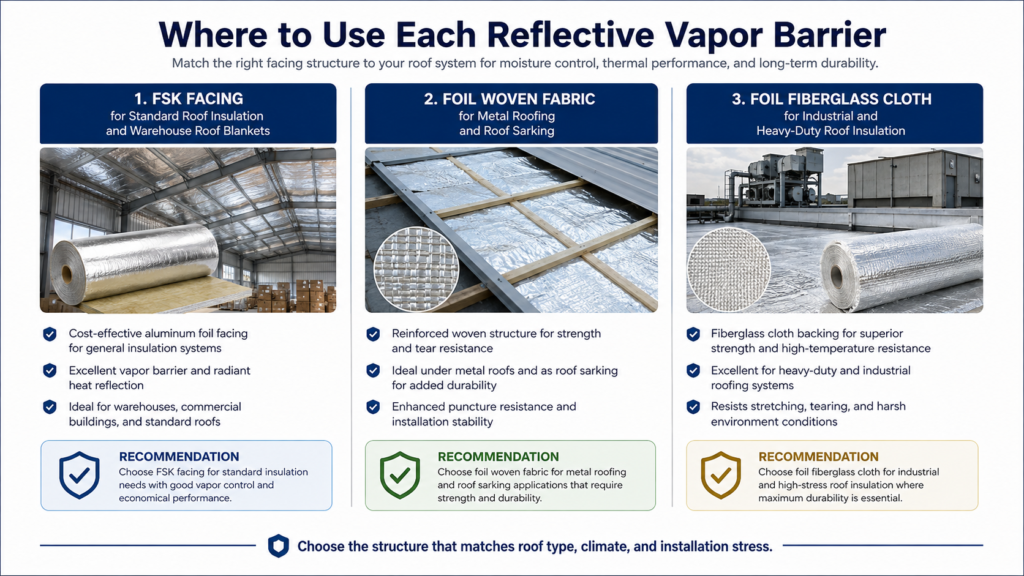
Different roof systems require different facing structures.
Metal Roofing
Typical requirements:
- High reflectivity
- Strong tear resistance
- Good installation durability
- Vapor control
Recommended options:
Aluminum Foil Woven Fabric
or
Reinforced Foil Vapor Barrier
Warehouse Roof Insulation
Typical requirements:
- Reflective performance
- Cost efficiency
- Wide roll width
- Good tensile strength
Recommended options:
FSK
or
Foil Woven Fabric
Commercial Roof Systems
Typical requirements:
- Strong vapor barrier
- Clean appearance
- Durable construction
Recommended options:
FSK
DFC
or
Heavy-Duty Reinforced Foil
Industrial Roof Insulation
Typical requirements:
- Higher strength
- Tear and puncture resistance
- Long-term durability
Recommended option:
Aluminum Foil Fiberglass Cloth
Step 2: Determine Vapor Barrier Requirements
The most important property of a vapor barrier is its resistance to water vapor transmission.
A continuous aluminum foil layer provides very strong vapor resistance.
However, final system performance also depends on:
- Foil thickness
- Lamination quality
- Pinholes
- Seams
- Fasteners
- Installation damage
A high-quality material can still lose performance if seams are not properly sealed.
Step 3: Evaluate Reflective Performance
Reflective insulation works by reducing radiant heat transfer.
For best performance, the reflective surface should typically face an air space.
Important factors include:
- Surface reflectivity
- Surface cleanliness
- Installation orientation
- Air gap
- Long-term surface condition
A reflective foil pressed directly against another solid surface will not provide the same radiant heat benefit as foil facing an air space.
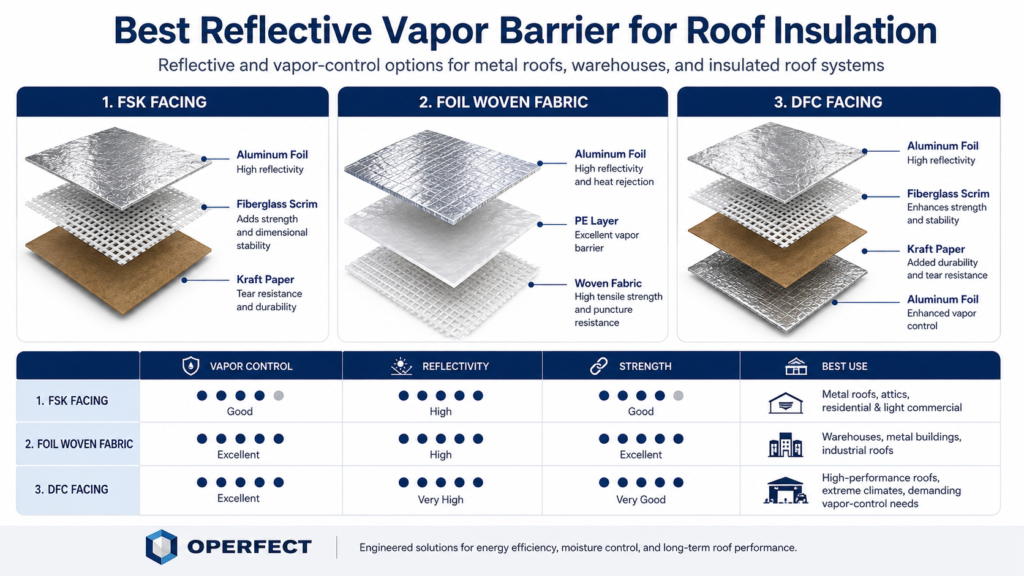
Option 1: FSK Facing
FSK structure:
Aluminum Foil
↓
Fiberglass Scrim
↓
Kraft Paper
FSK is a widely used reinforced aluminum foil facing.
Преимущества
- Excellent vapor barrier
- Good reflectivity
- Good mechanical strength
- Cost-effective
- Easy to laminate
Best For
- Roof insulation blankets
- Commercial buildings
- Warehouses
- General insulation systems
FSK is a good choice when balanced performance and cost are important.
Option 2: Aluminum Foil Woven Fabric
Typical structure:
Aluminum Foil
↓
PE Lamination Layer
↓
Woven PE / PP Fabric
This is one of the strongest options for roof and sarking applications.
Преимущества
- Excellent tear resistance
- High tensile strength
- Good flexibility
- Good weather resistance
- Strong installation durability
- Reflective surface
Best For
- Metal roofing
- Roof sarking
- Large industrial roofs
- Building wrap applications
- Applications with high installation stress
For roofing applications where strength and tear resistance are important, woven foil is often one of the most practical choices.
Option 3: DFC Double Foil Facing
DFC structure:
Aluminum Foil
↓
Fiberglass Scrim
↓
Kraft Paper
↓
Additional Aluminum Foil
DFC provides aluminum foil surfaces on both sides.
Преимущества
- Double reflective surfaces
- Excellent vapor barrier
- Premium appearance
- Additional surface protection
- Reinforced structure
Best For
- Premium roof insulation
- Double-sided reflective systems
- Commercial buildings
- High-value insulation products
Option 4: Aluminum Foil Fiberglass Cloth
Typical structure:
Aluminum Foil + Fiberglass Cloth
This structure uses full woven fiberglass fabric reinforcement.
Преимущества
- Excellent tensile strength
- Excellent tear resistance
- Strong puncture resistance
- High temperature stability
- Excellent durability
Best For
- Industrial roofing
- Heavy-duty insulation
- High-temperature environments
- Mechanical and industrial buildings
Option 5: Foil + PE / PET Composite
Aluminum foil can also be laminated with polymer films such as:
- PE film
- PET film
These structures can provide:
- Improved flexibility
- Moisture resistance
- Smooth surface
- Lightweight construction
Best For
Applications where:
- Flexibility
- Moisture resistance
- Lightweight structure
are more important than heavy mechanical reinforcement.
Reflective Vapor Barrier Comparison
| Material | Vapor Control | Reflectivity | Strength | Tear Resistance | Flexibility | Best Use |
|---|---|---|---|---|---|---|
| FSK | Excellent | Excellent | Good | Good | Good | Standard roof insulation |
| Foil Woven Fabric | Excellent | Excellent | Excellent | Excellent | Good | Roof sarking / metal roofs |
| DFC | Excellent | Excellent | Good | Good | Moderate | Premium roof insulation |
| Foil Fiberglass Cloth | Excellent | Excellent | Excellent | Excellent | Moderate | Heavy-duty industrial roof |
| Foil + PE / PET | Excellent | Excellent | Moderate | Good | Excellent | Flexible roof composites |
Which Reflective Vapor Barrier Is Best?
There is no single best material for every roof.
The best option depends on the application.
Best for Standard Roof Insulation
FSK
Why:
- Reliable vapor control
- Good reinforcement
- Cost-effective
- Widely used
Best for Metal Roofing and Sarking
Aluminum Foil Woven Fabric
Why:
- Excellent tear resistance
- Strong installation durability
- Suitable for wide roof areas
- Good reflective performance
Best for Premium Double-Sided Reflective Systems
DFC
Why:
- Aluminum foil on both sides
- Premium appearance
- Additional protection
Best for Heavy-Duty Industrial Roofing
Aluminum Foil Fiberglass Cloth
Why:
- High tensile strength
- Excellent puncture resistance
- Strong durability
- High-temperature stability
Best for Flexible Lightweight Applications
Foil + PE / PET Composite
Why:
- Lightweight
- Flexible
- Easy to process
- Good moisture resistance
Step 4: Consider Mechanical Strength
Roofing materials are often exposed to more handling stress than indoor insulation facings.
The material may be:
- Pulled across roof structures
- Stapled
- Fastened
- Walked near
- Exposed during installation
- Cut around penetrations
For this reason, tear resistance is especially important.
If the roof project involves large spans or rough installation:
→ Choose woven reinforcement or fiberglass cloth.
Step 5: Consider Climate Conditions
Hot Climate
Focus on:
- Reflective performance
- UV exposure
- Thermal durability
A clean aluminum foil surface facing an air space can help reduce radiant heat gain.
Humid Climate
Focus on:
- Vapor barrier performance
- Moisture resistance
- Seam sealing
Cold Climate
Focus on:
- Condensation control
- Vapor migration direction
- Proper system design
The location of the vapor-control layer should match the roof assembly and climate.
Step 6: Check Fire Performance
Roof insulation materials may need to meet project-specific fire requirements.
The finished composite should be evaluated as a complete structure.
Important components include:
- Aluminum foil
- Reinforcement
- Polymer film
- Kraft paper
- Adhesive
- Coating
If fire performance is required, confirm:
- Flame spread
- Smoke development
- Applicable test standard
- Fire-retardant treatment
Step 7: Confirm Production and Installation Requirements
Before ordering, confirm:
- Roll width
- Roll length
- Core size
- Roll weight
- Foil thickness
- Reinforcement type
- Tear strength
- Tensile strength
- Printing
- Surface treatment
- Fire-retardant options
For roof insulation manufacturers, wide-width materials can reduce seams and improve production efficiency.
Buyer Checklist
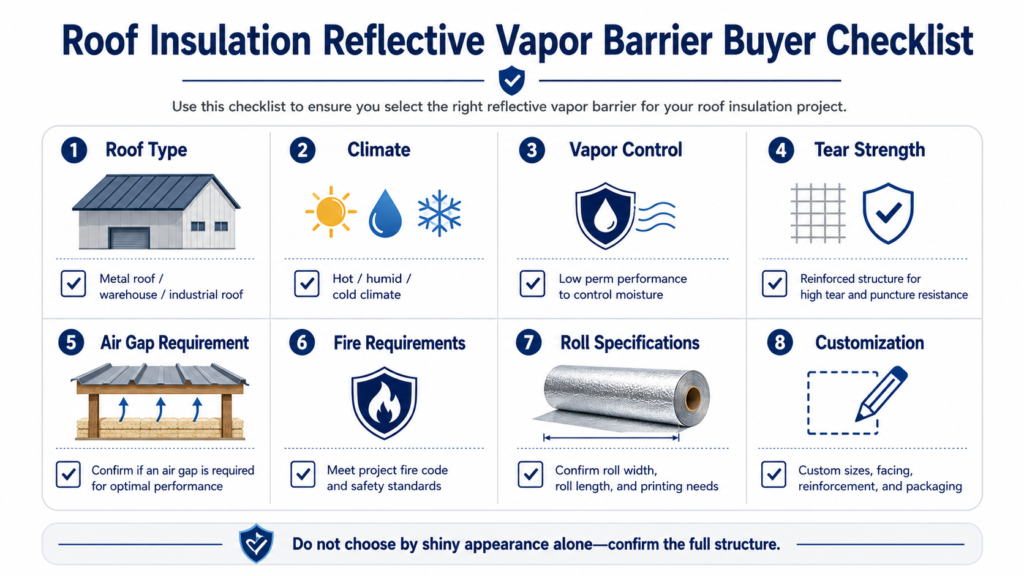
Before choosing a reflective vapor barrier for roof insulation, confirm:
Roof Type
- Metal roof?
- Commercial roof?
- Industrial roof?
- Residential roof?
Climate
- Hot?
- Humid?
- Cold?
- High UV exposure?
Vapor Requirements
- Required vapor transmission level
- Condensation risk
- Seam sealing method
Mechanical Requirements
- Tensile strength
- Tear strength
- Puncture resistance
- Installation stress
Reflective Requirements
- Is there an air space?
- Is radiant heat control important?
- Will the foil remain clean and exposed?
Production
- Roll width
- Roll length
- Lamination
- Cutting
- Printing
Customization
- Logo printing
- Color
- Reinforcement
- Fire-retardant treatment
- Packaging
Common Buyer Mistakes
Choosing Only by Reflective Appearance
Two shiny materials may have very different:
- Foil thickness
- Reinforcement
- Vapor performance
- Strength
Always confirm the full structure.
Ignoring Tear Strength
For roofing applications, poor tear resistance can cause damage during installation.
Expecting Foil to Replace Insulation
Reflective foil helps control radiant heat but does not replace glass wool, rock wool or other thermal insulation.
Ignoring the Air Gap
Reflective performance is most effective when the foil surface faces an air space.
Ignoring Seam Sealing
A vapor barrier must remain continuous.
Unsealed joints can significantly reduce overall system performance.
FAQ
What is the best reflective vapor barrier for metal roofing?
Aluminum foil woven fabric is often a strong choice because it combines reflective performance with high tear resistance and installation durability.
Is FSK suitable for roof insulation?
Yes.
FSK is widely used for roof insulation where vapor control, reinforcement and cost efficiency are important.
Is double foil better than single foil?
Not always.
DFC provides foil surfaces on both sides, but the best choice depends on the roof assembly and whether both reflective surfaces provide practical value.
Can reflective foil reduce roof heat?
Yes, when installed correctly facing an air space, reflective foil can reduce radiant heat transfer.
It should be used together with appropriate thermal insulation.
Which facing is strongest?
Aluminum foil fiberglass cloth and foil woven fabric are both strong options.
Fiberglass cloth is suitable for industrial and high-temperature applications, while woven fabric is especially practical for roofing and sarking.
Conclusion
The best reflective vapor barrier for roof insulation depends on the roof structure, climate, mechanical requirements and target performance.
For standard roof insulation, FSK provides a reliable balance of vapor control, reflectivity and cost.
For metal roofing and sarking, aluminum foil woven fabric provides excellent tear resistance and installation durability.
For premium double-sided reflective systems, DFC is a suitable choice.
For heavy-duty industrial roofing, aluminum foil fiberglass cloth provides stronger mechanical performance.
For flexible and lightweight systems, foil + PE / PET composites can provide a practical alternative.
OPERFECT® supplies customized reflective vapor barrier materials for roof insulation, including FSK, aluminum foil woven fabric, DFC, aluminum foil fiberglass cloth and other reinforced foil composites, with customized widths, roll sizes, printing and OEM/private-label options.