How to Reduce Cost Without Sacrificing Insulation Facing Performance
A Practical Cost-Saving Guide for Aluminum Foil Composite Buyers
Introduction
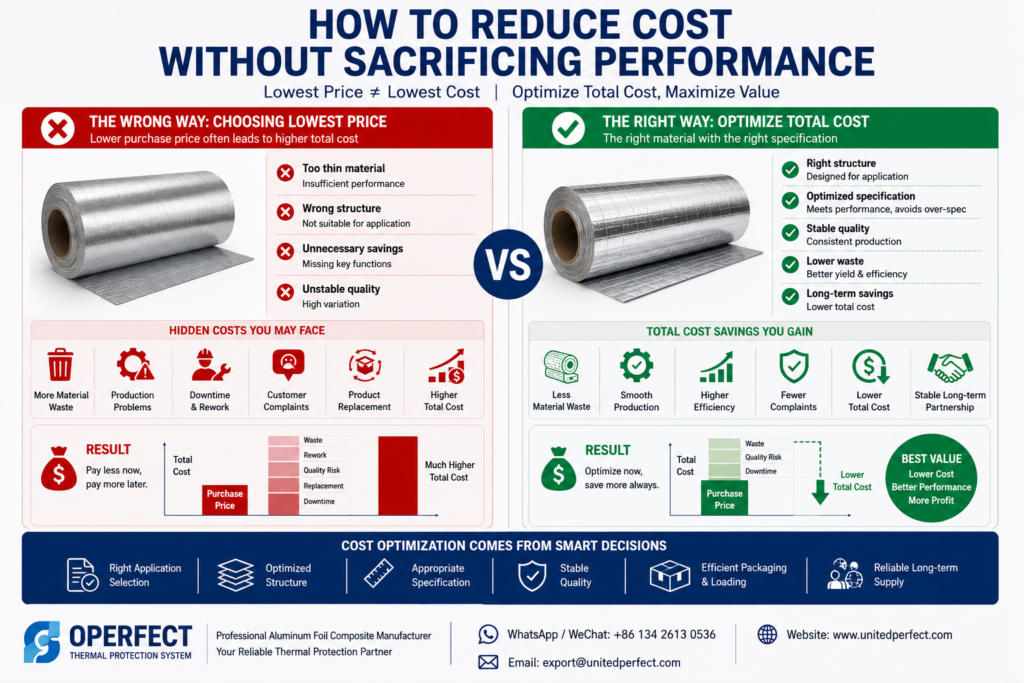
Cost control is an important part of every insulation material purchasing decision.
However, reducing the purchase price is not always the same as reducing the total cost.
Choosing a lower-cost material without considering its structure, performance, production compatibility, or quality consistency can create additional costs through:
- Material waste
- Production problems
- Rework
- Installation difficulties
- Customer complaints
- Product replacement
- Supply interruptions
A better purchasing strategy is to optimize the total cost of ownership while maintaining the performance required for the application.
This guide explains practical ways to reduce insulation facing costs without compromising product quality or system performance.
1. Start With the Application, Not the Price
The first step in cost optimization is understanding what the facing material actually needs to do.
Different applications require different performance levels.
For example:
HVAC Insulation
Typical priorities may include:
- Vapor control
- Surface protection
- Easy handling
- Consistent appearance
Glass Wool / Rock Wool
Typical priorities may include:
- Stable lamination
- Production compatibility
- Dimensional consistency
PIR/PUR Panels
Typical priorities may include:
- Heat-sealing performance
- Bonding
- Production efficiency
Industrial Insulation
Typical priorities may include:
- Mechanical strength
- Durability
- Surface protection
The most economical solution is therefore not necessarily the thinnest or lightest material.
It is the material that provides the required performance without unnecessary specifications.
2. Avoid Over-Specification
One common way buyers increase costs is by purchasing specifications that exceed the actual application requirements.
For example, a project may specify:
- Very heavy reinforcement
- Excessive foil thickness
- Extra layers
- Higher-strength materials
when the application does not actually require them.
This creates unnecessary material cost.
Better Approach
Define the minimum acceptable performance first.
Then optimize:
- Aluminum foil thickness
- Reinforcement weight
- Number of layers
- Adhesive system
- Finished weight
The objective should be:
Required Performance + Optimized Structure
rather than:
Maximum Specification
3. Optimize the Lamination Structure
A composite product should be designed as a system.
Different layers provide different functions.
Typical components include:
- Aluminum foil
- Fiberglass scrim
- Fiberglass cloth
- Kraft paper
- PE film
- PET film
- Heat-sealing layer
Adding more layers does not automatically mean better performance.
A well-designed structure can often achieve the required result with fewer or more efficient materials.
For example:
Application Requirement
↓
Required Performance
↓
Layer Function
↓
Optimized Structure
This is where an experienced manufacturer can create significant value.
4. Compare Suppliers Using the Same Specification
A common purchasing mistake is comparing different products only by unit price.
Supplier A may offer:
- Lower foil thickness
- Lower reinforcement weight
- Shorter roll length
while Supplier B offers:
- Higher foil thickness
- Heavier reinforcement
- Longer roll length
The lower quoted price does not necessarily represent the lower actual cost.
Better Approach
Use a standardized RFQ.
Ask every supplier to quote the same:
- Product structure
- Foil thickness
- Reinforcement
- Width
- Roll length
- Packaging
- Order quantity
- Delivery terms
Only then can buyers make a meaningful comparison.
5. Evaluate Cost Per Square Meter
For rolled insulation facing materials, price per roll can be misleading.
A better comparison may include:
Cost per square meter
rather than simply:
Price per roll
Consider:
- Roll width
- Roll length
- Finished weight
- Material structure
- Usable area
A slightly more expensive roll may provide significantly more usable material.
Example
Supplier A:
- Lower price per roll
- Shorter roll length
Supplier B:
- Higher price per roll
- Longer roll length
The second supplier may actually provide the lower cost per square meter.
6. Reduce Waste Through Better Roll Specifications
Roll specifications can have a major effect on total cost.
Consider optimizing:
- Width
- Roll length
- Core diameter
- Packaging
- Pallet configuration
If the product width is closely matched to the customer’s production process, material waste can be reduced.
For industrial customers, even a small reduction in production waste can create meaningful annual savings.
Better Approach
Discuss actual production requirements with the supplier before finalizing roll dimensions.
7. Optimize Packaging and Container Loading
International buyers should consider logistics as part of product cost.
Packaging affects:
- Container utilization
- Product protection
- Shipping cost
- Handling efficiency
A supplier may help optimize:
- Roll arrangement
- Pallet quantity
- Carton configuration
- Container loading
Better loading efficiency can reduce the logistics cost allocated to each square meter of material.
8. Buy Based on Total Cost, Not Purchase Price
A product with a lower purchase price can become more expensive if it creates:
- Higher waste
- More production downtime
- More rejects
- More complaints
- More replacements
A better calculation is:
Total Cost = Material Cost + Logistics + Waste + Quality Risk + Operational Cost
This is particularly important for large-volume insulation manufacturers.
9. Choose the Right Supplier for Long-Term Cost Control
A reliable supplier can help reduce costs over time.
Long-term cooperation may provide opportunities for:
- Structure optimization
- Packaging improvement
- Production planning
- Container optimization
- Stable raw material sourcing
- Reduced quality problems
The supplier should become part of the customer’s cost-optimization process.
10. Avoid Excessive Changes Between Suppliers
Changing suppliers frequently may appear to create price competition.
However, frequent changes can also create:
- Different product specifications
- Production adjustments
- Quality variation
- New sample testing
- Packaging changes
- Communication costs
For manufacturers using facing materials continuously, supply stability can have significant economic value.
11. Use Samples to Optimize Before Mass Production
Samples should not only be used to approve appearance.
They can also be used to test cost efficiency.
Before mass production, buyers can compare:
- Different foil thicknesses
- Different reinforcement weights
- Different layer structures
- Different roll specifications
The goal is to identify the lowest-cost structure that still meets the required performance.
12. Cost Optimization Checklist
Before placing an order, ask:
| Evaluation | Question |
|---|---|
| Приложение | What performance is actually required? |
| Structure | Are all layers necessary? |
| Foil | Is the foil thickness optimized? |
| Reinforcement | Is the reinforcement sufficient but not excessive? |
| Dimensions | Are width and roll length optimized? |
| Waste | Can production waste be reduced? |
| Packaging | Is container loading efficient? |
| Quality | Is the lower price creating additional risk? |
| Supplier | Can the supplier support long-term optimization? |
13. Why OPERFECT Can Help Reduce Total Cost
OPERFECT approaches cost optimization through product structure and supply chain efficiency, rather than simply reducing material specifications.
We support customers with:
Structure Optimization
- Aluminum foil selection
- Reinforcement selection
- Layer configuration
- Customized composite structures
Specification Optimization
- Foil thickness
- Width
- Roll length
- Core size
- Finished weight
Manufacturing Optimization
- Stable production
- Quality control
- Repeat-order consistency
Logistics Optimization
- Export packaging
- Pallet configuration
- Container loading
- Global shipment coordination
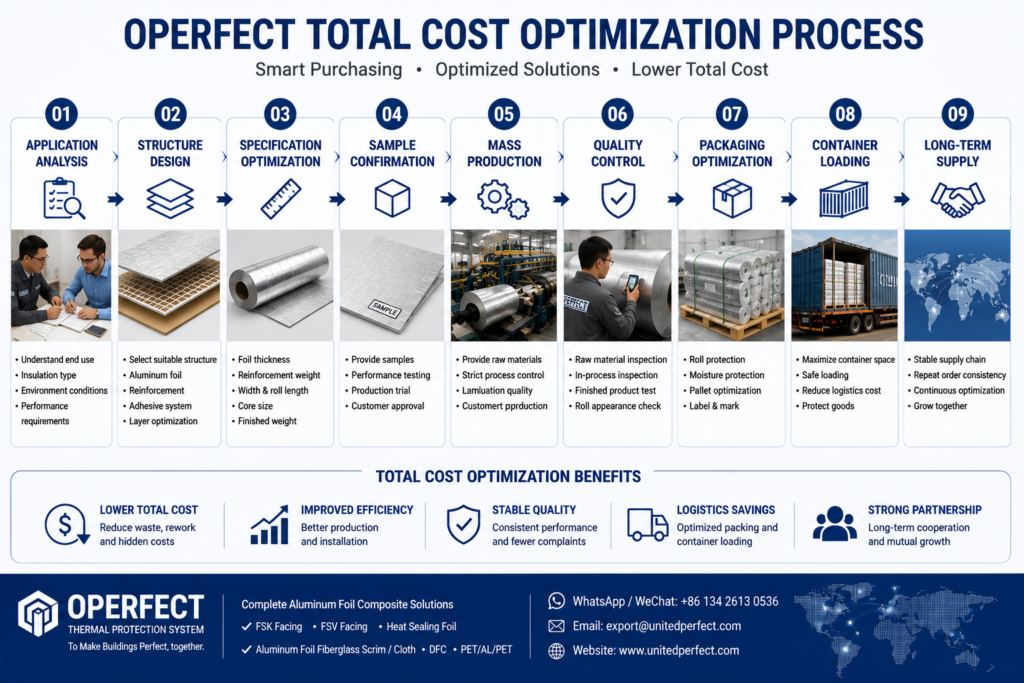
14. The OPERFECT Approach
A better cost-control process is:
Customer Application
↓
Performance Requirement
↓
Structure Design
↓
Sample Testing
↓
Specification Optimization
↓
Mass Production
↓
Quality Control
↓
Packaging & Loading
↓
Long-Term Supply
This approach helps customers control costs while maintaining the performance required by their insulation systems.
Conclusion
Reducing insulation facing costs should never mean simply choosing the cheapest material.
The better strategy is to optimize the complete purchasing system.
The most effective cost-saving opportunities often come from:
- Correct product selection
- Optimized material structures
- Standardized supplier comparison
- Reduced production waste
- Efficient roll specifications
- Better packaging
- Optimized container loading
- Stable long-term supply
The goal is simple:
Reduce unnecessary cost without reducing necessary performance.
OPERFECT works with global insulation manufacturers, distributors, importers, and building material companies to develop practical aluminum foil composite solutions that balance performance, quality, cost, and supply reliability.
Contact OPERFECT
United Perfect Group,To Make Buildings Perfect, together.
Global Business Director: Mr. Du
WhatsApp / WeChat: +86 134 2613 0536
Электронная почта: export@unitedperfect.com
Веб-сайт: www.unitedperfect.com