
Custom PET/PE and VMPET/PE Laminates: Structure Selection and Applications
SEO Title: Custom PET/PE & VMPET/PE Laminates for Industrial Applications | OPERFECT
Meta Description: Explore PET/PE and VMPET/PE laminated films for industrial converting, cable protection, insulation facing and moisture-barrier applications. Custom laminate solutions from OPERFECT.
Suggested URL: /custom-pet-pe-vmpet-pe-laminates/
Understanding PET/PE and VMPET/PE Laminated Films
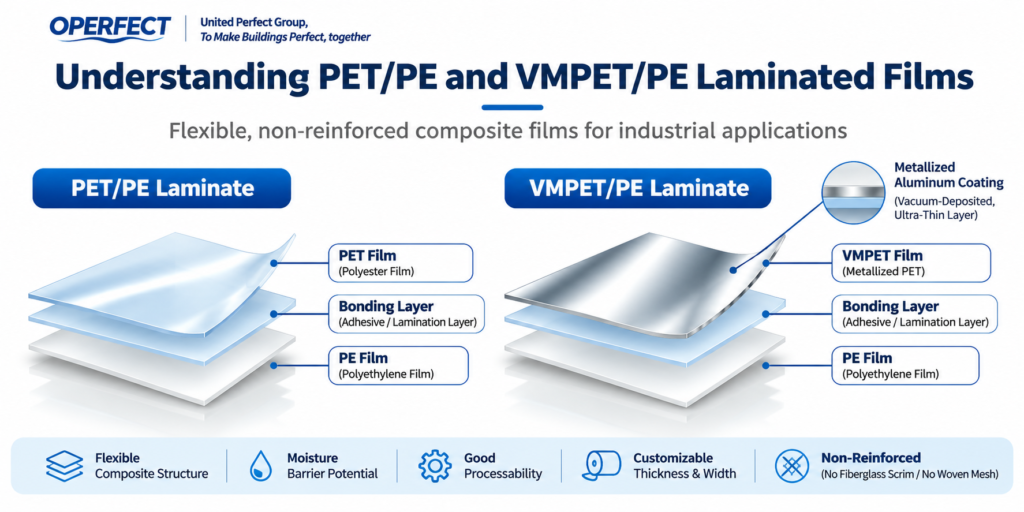
PET/PE and VMPET/PE laminates are flexible, non-reinforced composite films used in industrial converting, protective materials, insulation facings and selected cable-related applications.
Both combine polyester-based films with polyethylene (PE), but their structures and functional characteristics differ.
- PET/PE: Polyester (PET) film laminated with polyethylene (PE) film.
- VMPET/PE: Vacuum-metallized polyester (VMPET) film laminated with polyethylene (PE) film.
Unlike reinforced foil facings such as FSK, both structures contain no fiberglass scrim, woven reinforcement or reinforcing grid.
For industrial buyers, selecting the right laminate involves more than comparing thickness and price. Barrier performance, bonding compatibility, processing conditions and final applications must all be considered.
At OPERFECT, we support industrial manufacturers, converters and international distributors with customized flexible laminate structures and OEM supply solutions.
1. PET/PE vs. VMPET/PE: Structure and Performance
PET/PE Laminated Film
Typical Structure: PET Film + Bonding Layer + PE Film
PET provides mechanical strength, dimensional stability and a suitable surface for selected converting processes.
PE contributes flexibility, moisture resistance and, with a suitable grade, heat-sealing capability.
PET/PE is commonly considered for industrial protective films, further lamination and applications where a flexible, non-metallized composite is required.
VMPET/PE Laminated Film
Typical Structure: Vacuum-Metallized PET Film + Bonding Layer + PE Film
VMPET is produced by depositing a thin aluminum coating onto polyester film under vacuum conditions.
The metallized layer creates a metallic appearance and can improve light and moisture barrier performance.
Combined with PE, it forms a flexible composite suitable for selected protective, industrial facing and barrier applications.
Key Differences
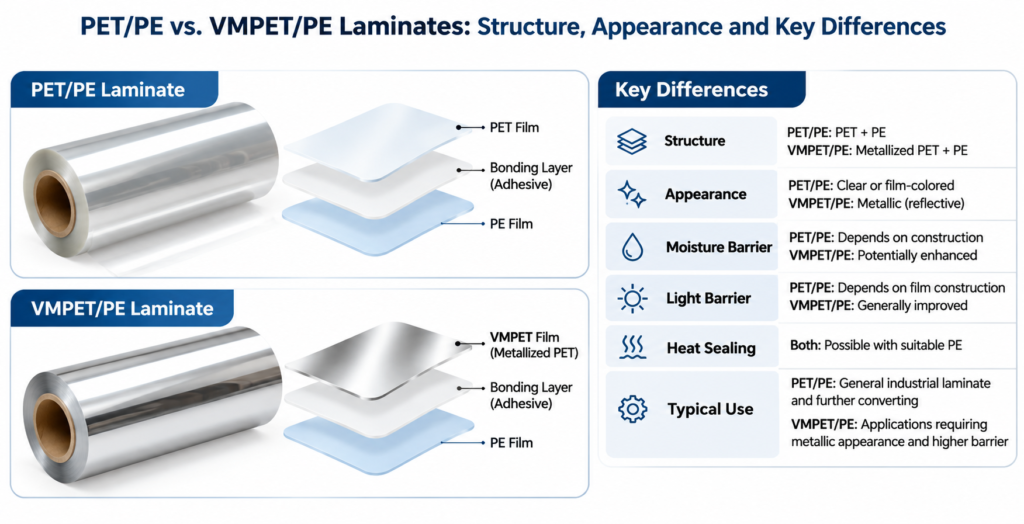
| Feature | PET/PE | VMPET/PE |
|---|---|---|
| Structure | PET + PE | Metallized PET + PE |
| Reinforcement | No scrim or grid | No scrim or grid |
| Appearance | Typically clear or film-colored | Metallic appearance |
| Moisture barrier | Depends on construction | Potentially enhanced by metallization |
| Light barrier | Depends on film construction | Generally improved by metallization |
| Heat sealing | Possible with suitable PE | Possible with suitable PE |
| Main consideration | Flexible industrial laminate | Metallic appearance and enhanced barrier potential |
Important: VMPET is not the same as solid aluminum foil. Metallized PET and aluminum foil differ in barrier, mechanical and electrical properties and should not be treated as universally interchangeable.
Actual performance depends on the complete laminate structure and should be verified for the intended application.
2. Main Industrial Applications
Industrial Lamination and Converting
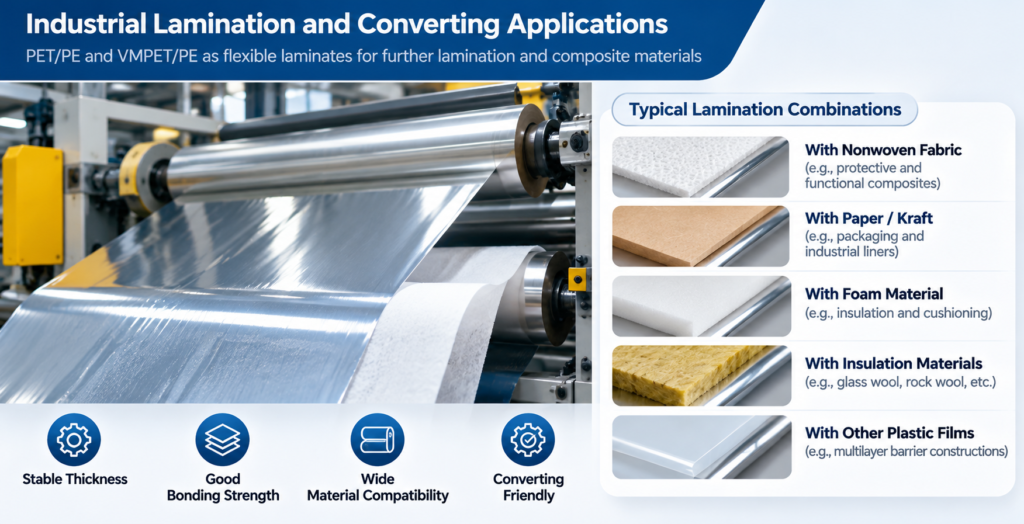
PET/PE and VMPET/PE films can serve as intermediate materials for further lamination with other substrates, including:
- Nonwoven fabrics.
- Paper and kraft materials.
- Foam and insulation materials.
- Other plastic films.
- Selected industrial protective substrates.
Industrial converters typically focus on film thickness consistency, surface treatment, bonding strength, roll quality and compatibility with downstream processing equipment.
For secondary lamination, the material structure should be evaluated according to the customer’s bonding method and production conditions.
Cable Wrapping and Protective Materials
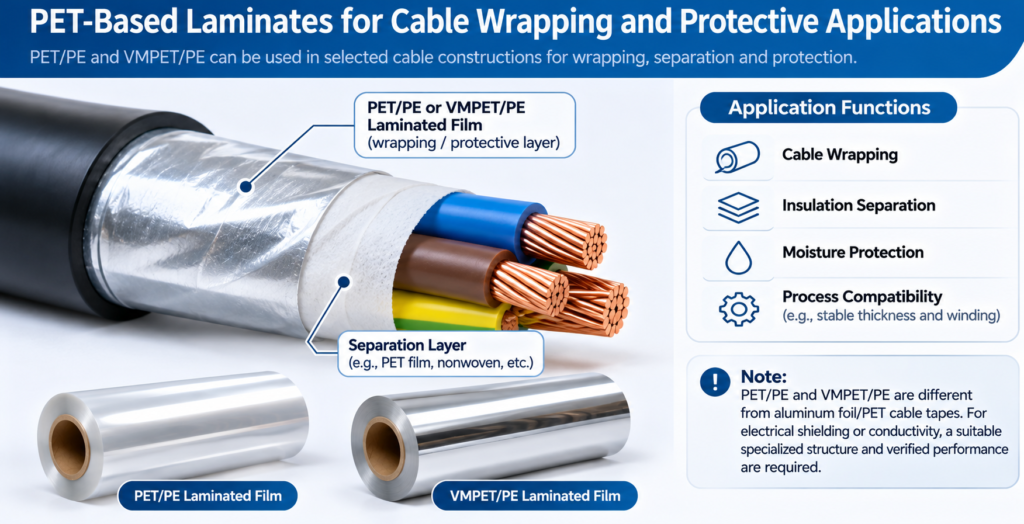
PET-based films and specialized composite materials are used in cable manufacturing for wrapping, separation and protective functions.
Depending on the application, buyers may require controlled thickness, flexibility, mechanical durability and compatibility with cable production equipment.
PET/PE, VMPET/PE and aluminum foil/PET cable tapes are different constructions. Where electrical shielding or conductivity is required, a suitable specialized structure and verified electrical performance are necessary.
OPERFECT can discuss cable-related laminate requirements based on the customer’s technical specifications.
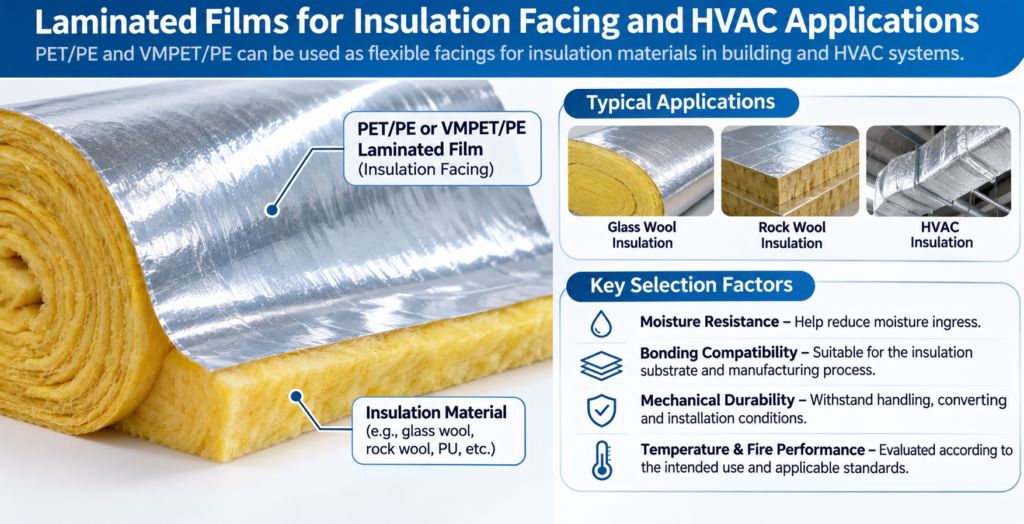
Insulation Facing and HVAC Materials
Flexible laminated films may be incorporated into selected insulation facing constructions, including:
- Glass wool and rock wool insulation.
- Polyurethane insulation-related materials.
- Industrial thermal insulation.
- HVAC insulation protection.
Important selection factors include moisture resistance, bonding compatibility, mechanical durability and applicable temperature or fire-performance requirements.
A metallized appearance alone does not establish a specified thermal resistance or radiant-barrier performance.
Industrial Protective and Moisture-Barrier Materials
PET/PE and VMPET/PE laminates may be considered for industrial protective applications, such as:
- Machinery and equipment protection.
- Moisture-resistant industrial wrapping.
- Protective covers for manufactured components.
- Customized multilayer barrier materials.
The appropriate structure depends on the required protection level, environmental conditions and downstream processing requirements.
Other Potential Applications
PET/PE and VMPET/PE structures are also used in the wider flexible packaging industry, including heat-sealable and moisture-barrier constructions.
However, packaging applications—particularly food-contact uses—require specific material selection, compliance verification and testing.
3. What Should Buyers Consider When Selecting a Laminate?
Selecting the right material requires balancing technical performance, processing compatibility and cost.
Film Thickness and Structure
PET and PE thickness influence flexibility, mechanical strength, handling and converting performance.
Moisture Barrier Performance
Where moisture protection is critical, buyers should specify the required water vapor transmission rate (WVTR), test method and conditions.
Bonding and Lamination Strength
The laminate must withstand relevant converting, handling and end-use conditions without unacceptable delamination.
Temperature Resistance
There is no universal operating temperature range for all PET/PE or VMPET/PE laminates. Performance depends on film grades, bonding systems and exposure conditions.
Further Processing Compatibility
For printing, coating, heat sealing or secondary lamination, buyers should confirm the required surface characteristics and processing conditions.
Roll Specifications
Roll width, length, core diameter, winding direction and packaging should match the customer’s production requirements.
4. Custom PET/PE and VMPET/PE Lamination Solutions from OPERFECT
Different industrial applications require different material combinations.
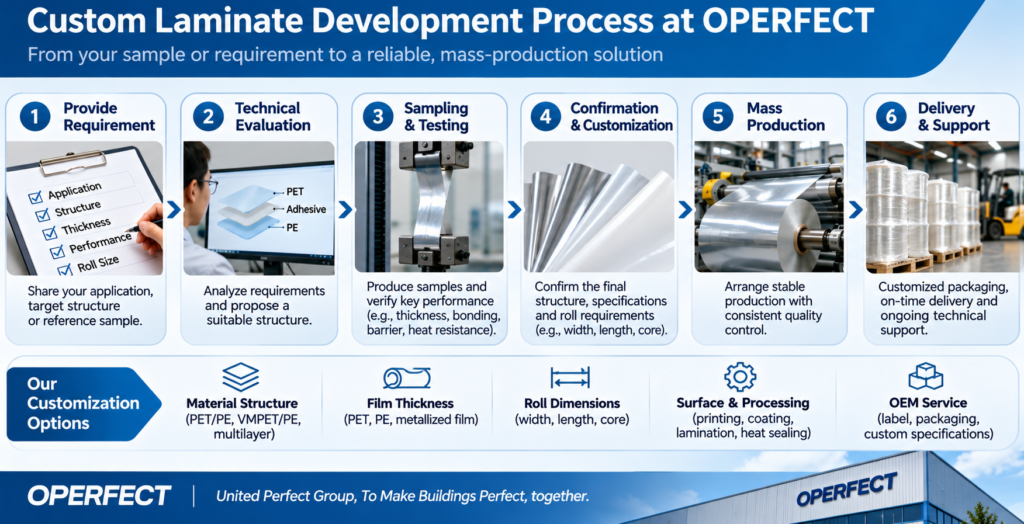
OPERFECT works with manufacturing and converting resources to support customized laminate structures based on customer specifications and reference samples.
Customization Options
- Material structures: PET/PE, VMPET/PE and selected customized multilayer constructions.
- Film specifications: PET thickness, PE grade and thickness, metallized film characteristics.
- Roll dimensions: Customized width, length, core and winding requirements.
- Processing requirements: Surface characteristics, bonding compatibility and downstream converting needs.
- OEM support: Customer-specific specifications, packaging and labeling.
MOQ, production feasibility and lead time depend on the selected construction and order requirements.
Custom Development from Reference Samples
If you already use a laminated material, OPERFECT can help evaluate an alternative or modified structure.
Our typical process includes:
- Reviewing the existing sample or technical specification.
- Understanding the application and processing conditions.
- Identifying critical performance requirements.
- Discussing suitable material structures and sampling.
- Confirming commercial specifications and delivery requirements.
The objective is to develop a laminate that meets the customer’s functional and commercial needs—not simply reproduce its appearance.
5. Frequently Asked Questions
Q1. What is the main difference between PET/PE and VMPET/PE?
PET/PE uses non-metallized polyester and polyethylene films. VMPET/PE incorporates vacuum-metallized polyester, providing a metallic appearance and potentially enhanced barrier performance.
Q2. Do PET/PE and VMPET/PE contain fiberglass scrim?
No. The standard structures discussed here are non-reinforced laminates without fiberglass scrim or woven mesh.
Q3. Can these films be used for further industrial lamination?
Yes, suitable structures may be used for secondary lamination. Surface treatment, bonding compatibility and processing conditions should be evaluated.
Q4. Can PET-based laminates be used in cable manufacturing?
Certain PET-based composite materials can be used for cable wrapping and protection. Electrical shielding applications require suitable specialized structures and verified performance.
Q5. Can VMPET/PE replace aluminum foil laminates?
Not automatically. VMPET and solid aluminum foil have different physical, barrier and electrical characteristics. Substitution requires application-specific evaluation.
Q6. Can OPERFECT customize film thickness and roll dimensions?
Yes. Custom film thickness, material combinations, roll width, length and packaging can be discussed according to technical feasibility and MOQ.
Q7. Can OPERFECT develop a laminate from an existing sample?
Yes. Customers can provide reference samples, technical drawings or existing specifications for evaluation and customized structure discussions.
Looking for a Custom PET/PE or VMPET/PE Laminate Supplier?
Industrial manufacturers need laminated materials that meet their processing requirements, technical specifications and end-use applications.
OPERFECT supports international manufacturers, industrial converters, importers and distributors with customized flexible laminate solutions.
Whether you need PET/PE, VMPET/PE or a more complex multilayer structure, our team can help evaluate your requirements and coordinate a suitable supply solution.
Request a Custom Laminate Quotation
Please share:
- Material structure or reference sample.
- Intended industrial application.
- Film thickness and roll dimensions.
- Required barrier, bonding or temperature performance.
- Estimated order quantity.
- Destination country.
Tell us your application. Let’s discuss the right laminate structure.
OPERFECT | Jinan United Perfect Building Materials Corporation
United Perfect Group, To Make Buildings Perfect, together.
Contact Our Global Team
Global Business Director: Mr. Du
WhatsApp/WeChat: +86 134 2613 0536
Correo electrónico: export@unitedperfect.com
Official Website: www.unitedperfect.com