Compare aluminum foil facing and metallized film facing, including structure, vapor barrier performance, reflectivity, durability, cost and insulation applications.
Introduction
Aluminum foil facing and metallized film facing are both widely used in insulation and building material applications.
At first glance, the two materials may look very similar because both have a bright metallic surface.
However, their structures are fundamentally different.
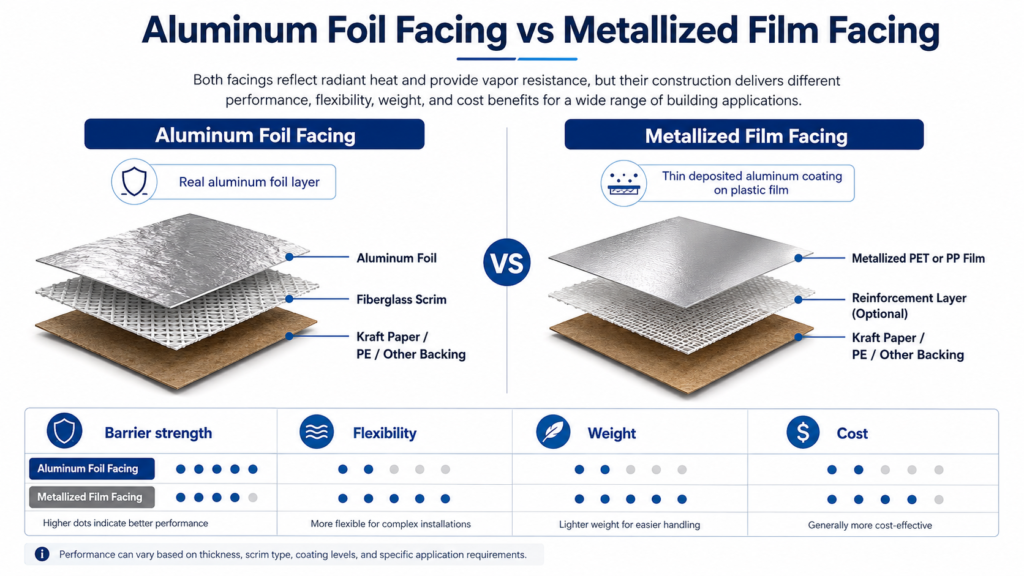
Aluminum foil facing uses a real aluminum foil layer.
Metallized film facing uses a plastic film with an extremely thin metallic coating deposited on its surface.
This difference affects:
- Vapor barrier performance
- Mechanical behavior
- Flexibility
- Durability
- Cost
- Application suitability
For insulation manufacturers and building material buyers, understanding these differences is important before selecting a facing material.
What Is Aluminum Foil Facing?
Aluminum foil facing uses a continuous aluminum foil layer as the main functional surface.
A typical reinforced structure may include:
Aluminum Foil
↓
Fiberglass Scrim
↓
Kraft Paper / PE Film / Other Backing
Common examples include:
- FSK
- DFC
- FSV
- Tejido de papel de aluminio
- Aluminum foil nonwoven composites
The aluminum foil layer provides strong barrier and reflective properties.
What Is Metallized Film Facing?
Metallized film facing is made by applying a very thin metallic layer, typically aluminum, onto a polymer film.
Typical structure:
Metallized PET or PP Film
↓
Reinforcement Layer (Optional)
↓
Kraft Paper / PE / Other Backing
Unlike aluminum foil, the metallic layer is not a standalone sheet of aluminum.
Instead, it is a thin deposited coating on a plastic substrate.
Common base films include:
- PET
- PP
- Other polymer films
Structure Comparison
| Feature | Aluminum Foil Facing | Metallized Film Facing |
|---|---|---|
| Metallic Layer | Solid aluminum foil | Thin deposited aluminum coating |
| Base Material | Aluminum | PET / PP film |
| Typical Reinforcement | Scrim / Kraft / PE / Nonwoven | Scrim / Film / Paper |
| Surface Appearance | Metallic foil | Bright metallic film |
| Flexibility | Moderate | Higher |
| Weight | Higher | Lower |
| Cost | Higher | Usually lower |
Vapor Barrier Performance
Aluminum Foil Facing
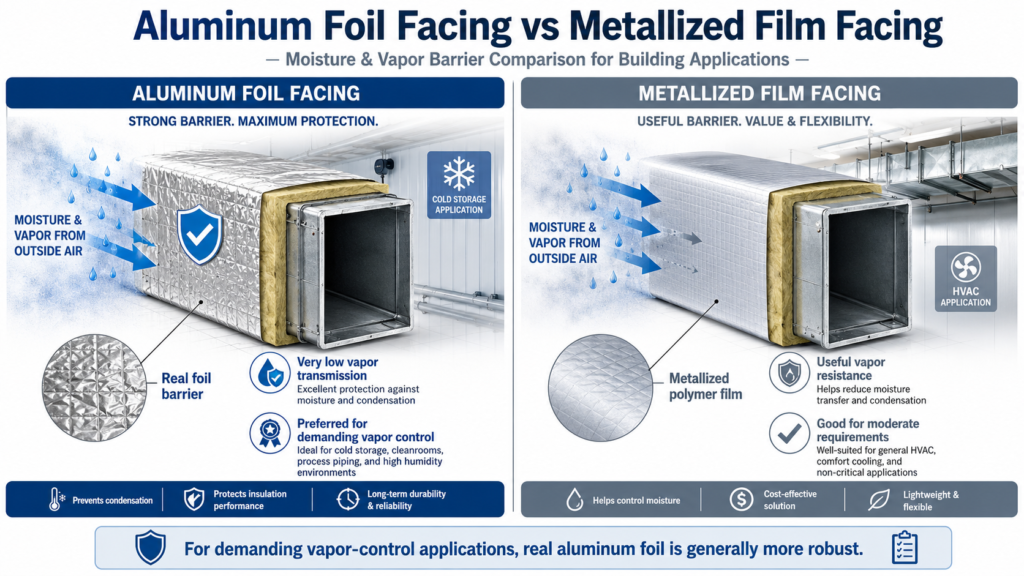
One of the strongest advantages of real aluminum foil is its excellent resistance to water vapor transmission.
When properly laminated and free from damage, aluminum foil provides a very effective vapor barrier.
This makes it suitable for:
- HVAC insulation
- Cold storage
- Industrial insulation
- Vapor-control systems
- High-performance insulation products
Metallized Film Facing
Metallized film can also provide useful vapor resistance.
However, the metallic coating is much thinner than real aluminum foil.
Its final barrier performance depends heavily on:
- Film type
- Metallization quality
- Coating continuity
- Film thickness
- Lamination structure
For applications with demanding vapor-control requirements, real aluminum foil is generally the more robust option.
Reflective Performance
Both materials can provide a reflective metallic surface.
Aluminum Foil
Advantages include:
- High reflectivity
- Durable metallic surface
- Long-term reflective performance
When installed facing an air space, aluminum foil can support radiant heat control.
Metallized Film
Metallized PET or PP can also provide a bright reflective appearance.
Advantages include:
- Lightweight construction
- Smooth surface
- Attractive metallic finish
For applications mainly requiring reflective appearance rather than maximum barrier performance, metallized film may be a cost-effective option.
Mechanical Performance
Aluminum Foil Facing
Real aluminum foil provides:
- Good dimensional stability
- Strong barrier integrity
- High temperature resistance
However, unsupported foil can wrinkle or tear.
Therefore, reinforcement layers such as fiberglass scrim are commonly added.
Metallized Film Facing
The polymer film provides:
- Higher flexibility
- Better elongation
- Better resistance to repeated bending
- Lower risk of foil cracking
This can make metallized film easier to process in flexible applications.
Aluminum Foil vs Metallized Film Performance Comparison
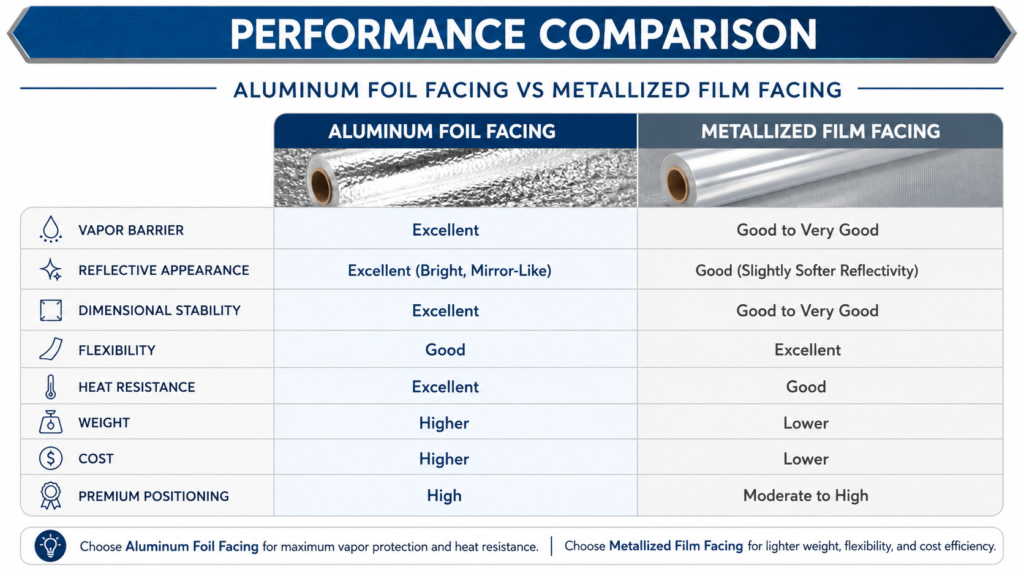
| Performance | Aluminum Foil Facing | Metallized Film Facing |
|---|---|---|
| Barrera de vapor | Excellent | Good to Very Good |
| Reflective Appearance | Excellent | Excellent |
| Dimensional Stability | Excellent | Good |
| Flexibility | Moderate | Higher |
| Heat Resistance | Higher | Depends on polymer |
| Tear Resistance | Depends on reinforcement | Good |
| Weight | Higher | Lower |
| Cost | Higher | Lower |
| Premium Positioning | Higher | More economical |
Temperature Resistance
Aluminum Foil Facing
Aluminum itself can tolerate high temperatures.
The actual temperature resistance of the finished facing depends on:
- Adhesive
- Scrim
- Kraft paper
- Polymer layers
It is commonly preferred for more demanding thermal applications.
Metallized PET Facing
PET provides relatively good temperature resistance compared with many flexible polymer films.
Metallized PET is commonly used where:
- Lightweight construction
- Flexibility
- Reflective appearance
are important.
Metallized PP Facing
PP-based metallized films are generally:
- Lightweight
- Flexible
- Cost-effective
They are suitable for less demanding temperature environments.
Appearance
One reason buyers sometimes confuse the two materials is that both can look silver and reflective.
However:
Aluminum Foil Facing
Usually has:
- More traditional foil appearance
- Natural foil texture
- Strong metallic feel
Metallized Film
Usually has:
- Smoother surface
- More uniform gloss
- Film-like appearance
The desired appearance can influence material selection.
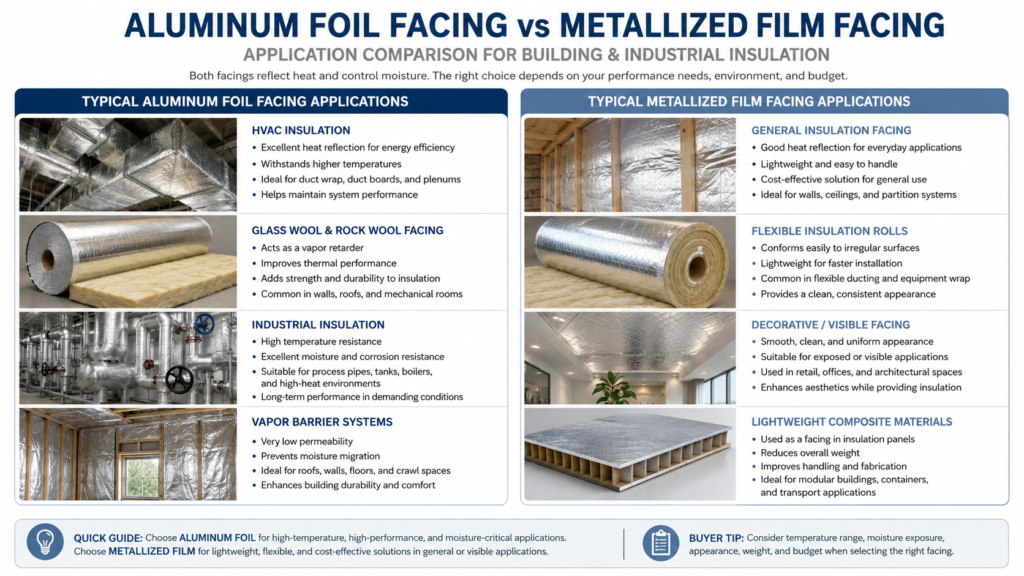
Common Applications of Aluminum Foil Facing
HVAC Insulation
Used for:
- Duct insulation
- Pipe insulation
- Mechanical insulation
Glass Wool and Rock Wool
Common facing structures include:
- FSK
- FSV
- DFC
Industrial Insulation
Suitable for:
- Equipment insulation
- Pipe systems
- Thermal insulation products
Vapor Barrier Systems
Selected when low vapor permeability is a key requirement.
Common Applications of Metallized Film Facing
General Insulation Facing
Suitable for insulation products where:
- Lightweight structure
- Metallic appearance
- Cost efficiency
are important.
Decorative or Visible Facing
The smooth reflective surface can provide a clean finished appearance.
Flexible Insulation Products
The polymer film structure provides good flexibility for:
- Rolls
- Blankets
- Flexible laminates
Packaging and Composite Materials
Metallized films are also widely used in applications requiring:
- Lightweight barriers
- Reflective surfaces
- Flexible processing
When Should You Choose Aluminum Foil Facing?
Choose real aluminum foil facing when you need:
✓ Strong vapor barrier performance
✓ Higher temperature resistance
✓ Robust long-term barrier performance
✓ Premium insulation facing
✓ Traditional FSK / FSV / DFC structures
Typical applications:
- HVAC insulation
- Cold storage
- Industrial insulation
- High-performance building insulation
When Should You Choose Metallized Film Facing?
Choose metallized film facing when you need:
✓ Lightweight construction
✓ Higher flexibility
✓ Bright metallic appearance
✓ Cost-effective solution
✓ Flexible converting performance
Typical applications:
- General insulation
- Flexible insulation rolls
- Decorative facing
- Cost-sensitive projects
Buyer Checklist
Before ordering, confirm the following:
1. Is the surface real aluminum foil or metallized film?
Do not judge only by appearance.
Ask the supplier to confirm the actual material structure.
2. What level of vapor resistance is required?
For demanding vapor-control applications:
→ Aluminum foil is generally preferred.
For moderate requirements:
→ Metallized film may be suitable.
3. Is flexibility important?
If repeated bending or flexible processing is required:
→ Metallized film may offer advantages.
4. What temperature will the material experience?
Higher-temperature applications generally favor aluminum foil structures.
5. What is the target product positioning?
For premium technical insulation:
→ Aluminum foil facing
For cost-sensitive or lightweight applications:
→ Metallized film facing
FAQ
Is metallized film the same as aluminum foil?
No.
Aluminum foil is a continuous sheet of aluminum.
Metallized film is a polymer film coated with a very thin metallic layer.
Can metallized film replace aluminum foil facing?
In some applications, yes.
It depends on vapor barrier requirements, temperature, durability and cost targets.
For demanding insulation applications, real aluminum foil is generally preferred.
Which one is more flexible?
Metallized film is generally more flexible because the main structural layer is polymer film rather than metal foil.
Which one is more economical?
Metallized film is generally more economical because it uses only a very thin aluminum coating.
Conclusion
Although aluminum foil facing and metallized film facing may look similar, their structures and performance characteristics are different.
Aluminum foil facing provides stronger vapor barrier performance, higher temperature capability and robust long-term insulation protection.
Metallized film facing provides a lighter, more flexible and cost-effective solution with an attractive reflective appearance.
The correct choice depends on:
- Vapor barrier requirements
- Temperature
- Flexibility
- Application environment
- Cost target
OPERFECT® supplies customized aluminum foil facings and metallized film composite materials with different reinforcement structures, backing materials, roll specifications and OEM/private-label options for insulation manufacturers and building material suppliers.