Compare heat sealing foil and standard aluminum foil facing materials, including structure, production process, bonding performance and insulation applications.
Introduction
For insulation manufacturers, choosing the right aluminum foil facing material affects not only product performance but also manufacturing efficiency.
Traditional aluminum foil facings usually require adhesive lamination to bond with insulation materials.
Heat sealing foil provides an alternative solution by using a heat-activated bonding layer that allows direct bonding through controlled temperature and pressure.
The main difference is:
Standard Aluminum Foil Facing → Adhesive bonding process
Heat Sealing Foil → Thermal bonding process
Both solutions can provide excellent insulation facing performance, but they are designed for different production requirements.
What Is Standard Aluminum Foil Facing?
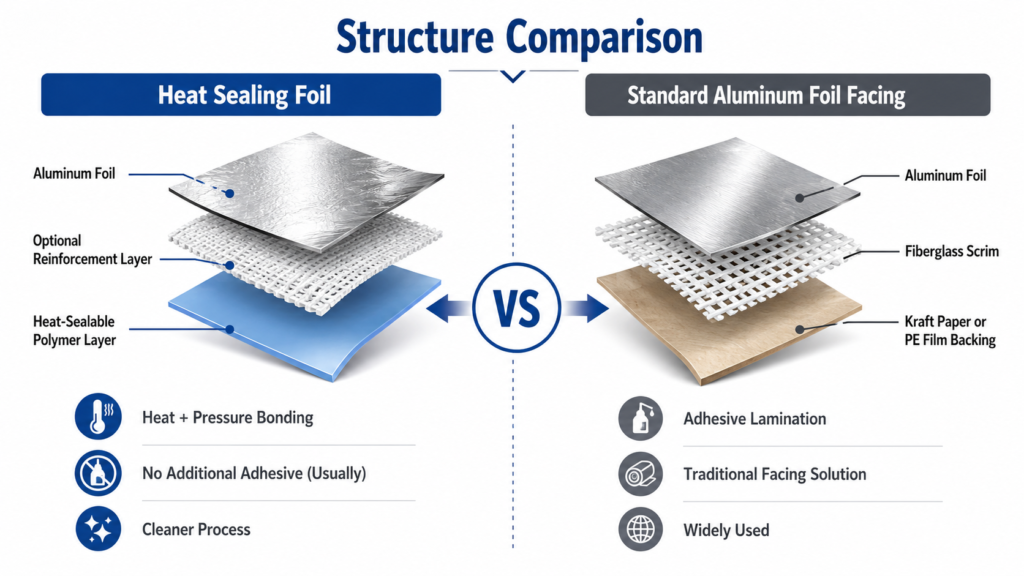
Standard aluminum foil facing refers to traditional foil composite materials used for insulation products.
Common structures include:
FSK Facing
Aluminum Foil
↓
Fiberglass Scrim
↓
Kraft Paper
FSV Facing
Aluminum Foil
↓
Fiberglass Scrim
↓
PE Film
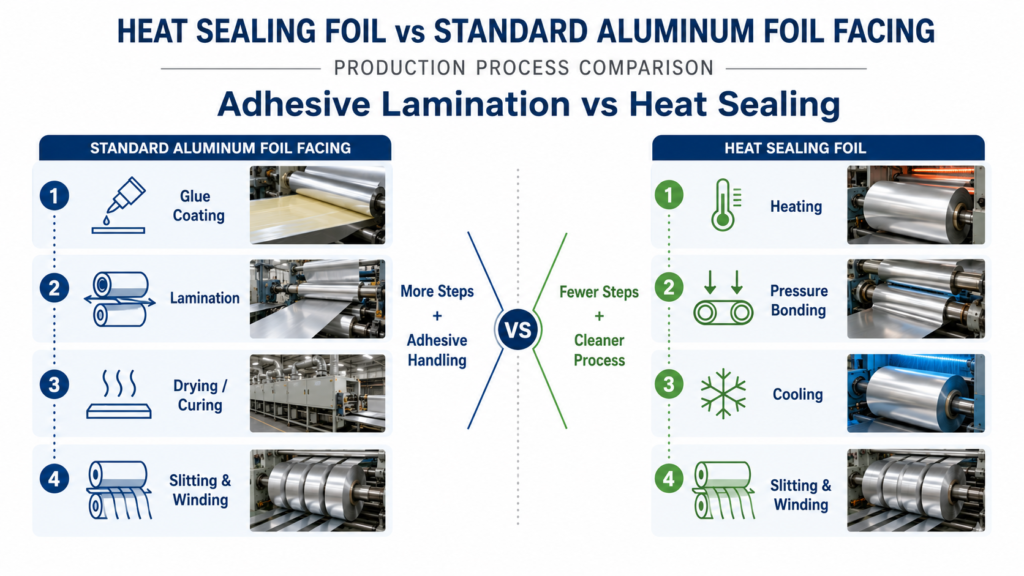
The facing is usually bonded to insulation materials through:
- Water-based adhesive
- Hot melt adhesive
- Lamination glue
What Is Heat Sealing Foil?
Heat sealing foil is an aluminum foil composite material designed with a heat-activated bonding layer.
Typical structure:
Aluminum Foil
↓
Reinforcement Layer (Optional)
↓
Heat Sealable Polymer Layer
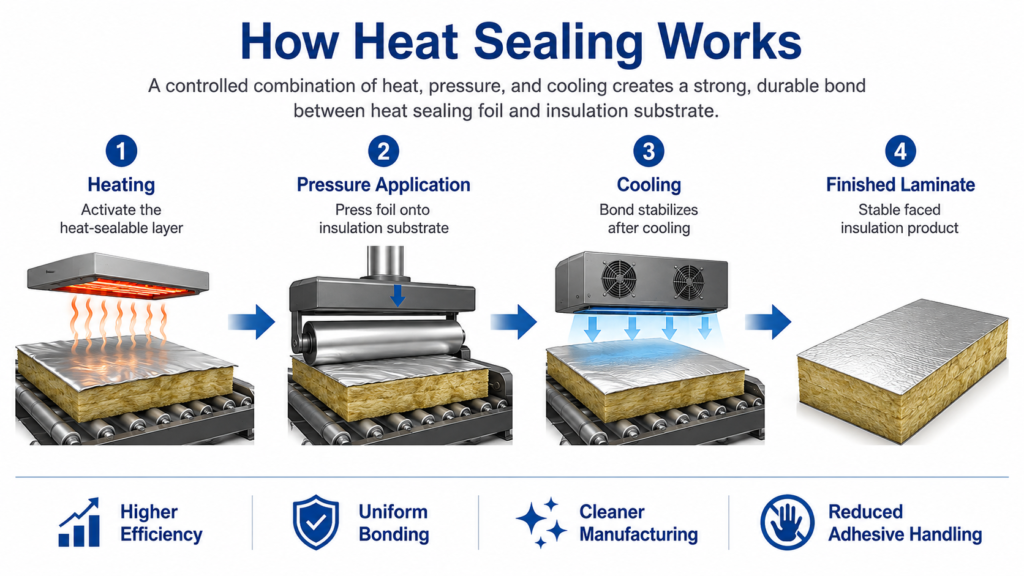
During production, heat and pressure activate the polymer layer, creating direct bonding with compatible insulation materials.
How Heat Sealing Foil Works
The heat sealing process uses controlled manufacturing conditions:
Heating
The bonding layer reaches its activation temperature.
Pressure Application
The foil is pressed onto the insulation substrate.
Cooling
The polymer layer solidifies and forms a stable bond.
Important process parameters include:
- Temperature
- Pressure
- Production speed
- Substrate compatibility
Structure Comparison
| Feature | Heat Sealing Foil | Standard Aluminum Foil Facing |
|---|---|---|
| Bonding Method | Thermal bonding | Adhesive lamination |
| Adhesive Required | Usually no additional adhesive | Usually required |
| Production Process | Heat + pressure | Glue coating + lamination |
| Manufacturing Efficiency | Higher automation potential | Depends on adhesive process |
| Surface Cleanliness | Cleaner process | Requires adhesive management |
| Customization | High | High |
Key Advantages of Heat Sealing Foil
1. Simplified Production Process
Heat sealing foil can reduce the need for separate adhesive application.
Benefits:
- Fewer production steps
- Reduced adhesive handling
- Cleaner manufacturing environment
- Easier automation
2. Improved Production Efficiency
For high-volume insulation manufacturing, heat sealing technology can provide:
- Faster production speed
- Stable bonding quality
- Reduced process variation
3. Strong and Uniform Bonding
Thermal bonding creates a consistent connection between facing and insulation materials.
Ventajas:
- Uniform adhesion
- Reduced risk of uneven glue application
- Stable product quality
4. Cleaner Manufacturing
Compared with adhesive lamination, heat sealing can reduce:
- Glue storage requirements
- Adhesive waste
- Solvent-related concerns
- Production mess
Advantages of Standard Aluminum Foil Facing
1. Wide Application Compatibility
Traditional foil facings are widely accepted across many insulation products.
Applications include:
- Lana de vidrio
- Lana de roca
- HVAC insulation
- Building insulation
2. Flexible Production Options
Manufacturers can adjust:
- Adhesive type
- Glue amount
- Lamination speed
- Substrate selection
3. Cost Efficiency
For many standard insulation products, traditional foil facing remains a practical solution due to:
- Established production processes
- Lower equipment requirements
- Wide market acceptance
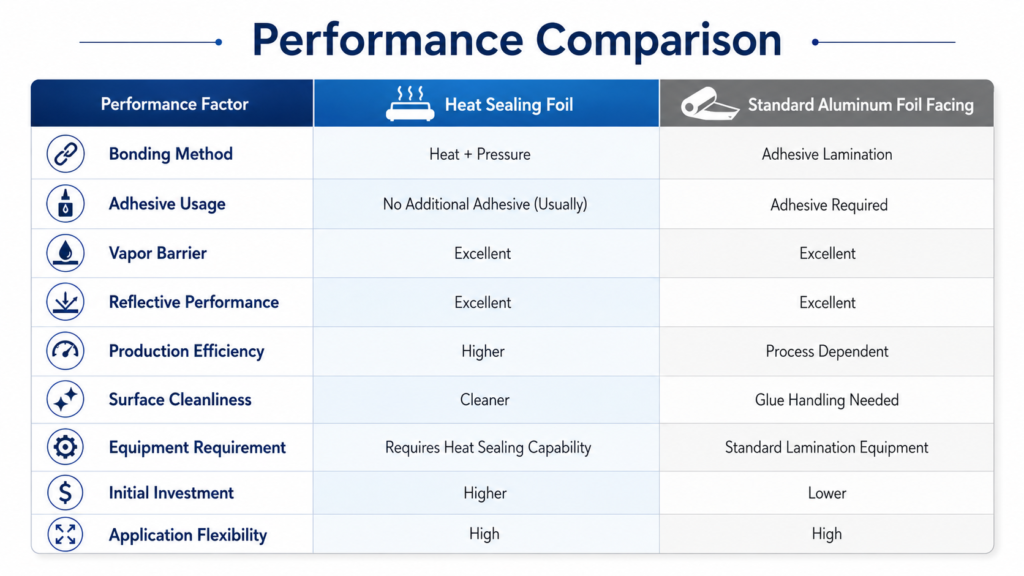
Heat Sealing Foil vs Standard Foil Facing Performance
| Performance | Heat Sealing Foil | Standard Foil Facing |
|---|---|---|
| Barrera de vapor | Excellent | Excellent |
| Reflective Performance | Excellent | Excellent |
| Production Efficiency | Higher | Depends on process |
| Equipment Requirement | Requires heat sealing capability | Standard lamination equipment |
| Adhesive Usage | Reduced | Required |
| Processing Flexibility | High | High |
| Initial Investment | Higher | Lower |
Application Comparison
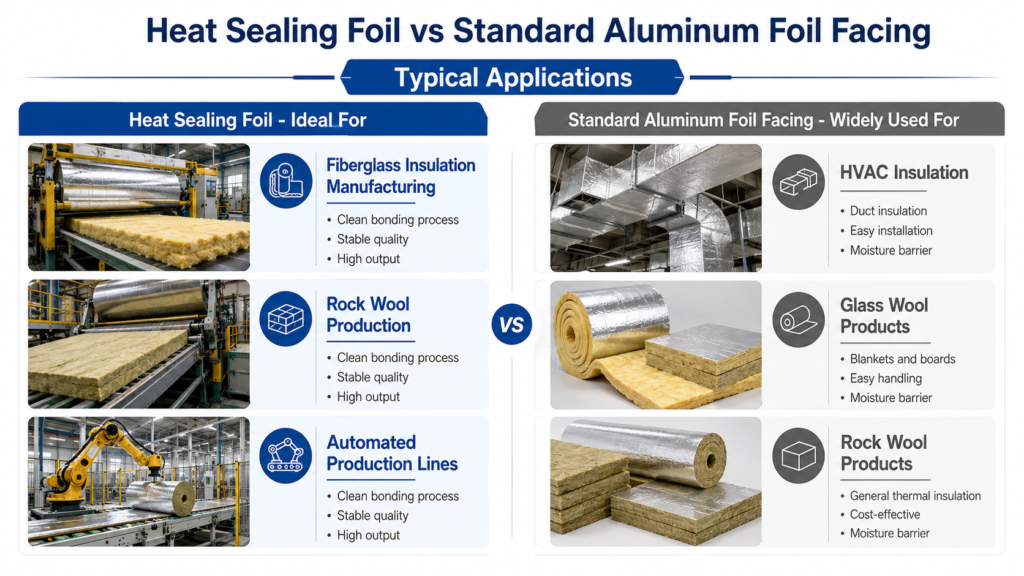
Heat Sealing Foil Applications
Recommended for:
Fiberglass Insulation Manufacturing
Benefits:
- Faster production
- Cleaner bonding process
- Stable quality
Rock Wool Production
Suitable for:
- Insulation boards
- Insulation blankets
- Composite insulation products
Automated Production Lines
Ideal for manufacturers focusing on:
- High output
- Consistent quality
- Reduced manual processes
Standard Aluminum Foil Facing Applications
Common applications include:
HVAC Insulation
- Duct insulation
- Pipe insulation
- Mechanical insulation
Glass Wool Products
- Fiberglass blanket
- Fiberglass roll
- Insulation board
Rock Wool Products
- Thermal insulation
- Fire-resistant insulation systems
How to Choose Between Heat Sealing Foil and Standard Foil Facing?
Choose Heat Sealing Foil When:
You need:
✓ High production efficiency
✓ Automated manufacturing process
✓ Reduced adhesive usage
✓ Cleaner production environment
✓ Consistent bonding quality
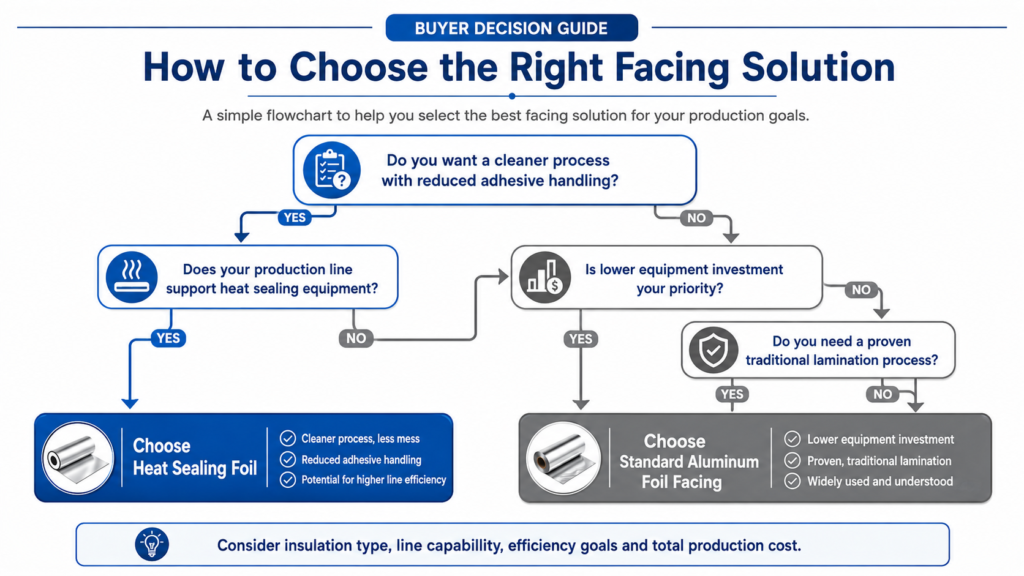
Choose Standard Aluminum Foil Facing When:
You need:
✓ Proven production method
✓ Flexible adhesive options
✓ Lower equipment investment
✓ Wide application compatibility
Important Buyer Considerations
Before selecting a facing material, consider:
1. Production Equipment
Does your production line support:
- Heat sealing
- Thermal bonding
- Temperature control?
2. Insulation Substrate
Check compatibility with:
- Fibra de vidrio
- Lana de roca
- Foam insulation
- Composite boards
3. Production Volume
High-volume manufacturers may benefit more from heat sealing solutions.
4. Product Requirements
Consider:
- Vapor barrier requirements
- Surface appearance
- Bond strength
- Final application
FAQ
Does heat sealing foil replace adhesive completely?
In many applications, heat sealing foil reduces or eliminates the need for additional adhesive. The exact process depends on the insulation substrate and production conditions.
Is heat sealing foil stronger than normal foil facing?
Bond strength depends on:
- Polymer layer
- Processing temperature
- Pressure
- Substrate compatibility
A properly processed heat sealing foil can provide reliable bonding performance.
Can heat sealing foil be customized?
Yes.
Customization options include:
- Aluminum foil thickness
- Reinforcement structure
- Heat seal coating type
- Roll width
- Packaging
- Private label printing
Conclusion
Heat sealing foil and standard aluminum foil facing are both effective solutions for insulation manufacturing.
Standard aluminum foil facing provides a proven and flexible solution widely used in insulation products.
Heat sealing foil provides an advanced bonding solution designed for manufacturers seeking higher production efficiency, cleaner processing and automated manufacturing.
OPERFECT® supplies customized aluminum foil facing materials including heat sealing foil, FSK, FSV and other reinforced foil composites for global insulation manufacturers.